Language
Transforming Network Energy Efficiency with AIREngine
Release Date:2026-01-22
By Guo Cheng, Fan Yingying
With the widespread deployment of 5G networks, global operators face rising energy consumption that outpaces revenue growth. Data shows that network energy expenditures account for approximately 25% to 30% of operators' OPEX. Conventional energy-saving approaches often compromise user experience and fail to satisfy the varied demands of applications such as short videos, cloud gaming, and the industrial internet. ZTE’s AI-powered intelligent RAN energy-saving solution addresses this challenge by leveraging the computing capabilities of the AIREngine—an intelligent board embedded in the BBU—and incorporating service-aware perception and real-time intelligent decision-making technologies. This enables accurate understanding of user experience and service requirements while significantly improving network energy efficiency. AIREngine allows base stations to not only sense services but also understand their requirements, optimizing energy efficiency without compromising user experience and helping operators move toward a green 5G era.
Service-Aware Optimization:From Traffic-Based to Service-Centric
Conventional energy-saving technologies generally depend on coarse-grained traffic-load-based management, often involving component or equipment shutdowns. However, AIREngine equips base stations with real-time, comprehensive service awareness capabilities, enabling more accurate and refined energy savings. AI-driven energy savings encompasses two main processes: AI-assisted identification of service patterns and optimization of energy-saving strategies based on service requirements.
AI-assisted service pattern recognition leverages the inherent computational capabilities of the base station together with streamlined AI models to comprehensively identify and analyze applications. As shown in Fig. 1, service data flows captured at the base station, with minimal plaintext parsing, are used to extract key service patterns and establish an offline service pattern library, enabling the following capabilities:
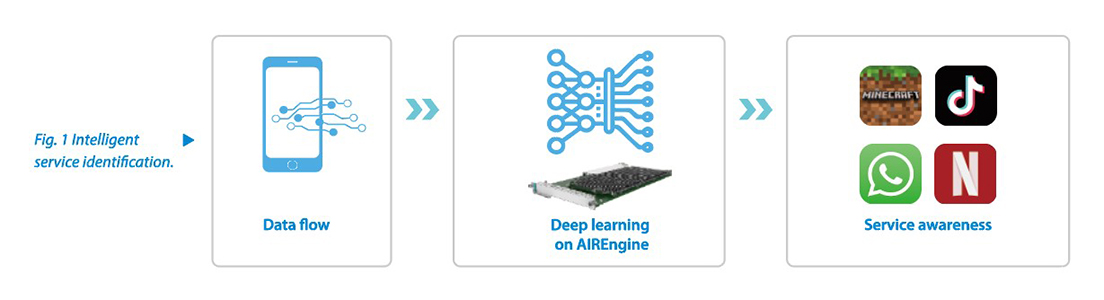
- Accurate identification: By analyzing merely 0.1% of packet header information, over 16,000 application categories and key features can be accurately identified with an accuracy rate exceeding 99%.
- Dynamic modeling: Customized KPIs are designed for specific services (e.g., live streaming, gaming, and IoT). For instance, stutter rates and initial frame delay are prioritized for short videos; end-to-end latency is strictly capped at ≤50 ms for cloud gaming, and ultra-low jitter (<1 ms) is maintained for industrial-grade applications.
Service-centric energy-saving strategy optimization introduces the dimension of "service distribution prediction" in addition to conventional "traffic load forecasting." It precisely predicts the temporal and spatial distribution of each service category, while accounting for the characteristics and applicability of energy-efficient technologies, as well as peak usage periods of key services, such as live streaming and gaming events. This approach efficiently improves energy savings during idle times and in less busy areas, all while maintaining a high-quality user experience. Additionally, it incorporates dynamic service models to iteratively optimize energy-saving technology activation and deactivation thresholds, effectively balancing network energy consumption with user performance.
Real-Time Intelligent Decision-Making: Balancing Energy Efficiency and User Experience
Conventional AI-driven energy-saving solutions usually apply "post-evaluation" approaches, which do not provide real-time feedback on the performance of the energy-saving network. The adjustment periods for these approaches may extend from several hours up to a whole day, lacking the flexibility required to effectively resolve network performance issues resulting from unexpected service changes. The "intelligent real-time decision-making" mechanism powered by AIREngine provides networks the capability of "autonomous neural reflex," allowing the dynamic optimization of energy-saving strategies within one second.
- Real-time KPI monitoring and intelligent coordination: By continuously collecting near real-time performance data from base stations, KPIs including latency, packet loss rate, and throughput are monitored to generate a Network Health Score. This system rapidly detects potential anomalies after energy-saving policies are activated, then implements real-time adjustments and optimizations. As a result, it effectively mitigates network performance degradation caused by energy-saving measures and maintains an optimal balance between energy efficiency and service performance.
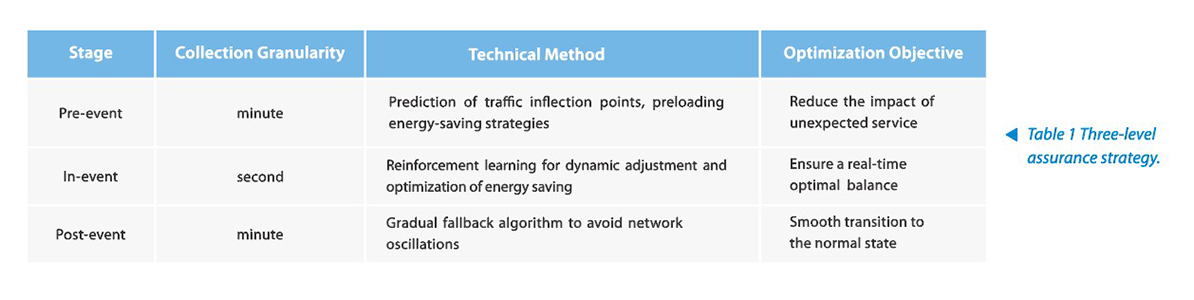
- Three-level assurance strategy: Through "pre-event" monitoring, "in-event" prevention, and "post-event" assurance, this strategy achieves real-time, event-driven, and periodic assurance, providing comprehensive protection for stable network operation (see Table 1).
Recently, we completed the verification of the AIREngine-based AI energy saving solution in Jiangsu Province. The verification demonstrated that, while maintaining stable performance and user service perception indicators, the site achieved an additional daily energy consumption reduction of over 12%. With the advancement of 5G-A and 6G research, the enhanced energy-saving solution based on AIREngine is not only suitable for current 5G networks but is also capable of smoothly evolving to future architectures. By integrating LLM technologies, it enables more precise service intent prediction. Through the combination of single-site intelligence and network-level coordination, energy efficiency gains are maximized, helping operators achieve network carbon neutrality.
Driven by the digital economy and China’s carbon peaking and neutrality strategy, the “service-aware + real-time intelligent decision-making” solution is reshaping network energy saving. It represents a breakthrough in the integration of AI and communications, enabling operators to achieve both OPEX reduction and user experience assurance.

.png)

.png)

.png)

.png)