Language
"Dual-Intelligence Collaboration" Network Experience Assurance System by Yunnan Mobile
Release Date:2026-01-22
By Chen Ruijie, Zhao Li, Yang Xiaokang
On April 13, 2025, as the dawn of the Dai New Year (1387 in the Dai calendar) illuminated Xishuangbanna, a grand event unfolded, blending national cultural inheritance with the innovation of digital and intelligent technologies. Faced with the network surge caused by over two million visitors, China Mobile’s Yunnan Branch (Yunnan Mobile), in collaboration with ZTE, integrated large language model (LLM)-powered agents with ZTE’s AIREngine intelligent computing engine to create a "dual-intelligence collaboration" network experience assurance system. This successfully set a benchmark in the field of communication assurance, offering an innovative solution to the "signal upgrade" special action, which provides significant value to the industry.
Full-Process Network Assurance System
As a crucial medium for information transmission, the stability and efficiency of mobile networks are critical to user experience. With the widespread adoption of 5G technology, the network architecture becomes increasingly complicated, and the traditional network operation and maintenance (O&M) mode faces huge challenges. To solve this problem, ZTE uses generative artificial intelligence (GenAI) technology to develop a telecom multi-agent collaboration (TMAC) system that improves wireless network service quality, optimizes user experience, and enhances network O&M efficiency.
The TMAC solution consists of three parts: agents in the network; agent lifecycle management and monitoring; and the agent factory, which is a dedicated platform for agent design and skill improvement. As shown in Fig. 1, the agents in the network include both cross-domain and single-domain agents. These agents can be divided into interactive agents, insight collection agents, analysis agents, decision-making agents, and execution agents based on their roles. Agents can also be customized to meet uer requirements and can load knowledge and skills as needed to meet O&M requirements in different scenarios.
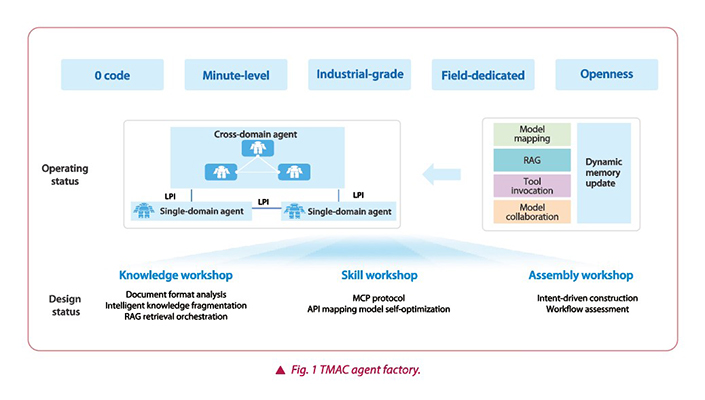
The TMAC solution builds a comprehensive data monitoring system by collecting real-time data from network devices, user behaviors, service traffic, and other dimensions. It leverages LLM agent technology and uses big data analysis and machine learning algorithms to mine network data for real-time network status monitoring and prediction. Based on the AI analysis results, the system automatically generates optimization policies and dynamically adjusts network resources through a closed-loop control system.
The TMAC solution offers the following innovations:
- Cross-domain collaboration technology: Breaks through the inter-domain restrictions of traditional network O&M, and implements collaboration across wireless, core, and transmission domains.
- Efficient AI analysis engine: Uses advanced machine learning algorithms to improve the accuracy and efficiency of network analysis.
- Automatic closed-loop control: Automates the entire network O&M process, from problem detection to policy execution.
Based on a commercial super-large-scale network management system, Yunnan Mobile has built a TMAC-based LLM O&M platform using a domestic intelligent computing server. By leveraging the innovative dual-engine architecture of ZTE's Nebula Telecom Large Model and the DeepSeek LLM, the capabilities of LLM agents are enhanced for rule compliance, general inference, analogical inference, temporal reasoning, and data statistics under complex scenarios. Through innovations such as natural language interaction, multi-agent collaboration, adaptive policy generation, and interactive geographical monitoring, Yunnan Mobile has established a full-process network assurance system featuring all-domain perception, dynamic scheduling, and real-time optimization.
Key Application Outcomes of the Network Assurance System
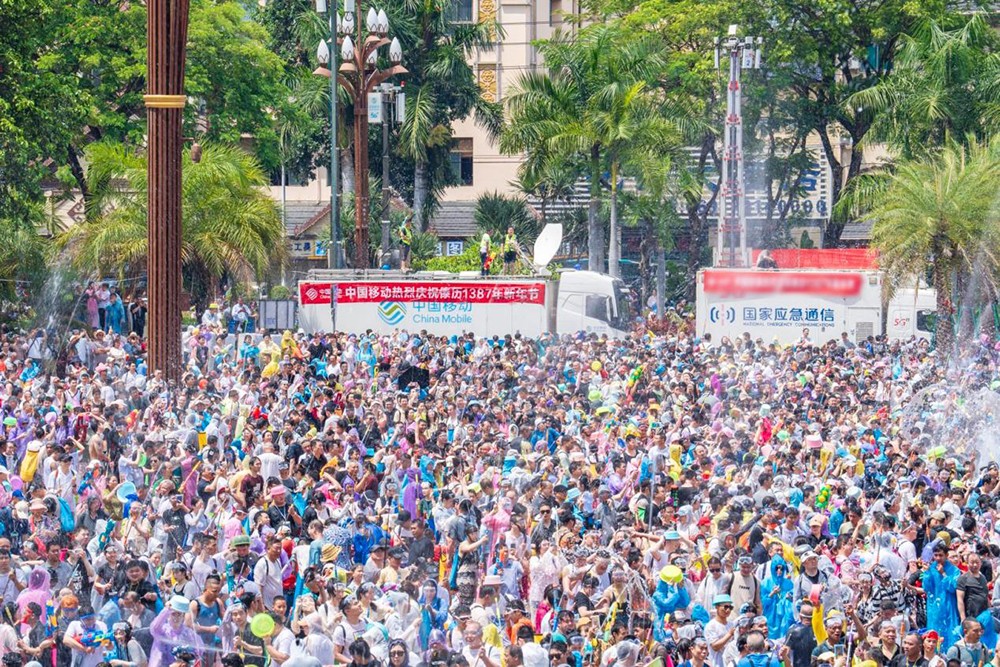
For this water-splashing festival assurance, the LLM multi-agent system was employed to build a group intelligent decision-making center, providing precise assurance for 798 cells across 180 base stations in key areas such as the Spraying Square and the Gaozhuang Scenic Area. During the assurance period, the proportion of high-load cells decreased by more than 20% year-on-year. User experience remained optimal, and the assurance target of "zero perceptible latency, zero service interruption, and zero major complaints" was achieved.
While innovating the network assurance system, Yunnan Mobile paid close attention to user experience, deploying the AIREngine together with AI agents to build a "dual-intelligence" network experience assurance system. The AIREngine board carries an AI-driven service perception engine and builds a multi-dimensional traffic feature library through deep learning, enabling the intelligent identification of user scenarios and dynamic policy optimization to ensure a smooth user experience.
During the assurance period, the uplink experience rate of live-streaming users increased significantly. The uplink rate of instant messaging services increased by about 30%, the downlink latency of the code-scanning service decreased by about 15%, and the latency of short video and webpage traffic decreased by about 26%.
As a pioneering practice of the national "AI+" strategy, the LLM O&M platform transforms O&M experience into reusable digital assets through knowledge distillation technology, and constructs an industry knowledge map covering the entire process of planning, construction, maintenance, and optimization. This assurance practice jointly undertaken by Yunnan Mobile and ZTE not only verifies the reliability of LLM technology in extremely complicated scenarios, but also provides a "Yunnan model" that can be replicated and promoted for the digital and intelligent governance of multi-ethnic residential areas in Southwest China, enabled by dual-intelligence collaboration. It also provides valuable experience for the subsequent large-scale application of LLM agents to improve the O&M efficiency and intelligence of communication networks.

.png)

.png)

.png)

.png)