Language
AIREngine Ushers in Precision Era of RAN Operations
Release Date:2026-01-22
By Wei Hang, Yan Haibo
The telecommunications industry is shifting from pipeline operations to experience-driven management. With the rapid growth of immersive services such as live streaming, video, cloud gaming, and VR/AR, user expectations have moved from basic network availability to service usability. However, the traditional KPI-centric operation model can no longer address the challenge of meeting KPIs while facing frequent user complaints, due to three limitations:
- Coarse data granularity: Traditional MR data only has a 5-second granularity and 20 UEs samples per cell, unable to reflect real-time user experience.
- Limited positioning accuracy: Hundred-meter-level geographic grids fail to precisely locate poor-quality areas, and complaint handling relies on manual correlation.
- Weak root cause analysis: Fewer than five types of poor-quality root causes can be identified based on network KPIs, with accuracy below 60%, insufficient for complex scenarios.
AIREngine Reshapes RAN’s "Nerve Endings"
As the core component of native AI in base stations, AIREngine overcomes the computational bottlenecks of traditional base station boards. Through innovations in three core capabilities—smallest granularity perception, ultra-high precision positioning, and real-time data correlation—it generates insights from network performance to user experience, enabling a shift from extensive operations to precision network management.
Smallest granularity perception bridges the gap between the network perspective and the user perspective. Traditional analysis relies on cell-level KPIs, while AIREngine shifts its perspective to "every data service session of users", supporting the collection of second-level KQI for over 16,000 applications. Take short video for example, AIREngine precisely quantifies users' video experience by real-time monitoring metrics such as "1-minute playback stutter counter" and "5-second playback buffer download time", and outputs service quality scores via the equivalent MOS indicator (EMI), making the abstract "user experience" measurable.
Ultra-high precision positioning improves accuracy from 100 m to 30 m. AIREngine integrates algorithms such as UTDOA, AOA, and fingerprint positioning, leveraging 4G UE GNSS correlation and backfilling, a dynamic fingerprint database, and a multi-RRU joint solution to enhance 5G UE positioning.
Real-time data correlation resolves the cross-domain data correlation issues of "slowness, inaccuracy, and low efficiency". Traditionally, core network and radio network data are reported in different domains and need correlation on big data platforms, which suffer from issues such as long latency, high error rates, and low correlation rates. In contrast, AIREngine achieves "second-level KPI + KQI built-in correlation", eliminating cross-domain transmission latency and correlation errors caused by domain-separated collection. It enables real-time data correlation of user experience and network performance, transforming poor-quality analysis from "vague speculation" to "precise quantitative analysis".
High-Value Scenarios for AIREngine
The three core capabilities of the AIREngine have reshaped network operations and unlocked tremendous application value in practical scenarios.
Efficient Customer Complaint Handling
Traditional complaint handling suffers from slow issue localization, poor reproducibility, and limited root cause analysis. AIREngine overcomes these issues by fully collecting KPIs and KQIs, visualizing data on map-based grids, and enabling second-level tracing, improving complaint resolution from daily to hourly. It combines user-level service experience metrics with over 10 types of root cause identification, with identification accuracy exceeding 90%, and builds a three-dimensional complaint traceability system covering both user experience and network performance perspectives.
Premium Package User Group Analysis
For premium package users, AIREngine automatically categorizes users based on identifiers (e.g., 5QI, RFSP) in call detail records. With 5-second service experience metrics and 30-meter positioning, it enables group-level classified experience evaluation and automatic poor-quality statistics. It supports comparative analysis across different user groups at the same time and location, as well as trend analysis. Additionally, by monitoring real-time service experience metrics like EMI scores and stutter frequency, AIREngine proactively identifies quality risks, advancing early warnings from hours to minutes.
Multi-Dimensional Visualization for High-Speed Rail
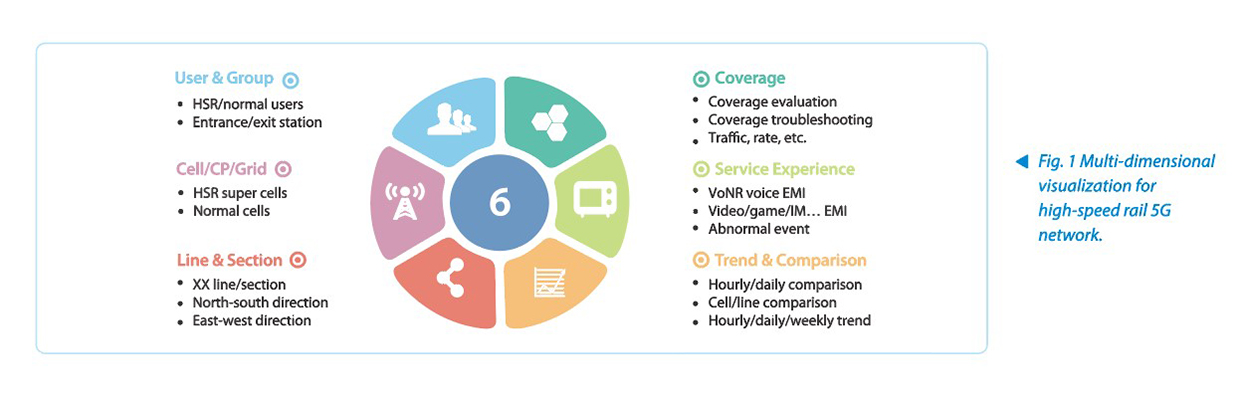
To address challenges such as high costs and difficulty in reproducing problems with traditional drive tests in high-speed rail, multi-dimensional visualization for the high-speed rail 5G network has been realized based on AIREngine, enabling zero drive testing (see Fig. 1). Features include automatic cell parameter matching, precise identification and positioning of high-speed rail users, and evaluation metrics statistics with geographic visualization at the line, section, cell, cell portion, and grid levels. It provides in-depth service analysis for experience evaluation and root-cause diagnosis of quality issues, along with network mirroring for playback and trend comparison. These features effectively address the operational challenges of the 5G network for high-speed rail.
5G-A Package Provisioning
Based on the grid-level data from AIREngine, end-to-end guarantees for package business operations can also be achieved:
- Before provisioning: With the input of business intentions and network conditions, algorithms such as time-series traffic load prediction calculate deployable grids, specifying the types of packages, the number of distributed packages, and the available package quantity.
- After provisioning: Service experience metrics for user groups are statistically analyzed based on RFSP and 5QI grouping. Package performance is evaluated, and optimization workflows are triggered.
This enables closed-loop management for 5G-A package provisioning, experience guarantee, and network optimization.
As 5G evolves toward intelligence and scenario-based deployment, AIREngine will further integrate generative AI models to achieve advanced autonomous network capabilities of "self-learning and self-decision", driving the ultimate transformation of network operation from "humans hunting for problems" to " AI-enhanced autonomous network ". In this crucial phase, AIREngine is both a technological innovation and a strategic direction for operators to step into the new blue ocean of "experience-centric operations".

.png)

.png)

.png)

.png)