Language
Empowering Service Agents with AgentGuard to Pioneer Mobile AI Era
Release Date:2026-01-22
By Bai Wei, Ni Yanzi
In the current wave of technological advancement, artificial intelligence (AI) is developing at an unprecedented pace, profoundly impacting every industry, including mobile communications.
During the traditional mobile internet era, the focus was on the "bit", emphasizing the digitization of information and the widespread availability of connectivity. Massive volumes of data flowed through networks as bitstreams, fueling the proliferation of countless applications. Today, with the rapid advancement of AI technologies, we are entering a new era—the mobile AI era—driven by "Token". Data is no longer merely a stream of bits; it is now infused with richer semantics and greater value, circulating and interacting across networks in the form of tokens.
The core of this transformation lies in the rapid development of large language models (LLMs) and AI agents.
LLMs and AI Agents Accelerate AI Inclusivity
With the rapid advancement of AI technology, particularly the rise of LLMs, AI applications are continuously expanding, gradually permeating every aspect of daily life. Technologies represented by DeepSeek are accelerating AI inclusivity by significantly reducing both training and inference costs, making AI no longer the exclusive privilege of a few tech giants, but increasingly a foundational capability accessible across all industries.
Meanwhile, general-purpose AI agents are also developing rapidly, driving AI’s evolution from an "advisor" to an "executor" and becoming key enablers for AI’s widespread adoption. By automating task workflows (e.g., order processing, data analysis) and enabling multimodal interactions (e.g., combined voice and visual commands), AI agents can boost efficiency by 4–5 times and achieve task completion rates exceeding 80%. The year 2025 is widely regarded as the “breakout year” for AI agents.
For AI democratization to succeed, it must integrate deeply with countless industries—inevitably bringing profound transformations in human-computer interaction paradigms and service models. AI agents act as intelligent assistants, capable of perceiving their environment, making autonomous decisions, and executing tasks. They can not only understand spoken language but also grasp underlying needs, make context-aware judgments, and carry out tasks on behalf of users.
Consequently, AI agents are reshaping how users access services and interact with systems: service entry points are shifting from traditional apps to AI agents (or “service agents”). Based on current terminal forms, AI agents are divided into two main categories:
- Digital assistants on AI-powered devices: Users can simply issue a voice command to activate these AI agents (digital assistants), which then think, plan, and execute tasks—transforming the conventional “open an app and perform step-by-step operations” model into a lightweight, intent-driven interaction paradigm.
- Embodied intelligence in physical entities, such as robots: These AI agents can carry out complex sequences of actions based on user instructions and are applied in fields like industrial manufacturing and healthcare services.
AI Agents Reshape Human-Computer Interaction and Drive New Demands
The rapid advancement of LLMs—characterized by “small parameters, high intelligence”—combined with breakthroughs in terminal hardware technology, are driving the intelligent upgrade of terminal devices. In China, the penetration rate of AI-powered terminals is rapidly increasing, and AI capabilities are increasingly becoming a standard feature in communication devices, including smartphones, PCs, wearable devices, as well as home and enterprise gateways.
Built upon this ubiquitous AI foundation, embedded AI agents (digital assistants) are developing rapidly, becoming new entry points for interaction and services. These digital assistants can serve as over-the-top (OTT) entry points, such as life management assistants and travel assistants, or as intelligent agents like 5G New Calling and real-time translation. With these service agents, users can simply issue natural language instructions, and the AI will handle the thinking, planning, and execution.
This evolution shifts user behavior from the traditional “open an app” paradigm to an intent-driven, agent-based interaction model, delivering a more convenient and lightweight human-computer interaction experience.
However, each step of the digital assistant’s autonomous reasoning, planning, and execution process requires multiple rounds of information exchange and inference with cloud-based LLM servers and application servers. This increases network performance demands by more than tenfold. For example, to ensure a smooth user experience, air interface latency must be within 160 milliseconds; to ensure accurate AI recognition, uploaded images must have a clarity of 1080P or higher, requiring an uplink rate of 20 Mbps or more.
Beyond digital assistants, AI agents are also catalyzing the emergence of various types of embodied intelligence, which will become the "emerging humans" of the future. To balance factors such as the size, weight, battery life, and cost of embodied intelligence, the industry is exploring a brain-body deployment architecture. This architecture is divided into end-cloud collaboration and end-edge-cloud collaboration. In end-edge-cloud collaboration, part of the computational load is offloaded to the edge, leveraging the edge's computing power and connectivity to allow the physical agent to operate more efficiently—reducing its onboard compute requirements, size, and weight.
To maintain real-time coordination, the edge-hosted model and the embodied agent must interact at frequencies of 10 Hz or higher, imposing even stricter requirements on network uplink throughput and air interface latency.
A New Service Paradigm for AI Interactions
The rapid development of AI agents, including digital assistants and embodied intelligence, is driving a fundamental shift in the role of communication networks—from mere data transmission pipelines to collaborative hubs for intelligent agents. To address this, ZTE has developed the innovative 5G-A AgentGuard solution (Fig. 1), which leverages intelligent identification and guarantee technologies to build a more deterministic mobile network, empowering the flourishing development of AI services.
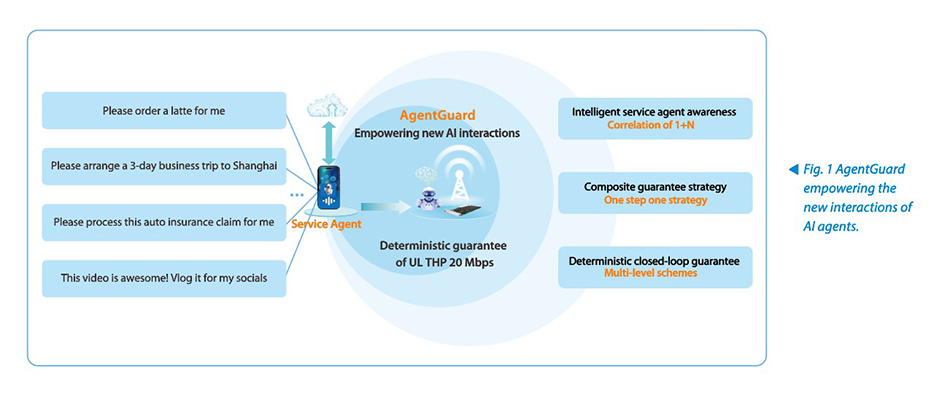
Based on mature 5G-A commercial networks and RAN-native AI capabilities, ZTE's AgentGuard transforms traditional rule-based network services into an intelligent, composite service guarantee mechanism that responds dynamically to the needs of service agents. It not only distinguishes whether a task is initiated by a user or a digital agent but also accurately identifies the agent's objective—such as ordering food or booking tickets—enabling more granular resource allocation. Crucially, to address the dynamic nature of AI agent-generated tasks, AgentGuard's policy has evolved from traditional coarse-grained business policies to a more refined, step-by-step approach, providing optimal network guarantees for each step of every task. Finally, through a multi-level joint guarantee mechanism encompassing cell, cluster, and network levels, ZTE's AgentGuard establishes a closed-loop deterministic guarantee policy, ensuring the smooth and accurate execution of digital agents.
At MWC Shanghai 2025, ZTE demonstrated the superior performance of AgentGuard in scenarios like digital assistant-based food ordering. ZTE's AgentGuard significantly enhances connection deterministic performance, boosting uplink data rates by over 20% and reducing task completion latency by more than 20%. This marks a significant innovation in network service models, driving the implementation of richer AI applications and significantly enhancing the user experience.
In the mobile AI era, AI capabilities are becoming foundational infrastructure—just like electricity and the internet. The synergistic development of LLMs and AI agents is breaking down technological barriers and reshaping industrial landscapes. As service agents evolve into intelligent partners for every individual and every industry, ZTE’s AgentGuard will continue to provide robust support for these agents. Their co-evolution will jointly accelerate the arrival of the intelligent era.
We look forward to collaborating with industry partners to actively advance the standardization and large-scale deployment of these technologies—and together, step into the new intelligent world of AI agents!

.png)

.png)

.png)

.png)