Language
Intelligent Digital Site: Key to Unlocking the Future of Autonomous networks
Release Date:2026-01-22
By Xu Falu, Tian Zhiji, Su Keke
Propelled by the wave of digital transformation, network intelligence is accelerating at an unprecedented pace, becoming a key force for social progress and industrial transformation. On the demand side, with the widespread application of technologies such as 5G, IoT, and AI, user expectations for network performance, reliability, and flexibility have significantly increased. Whether for high-definition video conferencing, autonomous driving, or real-time control in the industrial Internet, the network must respond quickly and precisely schedule resources to meet diverse service needs. On the supply side, continuous technological innovation is driving breakthroughs. The maturity of technologies like cloud computing, big data, and edge computing provides powerful technical support for network intelligence, enabling more efficient processing of massive amounts of data and facilitating intelligent decision-making and optimization.
The advent of autonomous networks is a crucial milestone in the evolution of network intelligence. It not only enables automated operation and maintenance (O&M) but also enhances network performance and efficiency through intelligent management and optimization. A site’s intelligence level directly affects overall network performance and O&M efficiency. Currently, site infrastructure still faces numerous challenges related to intelligence and sustainability. On one hand, the intelligence level of site equipment remains low, with insufficient sensing and control capabilities, limiting the extent of automated network O&M. On the other hand, site energy consumption is becoming a prominent issue, as traditional power supply and cooling methods struggle to meet sustainability goals, thus increasing operating costs and environmental pressure. To address these issues, intelligent digital sites have emerged as a critical solution enabling the comprehensive transition of autonomous networks into the L4 era.
ZTE's intelligent digital sites are defined by an integrated, three-dimensional framework encompassing vision, technical characteristics, and solutions. This framework covers the vision of holistic, online closed-loop management for the wireless network infrastructure, aiming for maximum resource efficiency and sustainable development, while enabling comprehensive upgrades of site infrastructure through intelligent sensing and control technologies.
Characteristics of the Intelligent Digital Site
The intelligent digital site leverages intelligent sensing and control technologies to optimize site resource utilization and management, significantly enhancing network performance and O&M efficiency. It collects real-time data on operational status of site equipment and environmental conditions, supporting intelligent network decision-making. With the use of
liquid cooling and intelligent energy-saving technologies, site energy consumption has been significantly reduced, contributing to green development goals. Furthermore, intelligent management reduces manual intervention, improving automation, efficiency, and lowering O&M costs.
Intelligent Sensing and Control: Activating and Coordinating Dumb Resources
Intelligent sensing and control technologies, embodied by devices such as beam tracking units and green Site Digital Unit (gSDU), transform dumb resources like antennas, power supplies, and optical cables into intelligent resources that are perceivable, manageable, and optimizable.
The beam tracking unit can achieve accurate, real-time acquisition of site parameters, including azimuth, downtilt, and GPS coordinates. It also supports full-dimensional, adjustable antenna beam steering and beamwidth, facilitating service-aware networking and user-centric beam steering. By integrating remote azimuth adjustment functionality, the beam tracking unit extends beam adjustment from the traditional vertical dimension to both vertical and horizontal dimensions. This allows dynamic adjustment of beam shape and direction based on user distribution and service changes, delivering "user-centric beam steering and service-aware networking" in the short term and ensuring a "premium network anytime, anywhere" in the long term.
The gSDU facilitates the telecommunications industry's transition to a green and intelligent future. Leveraging a dynamic, load-based wake-up mechanism, the gSDU precisely matches service demands to ensure user experience,
while enabling deep sleep. Complemented by a multi-dimensional protection mechanism, simplified deployment, and network management visualization and control capabilities, it breaks functional limitations of legacy devices and addresses the shortcomings of traditional solutions in user experience, device health, and management efficiency. Thus, a true "zero-load, zero-consumption" status can be achieved, significantly boosting site energy utilization efficiency and expanding the application of extreme sleep technology.
In addition to the aforementioned site infrastructure, communication equipment still includes non-manageable and non-controllable passive resources, most notably repeaters. Network-controlled coverage extension devices based on base station standard protocols can effectively address this issue. These devices integrate modules for collaboration with base stations, share the same element management system (EMS), enable unified scheduling of time-frequency resources, and seamlessly integrate into the live network.
Liquid Cooling Technology Drives Energy Savings
Applying liquid cooling technology to dissipate heat from the BBU provides higher heat dissipation efficiency and lower energy consumption compared to traditional air cooling, effectively reducing the PUE value of the equipment room. Furthermore, through intelligent control technology, the system can dynamically adapt to changes in equipment heat generation and ambient temperature, achieving optimal resource efficiency.
Sustainable Infrastructure
The construction of intelligent digital site infrastructure is executed with a strong focus on sustainability, adopting technologies such as flexible power supply, flexible cooling, and flexible installation, thereby enhancing site adaptability and flexibility.
Intelligent Digital Site Solutions
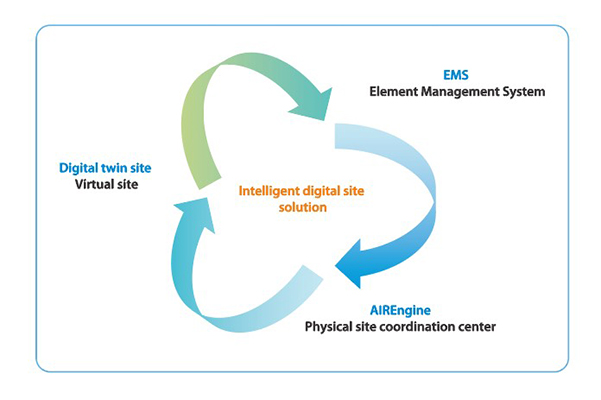
Intelligent digital site solutions utilize the EMS for centralized management and optimized scheduling of site infrastructure. They leverage the digital twin site (virtual site) for real-time monitoring and optimization, and rely on the AIREngine (physical site coordination center) to enable coordinated operations and intelligent management of site equipment.
As a virtual mapping of the physical site, the digital twin site can perceive, diagnose, and predict its real-time state. It supports optimization and issues instructions to guide decision-making across the lifecycle of the physical entity. This integration of the virtual and the physical not only enhances site intelligence but also provides accurate data to support intelligent network decision-making, accelerating the evolution of autonomous networks toward the L4 era.
As an integral component of the intelligent digital site, the beam tracking unit supports a wide range of application scenarios and can significantly enhance network coverage accuracy and user experience. For instance, in areas such as dormitories, teaching buildings, or factory areas, where user distribution fluctuates over time, the beam tracking unit can automatically adjust antenna orientation to focus coverage on user-concentrated areas. In scenarios involving large transportation vehicles with predetermined routes, such as high-speed rail, ships, and aircraft, it adjusts antenna orientation based on movement, enabling the main beam to track user mobility and enhance coverage performance and range. At sites vulnerable to typhoons, the beam tracking unit can automatically detect and rectify antenna attitude misalignment, maintaining a stable coverage. With the rapid development of AI and large model technologies, the beam tracking unit’s attitude sensing and three-dimensional dynamic adjustment capabilities will provide strong support for real-time and rapid network optimization.
The innovative air–liquid hybrid cabinet solution integrates liquid cooling through built-in modules to enable centralized heat dissipation, maximizing cold source utilization and significantly lowering energy consumption. Meanwhile, it adaptively adjusts cooling output and automatically switches operating modes based on equipment status and indoor/outdoor temperatures, enabling low-carbon and intelligent equipment room operations. Designed for centralized BBU deployment scenarios, the air-liquid hybrid cabinet delivers heat dissipation efficiency comparable to pure liquid cooling while retaining the convenience of air cooling. BBUs in live networks can be directly deployed in the cabinet. It is compatible with the standard equipment room, requiring no special specifications for power, load capacity, or height, and supports a wide range of application scenarios. In new construction scenarios, it supports low-energy operation while reducing the initial investment costs for air conditioners and standard indoor cabinets. In renovation scenarios, it delivers significant energy savings and supports cabinet consolidation, effectively improving space utilization.
The intelligent digital site solves the last-mile network intelligence challenge and removes bottlenecks for autonomous networks. It has not only made groundbreaking advancements in sensing, energy efficiency, and O&M efficiency, but also provided new ideas and directions for the future development of autonomous networks. With the continuous promotion and application of intelligent digital sites, we have reason to believe that autonomous networks will fully transition into the L4 era, bringing users more efficient, intelligent, and sustainable network services, and promoting the digital transformation and sustainable development of society.
Related Articles

.png)

.png)

.png)

.png)