Language
ZTE eMonitor Solution: Building the “Nervous System” of the Optical Fiber Network
Release Date:2025-11-26
Luan Tian
With the rapid development of FTTH networks in recent years, a massive number of fibers have been deployed as infrastructure. Since fibers are passive, there is no efficient way to test the fiber network. ZTE eMonitor is a dedicated solution for monitoring the optical fiber infrastructure, building a “nervous system” for the optical fiber network. It provides a real-time, accurate fault testing and measurement method without affecting existing services, thus helping build intelligent fiber networks.
Challenges in Optical Network Monitoring
Current optical network monitoring methods can no longer meet the increasing complexity of optical fiber networks, mainly due to the following limitations:
- Weak monitoring: There is no unified platform for monitoring the entire optical network topology and optical paths, nor an effective performance warning mechanism, making fault troubleshooting difficult.
- Low efficiency: Monitoring and troubleshooting rely heavily on manual operations, resulting in low efficiency and delayed fault recovery.
- Manual analysis: The lack of historical operational data requires engineers to manually analyze and determine fault points.
- Difficult fault localization: There is no effective way to detect faults in real time. Faults can only be identified through device alarms or customer reports, and traditional methods cannot accurately pinpoint fault locations.
As a result, optical fiber network monitoring and troubleshooting remain highly time-consuming and labor-intensive. There is an urgent need for an automated approach to fiber network fault analysis and localization to improve O&M efficiency and reduce maintenance costs.
ZTE eMonitor Solution
The ZTE eMonitor solution (Fig. 1) consists of both a hardware platform and a software platform.
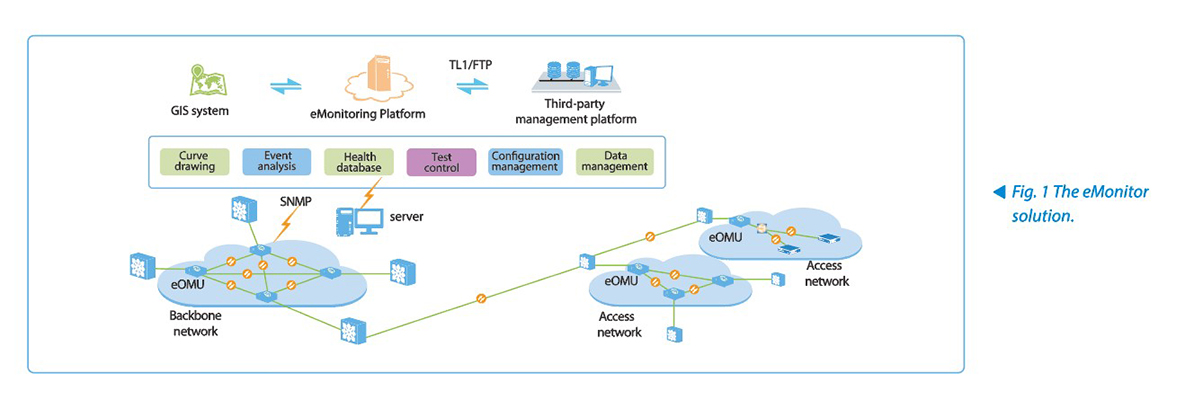
The hardware platform (eOMU) includes an OTDR module, a fiber switching matrix, and a WDM module. It is deployed between the active equipment and the fiber infrastructure. The OTDR module generates third-party test optical wavelengths, while the WDM module multiplexes these test wavelengths with the service optical wavelengths to test the optical fiber network.
The software platform provides an end-to-end intelligent process for testing optical fiber performance. It collects test data, analyzes types of faults, displays test results via a GUI, and builds a fiber “health database”. The platform also interconnects with third-party systems such as the OSS and GIS systems, to generate warning information, dispatch work orders, and display fault locations on the GIS map.
The ZTE eMonitor solution enables real-time testing of the fiber network without affecting existing services, making the whole optical fiber monitoring process intelligent, automated, and digital.
Platform-Based Test System, Realizing Real-Time Fault Monitoring
Unlike traditional manual handheld OTDR test methods, the solution builds an innovative platform-based test system to monitor the fiber performance 24/7 in an uninterrupted, centralized, and automatic manner, generating warnings in real time and visualizing faults in dark passive optical networks.
Health Database for Intelligent Analysis of Network Performance
By creating a fiber “health database”, the solution stores historical fiber network performance data. Through big data-driven intelligent analysis of test results, eMonitor identifies fiber network performance degradation events and generate pre-warnings.
Fully Intelligent Process, Reducing Fault Localization Time by 90%
The solution establishes a fully intelligent process for fiber network monitoring, ensuring that all the steps are implemented automatically. This approach shortens fault localization time by 90% compared with the traditional handheld OTDR test methods. Additionally, it adopts an industry-leading, in-house developed OTDR module to achieve test precision within one meter, greatly improving troubleshooting efficiency and accuracy.
Integration with GIS, Reducing Troubleshooting Time by 30%
The solution provides standard interfaces for integration with GIS systems, mapping physical fault locations based on their logical locations, guiding troubleshooting. It significantly shortens the time required for engineers to locate faults on-site, reducing the entire troubleshooting time by 30%.
Applications
The ZTE eMonitor solution has been widely deployed by operators, such as BTCL in Bangladesh, dstelecom in Portugal, ETB in Colombia, and China Mobile.
In one BTCL project, although the company had achieved more market share and revenues by providing various broadband services to high-end users, it faced increasingly prominent challenges in fiber network maintenance and service guarantee. These challenges included the lack of monitoring methods and end-to-end optical network service assurance systems, inefficient fault localization, and slow response to user complaints. It was urgent for BTCL to build a highly-efficient O&M system to monitor its fiber networks and improve customer satisfaction.
After evaluation, BTCL selected the ZTE eMonitor solution to build an intelligent, unified optical network monitoring platform. This solution helped significantly improve fault localization efficiency, reduce manpower and troubleshooting time, and lower troubleshooting costs. With the real-time warning mechanism of eMonitor, 35% of fiber faults were detected before customer reporting, reducing customer complaints. The fast fault response of eMonitor helped BTCL improve its customer satisfaction index, enhancing its market competitiveness and profitability.
Related Articles

.png)

.png)

.png)

.png)