Language
Contextualized Smart Care: A New Avenue for Carriers’ Value-Added Services
Release Date:2025-11-26
Wang Lili
In the third decade of the 21st century, the global digital landscape is being reshaped by rapidly advancing network technologies—5G, offering wide coverage, 1 ms ultra-low latency and 10 Gbps peak rates, alongside Wi-Fi 7, promising theoretical speeds of 46 Gbps+ and enhanced multi-device processing. These advancements lay a solid foundation for data-intensive, real-time applications. Meanwhile, national digital strategies (e.g., China’s “Digital China”, EU’s “Digital Strategy for Europe”) are accelerating transformation, with smart home evolving from a niche market to the mainstream as consumers increasingly seek more convenient, secure and personalized experiences.
Against this backdrop, telecom operators are at a turning point. The saturated fixed broadband market sees shrinking profit margins due to price wars and homogeneous services. Expanding innovative value-added services has become critical, with intelligent home care standing out due to its connection to users’ essential needs.
This has redefined home security. Traditional post-event video surveillance is replaced by modern intelligent care solutions that integrate property monitoring, elderly/child companionship, smart home connectivity, and real-time alerts. For instance, cameras can detect break-ins, elderly falls or children’s return, triggering lights or alarms automatically. Shifting from “passive monitoring” to “active care”, these solutions evolve into a comprehensive lifestyle service that addresses the upgraded demands of modern families.
Global Smart Care Market: Scale Expansion and Operator Layout
The global intelligent care market is growing explosively, driven by tech innovation and evolving user needs. According to Omdia’s data, global home security product shipments (excluding China) are expected to hit 230 million units by 2025, with home surveillance cameras accounting for 50 million units, or 21% of the market. Notably, home surveillance camera shipments are forecast to grow at a compound annual growth rate (CAGR) of 8%-10% between 2025 and 2030, pointing to a tens-of-billions-dollar market.
Key growth drivers include the expanding global aging population (1 in 6 people over 60 by 2030, according to the WHO), which is boosting demand for remote elderly monitoring via smart cameras. Additionally, rising numbers of urban single-person households are increasing home security needs; and post-pandemic remote work and flexible lifestyles are fueling reliance on smart home devices.
Telecom operators are capitalizing on this potential—over 90% of mainstream global operators now offer home care solutions through integrated “hardware + service” packages bundled with broadband, 5G, or fixed-line services. For example, Verizon’s “Smart Home Security” combines AI cameras with 5G, while AT&T uses subscriptions for cloud/AI features to generate recurring revenue.
Operators value this opportunity for three key benefits: enhanced user stickiness (with solutions tied to hardware/cloud reducing churn compared to basic broadband); a 15%-20% higher ARPU (per 2024 survey, as users pay for value-added security and convenience); and the ability to position themselves as “digital life partners,” building long-term user relationships and capturing broader smart home opportunities.
Industry Challenges: Balancing Computing Power, Cost, and User Experience
The intelligent care market, while full of opportunities, brings significant challenges to operators.
The top challenge is surging computing power demand driven by diversified scenarios and upgraded user experience. Scenarios have expanded beyond basic indoor monitoring to include indoor/outdoor dual-mode surveillance, multi-camera collaboration, and cross-device linkage (e.g., cameras integrated with smart locks/thermostats), all of which require massive data processing—outdoor cameras handle variable light (sunlight, rain, night), while multi-camera systems need real-time synchronization and unified analysis. Users also demand a higher-quality experience: low-latency live viewing (ideally ≤200 ms for emergency response), 24/7 cloud storage, HD playback, and AI alerts, further straining computing resources.
This creates a dilemma: deploying high-performance hardware at the terminals hikes device costs, raising TCO for users and hindering market penetration; offloading all tasks to the cloud drives up operators’ infrastructure costs (e.g. servers, energy, maintenance), eroding margins, and potentially causing latency that degrades user experience.
Another key challenge is ensuring AI accuracy and reliability. False alarms (caused by swaying leaves, insects, or lighting changes) are a major pain point—65% of users who abandoned solutions cited this (2023 survey). Reducing false alarms needs advanced AI algorithms and large training datasets, increasing computing and R&D costs. Additionally, data security and privacy are critical: cameras collect sensitive data (e.g., living habits, home layouts), forcing operators to invest heavily in encryption and compliance to gain trust, which adds operational complexity.
ZTE’s AI Scenario-Based Solution: End-Cloud Collaboration
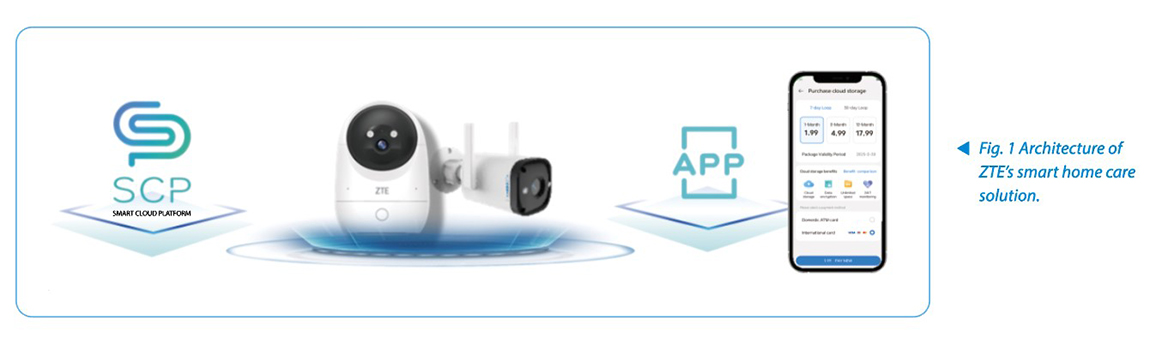
In response to these industry challenges, ZTE has launched an AI-driven, scenario-based smart care solution built on an end-cloud collaboration architecture (Fig. 1). This solution leverages ZTE’s decades of expertise in network infrastructure, AI technology, and smart home integration to strike a balance between computing power, cost, and user experience, providing operators with a powerful tool to seize the intelligent care market opportunity.
Core Architecture: End-Cloud Collaboration
ZTE’s solution is built on an innovative end-cloud collaboration architecture that allocates computing tasks between IP cameras (terminals) and the cloud based on their respective strengths.
At the terminal, ZTE’s IP cameras feature lightweight AI chips and edge computing, enabling them to handle basic data collection and real-time tasks like HD video capture, motion detection, and initial feature recognition—ensuring low-latency responses (e.g., instant local alerts for motion) and offering local SD card storage as backup during network outages.
On the cloud side, the intelligent care platform uses large-scale servers, advanced AI models, and distributed computing to process complex tasks like deep behavior analysis, multi-camera data fusion, and long-term storage. Offloading complexity to the cloud cuts terminal hardware costs by 30% compared to fully terminal-based solutions and enables remote management for operators (device monitoring, firmware updates, and user account control).
This model also addresses data security: it uses encrypted terminal-cloud transmission, complies with global regulations such as GDPR and China’s Personal Information Protection Law to give users control over their data, and supports local processing to keep data on-device.
Key AI Technology Highlights
ZTE’s solution stands out for its advanced AI capabilities, which are integrated into both terminal and cloud components to deliver accurate, reliable, and user-friendly intelligent care services. The core AI technologies include AI detection and alarm, enabling the system to identify risks and respond proactively.
- Area alarm: Using intelligent boundary recognition technology, the system allows users to define polygonal alert zones and adapt to different environments through multi-level sensitivity adjustment. It accurately distinguishes between real intrusions and interfering factors such as animals or light changes. Once an abnormality is detected, it immediately triggers an audio-visual alarm and pushes a notification to the user terminal, forming a complete protection loop. Ideal for perimeter protection and key area monitoring, it ensures the safety of critical areas while minimizing false alarms.
- Line-crossing alarm: Based on advanced video analysis algorithms, this feature supports flexible configuration of the positions and detection directions of virtual warning lines. Anti-interference algorithms effectively eliminate false triggers from environmental factors like swaying tree leaves and flying insects, generating alarms only when real targets cross the warning lines, making it suitable for access control and restricted area control.
- Loitering detection: Leveraging intelligent behavior analysis algorithms, the system accurately identifies abnormal loitering in specific areas. Users can customize time thresholds for triggering alarms, while the system evaluates movement trajectories and dwell duration to distinguish between normal stays from suspicious loitering.
- People counting: Employing high-precision detection algorithms, the system accurately counts people based on head and shoulder features without duplication. It supports generating time-based passenger flow analysis reports, providing data for operational decision-making in venues like cafes and retail stores.
Beyond security, ZTE’s solution caters to users’ emotional needs through the “Time Snapshot” feature, powered by cloud-side AI video analysis and editing technology. Traditional home cameras record hours of footage, requiring users to sift through lengthy videos to find meaningful moments—such as a baby’s smile, a pet’s playful antics, or a family gathering. Time Snapshot can edit the stored video of the day and condense it into a short video of less than 60 seconds.
The feature has been well received, especially among working parents who often miss family moments due to busy schedules. A 2024 ZTE survey showed that 82% of users rated Time Snapshot as “very useful” or “extremely useful,” greatly improving overall satisfaction with the solution.
Scenario-Specific Applications: From Home Care to Child Safety
ZTE’s solution is not a one-size-fits-all product but a flexible platform that can be tailored to diverse scenarios. By working closely with operators, ZTE has developed targeted solutions for different user groups and regions, achieving remarkable success in real-world applications.
Home Care Scenarios: Precisely Matching Needs to Boost Operators' Value-Added Services
In Guizhou Province, ZTE has assisted local operators in focusing on high-frequency and essential home demands, delving into scenario-specific needs and launching AI camera integrated packages. With AI technology at their core, these packages expand applications in home scenarios, covering functions such as elderly and child care, time snapshots, and home security.
Tailored packages are offered for different family scenarios:
- Urban package: Designed for urban single-person households, pet owners, children staying home alone, and baby crying monitoring, the urban package is available for 174 RMB/month on a 24-month term.
- Rural package: Targeting rural areas where there are many left-behind elderly, who lack care due to their children working in cities, the rural package is provided at 145 RMB/month on a 24-month term. This package includes SIM cards, broadband, and data plans, fully meeting families' daily internet needs.
Child Safety Scenarios: Comprehensive Protection to Reassure Parents
In the Guangxi Zhuang Autonomous Region, ZTE has supported local operators in launching scenario-driven child protection services, focusing on safety protection in high-frequency activity areas for children, such as schools and parks.
By deploying video surveillance equipment and integrating advanced image processing technologies like area analysis and motion detection, the following capabilities are achieved:
- Suspicious behavior recognition: Accurately detecting unauthorized personnel entering specific areas or abnormal behaviors.
- Real-time alert response: Once risks are identified, the video networking platform immediately pushes alert information to parents, including details such as time, location, and risk description.
These capabilities not only enhance children’s safety but also give parents peace of mind, knowing their children are in a secure environment.
ZTE, an industry leader in fixed network terminal products, is committed to consolidating foundational capabilities and strengthening technological innovation. The company will deepen its exploration of scenario-based video applications, accelerate the technological accumulation of video and AI capability components, while deepening cooperation across diverse fields such as households, businesses, communities, rural areas, and industries to create a new digitalized landscape.
Related Articles

.png)

.png)

.png)

.png)