Language
ZTE FTTx AI Solution: Building a Dual-Wheel AI Strategy of "AI for PON" & "PON for AI"
Release Date:2025-11-26
Zhu Zhenghua
Amid the accelerated global digital transformation, leading international telecom operators are placing increasing emphasis on integrating AI technology into fixed-network FTTx to enhance network quality and optimize operational efficiency. Deutsche Telekom, a European operator, is leveraging AI algorithms for PON port traffic prediction and dynamic bandwidth allocation. Meanwhile, leading Asian operators such as Japan's NTT are utilizing AI to achieve intelligent fault diagnosis, with systems capable of automatically identifying the deterioration trends of optical links and issuing early warnings. These practices demonstrate that AI has become a core means for operators to "improve quality and efficiency" in the FTTx field, helping them build differentiated advantages in fierce competition.
ZTE is constructing a collaborative system of "AI for PON" and "PON for AI" to empower PON with AI, while enhancing the AI service capabilities of PON networks, thereby promoting the evolution of autonomous networks.
AI for PON: ZTE's FTTx AI Solution Empowering Five Key Areas to Build Autonomous Networks
ZTE has launched a comprehensive FTTx AI solution, which reconstructs network capabilities from five aspects: planning, optimization, maintenance, resources, and operations (Fig. 1). This solution helps operators move toward Level 4 (L4) autonomous networks and achieve core values such as cost reduction, efficiency improvement, quality enhancement, and revenue growth.
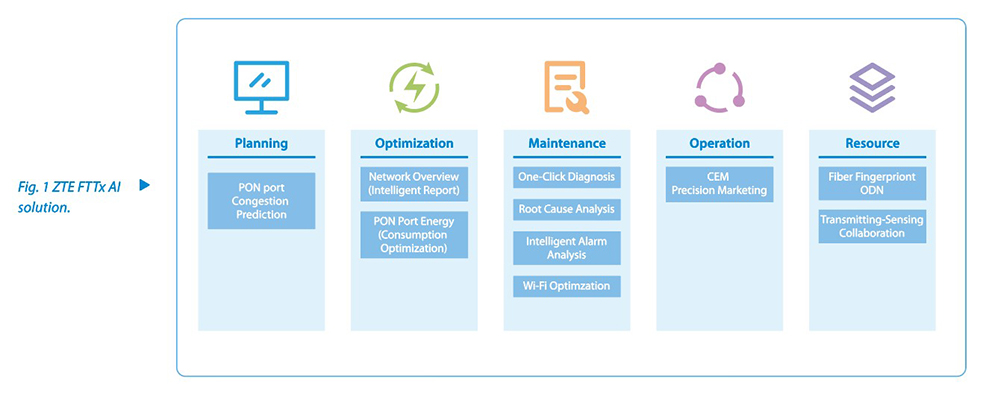
Planning First: AI-Driven PON Port Congestion Prediction for More Accurate Investment
Network planning is the starting point of FTTx construction. Traditional planning mostly relies on historical traffic growth trends for linear prediction, which often fails to accurately capture business changes. This can lead to resource misallocation, where some PON ports become congested prematurely while others have low utilization rates.
The core of ZTE's AI solution in the planning phase lies in PON port congestion prediction. This function collects massive amounts of historical data from the live network, including traffic data, user data, service data, and time data. Based on this multi-dimensional data, the ZTE AI engine conducts in-depth training and learning using time-series prediction models such as long short-term memory (LSTM) networks and machine learning algorithms. This enables it to not only identify simple linear growth trends but also capture complex non-linear patterns and periodic characteristics, providing high-precision prediction of PON port utilization for the next one, three, or even six months.
Operators can clearly see which areas and which PON ports will reach their congestion thresholds and when, based on the "network health heatmap" generated by AI prediction. This transforms investment decisions from "passive fire-fighting" to "proactive planning," allowing operators to accurately allocate capacity expansion resources to the areas that need them most.
Dynamic Optimization: Dual Focus on Intelligent Reporting and Green Energy Conservation
Network optimization is a continuous process. ZTE's AI solution in this phase focuses on improving efficiency and reducing green emissions.
- Intelligent reporting: From "data stacking" to "insight generation"
Traditional daily and weekly reports require O&M personnel to manually extract data from network management systems and create spreadsheets. ZTE's intelligent reporting function leverages AI natural language processing (NLP) and data analysis capabilities to achieve several key benefits.
First, it regularly and automatically generates core KPI performance reports, health assessment reports, user development reports, etc.
Second, it enables semantic interaction. O&M personnel only need to input requests such as "Check the peak utilization rate of XX community in the past week" via voice or text. The system can automatically understand the intent, generate results, and push them, greatly improving the efficiency of information acquisition.
Lastly, insight mining is performed as the AI automatically analyzes anomalies, correlates trends, and provides preliminary judgments on "possible causes of a certain indicator abnormality," directly supporting decision-making.
- PON port energy consumption optimization: Moving toward green networks
Energy conservation and emission reduction are crucial to operators' social responsibilities and operational costs. ZTE's solution realizes on-demand energy supply through AI. During low-traffic periods (e.g., late at night), the system automatically identifies idle or low-load PON ports and ONUs, and intelligently adjusts them to sleep or low-power modes through AI scheduling algorithms. At the same time, when users have service activation needs, the system can quickly resume operations without user perception.
All of this is achieved without manual intervention, minimizing network energy consumption while ensuring user experience, resulting in a win-win situation for both economic and social benefits.
Intelligent Maintenance: From "Personnel Finding Faults" to "Faults Finding Personnel"
O&M work is central to FTTx costs, and the value of AI in this field is most prominent. ZTE's solution transforms "passive response" maintenance into "proactive prediction and prevention" and "intelligent repair."
- One-click diagnosis and root cause analysis (RCA): When users report faults or the system generates alarms, O&M personnel no longer need to conduct step-by-step checks across multiple systems. They only need to enter the user account or device ID, and the AI engine automatically correlates data from all layers, including OLT, PON ports, optical splitters, ONUs, and even home Wi-Fi. Using AI algorithms such as Bayesian networks and decision trees, it locates the most likely root cause (e.g., excessive optical attenuation, ONU hardware failure, or neighbor interference) within minutes and provides repair suggestions, significantly shortening the mean time to repair (MTTR).
- Intelligent alarm analysis: Network management systems generate massive alarms every day, many of which are redundant and correlated. Through alarm compression, association rule mining, and root cause determination, AI condenses thousands of original alarms into several or even one core alarm event, directly pinpointing the essence of the problem. This frees O&M personnel from the burden of "alarm storms" and allows them to focus on key issues.
- Intelligent Wi-Fi Optimization: The "last mile" of user experience lies in Wi-Fi. Based on its self-developed ONUs (such as MC intelligent gateways), ZTE's AI solution continuously monitors the quality of the home Wi-Fi environment, including channel interference, signal strength, and the number of connected terminals. AI algorithms automatically analyze this data, intelligently recommend or automatically implement strategies such as optimal channel selection, transmit power adjustment, and Mesh network optimization. This ensures a seamless and high-quality home Wi-Fi experience and reduces complaints caused by poor Wi-Fi performance.
Precision Operations: CEM-Enabled Precision Marketing to Tap into the Data Goldmine
The customer experience management (CEM) system builds a comprehensive user profile. AI models segment users and accurately identify those at the risk of churn and those with value enhancement potential. Potential churn users are those with a history of poor experience and unresolved complaints. Users with value enhancement potential are those whose current packages can no longer meet their high-bandwidth needs and often reach speed bottlenecks.
Based on this analysis, operators can carry out precision marketing: push "e-sports acceleration packages" or higher-tier packages to users with poor gaming experience; recommend gigabit upgrade services to families that frequently watch 4K videos; and proactively provide experience restoration and care packages to potential churn users. This effectively improves user satisfaction (NPS), reduces churn rates, taps into the potential for ARPU growth, and realizes the transformation from "pipe operation" to "value operation."
Digital Resources: Fiber Fingerprint ODN to Achieve Intelligence of "Dumb Resources"
As the physical optical fiber link, optical distribution network (ODN) has long been regarded as a "dumb resource."
AI redefines the digital and intelligent ODN. The AI platform spans the entire ODN construction process, covering the planning, construction, maintenance, and optimization phases.
In the ODN planning phase, pattern training is introduced to identify the optimal path, achieve intelligent obstacle avoidance, conduct one-click on-site surveys, and intelligently produce design drawings. The design output serves as the final resource information.
In the ODN construction phase, standardized inspections, automatic information entry, and automatic acceptance are implemented, enabling intelligent resource visualization.
In the maintenance phase, automatic fault location, real-time network performance monitoring, and proactive O&M improve efficiency.
Finally, in the network optimization phase, comprehensive analysis algorithms are used for AI-driven analysis, network topology is automatically presented and managed visually, and intelligent network optimization guidance is provided.
PON for AI: ZTE Builds an AI-Ready FTTx Network as a Future-Oriented Intelligent Digital Foundation
Through technological innovation and ecological cooperation, ZTE empowers all aspects, from pipelines, platforms, ecology, and R&D to delivery, ensuring that its FTTx network becomes a powerful engine driving AI development.
Building a 50G PON Ultra-Broadband Pipeline to Lay the Foundation for AI Computing
AI applications, such as autonomous driving, industrial Internet, 8K ultra-high-definition video, and the metaverse, have extremely high requirements for network bandwidth, latency, and connection density. ZTE has proactively deployed 50G PON technology to build an unprecedented "large computing pipeline." Compared with current GPON and 10G PON, 50G PON provides symmetric bandwidth of up to 50 Gbps, millisecond-level latency, and strong multi-service bearing capacity. ZTE's 50G PON solution offers an unobstructed "expressway" for AI training and massive data flows, ensuring the real-time performance, stability, and large capacity required by AI applications. It serves as the core network foundation for building future smart cities and digital societies.
TITAN Platform with Embedded AI: A New Ecosystem for Collaborative Innovation
ZTE TITAN is an integrated system that combines chips, AI algorithms, and platforms, enabling optical networks to "think" and "make decisions" by themselves. By introducing digital twin technology, TITAN can build a digital replica of the network in the virtual space, using AI for simulation predictions, intelligent scheduling, and automated O&M. This not only realizes on-demand allocation of network resources and self-healing prediction of faults but also, more importantly, creates an open platform ecosystem.
Collaborating with Ecosystem Partners to Accelerate Intelligent Network Transformation
The transformation to intelligent networks cannot be accomplished by a single vendor. Therefore, ZTE actively collaborates with global ecosystem partners, including chip suppliers, cloud service providers, industry application developers, and standard organizations. By establishing joint innovation laboratories, promoting the unification of technical standards, and opening API interfaces, ZTE is committed to breaking technical barriers and promoting industrial integration. This collaboration accelerates the evolution from traditional networks to intelligent autonomous networks, ensuring that ZTE's solutions can be seamlessly integrated into the broader digital landscape, providing customers with end-to-end value, and driving the intelligent transformation of industries.
ZTE is making every effort to build an FTTx network oriented toward the AI future by through a comprehensive strategy: using 50G PON as the pipeline, the TITAN intelligent platform as the "brain," an open ecology as the link, and AI-empowered R&D as the engine.
Looking Ahead
With the deep integration of AI technology and optical access networks, FTTx will gradually evolve into a highly autonomous and flexibly intelligent digital infrastructure. ZTE will continue to deepen the two-way empowerment of "AI for PON" and "PON for AI," driving a fundamental transformation of networks from passive operation and maintenance to active perception, and from bandwidth provision to experience guarantee. We look forward to working with global operators and ecosystem partners to jointly build and embark on a new chapter of integration between communications and intelligence.
Related Articles

.png)

.png)

.png)

.png)