Language
ZTE CEM: Proactive Operations from Bandwidth to Experience
Release Date:2025-11-26
Wei Xiu
In the digital economy era, customer experience has become a core element of competition among operators. Gartner research shows that 84% of enterprises have achieved significant revenue growth after optimizing customer experience. Excellent experience not only enhances user loyalty and brand reputation but also directly drives business growth. Facing an increasingly saturated broadband market and homogeneous competition, operators are undergoing a strategic transformation from "bandwidth operation" to "experience operation". Systematically managing customer experience has become the key to winning future competition.
Currently, operators generally face the dilemma of "excellent network indicators but poor user perception". User experience data is scattered across different network elements and systems, forming data silos that make collaborative analysis difficult. In addition, traditional operation and maintenance rely on passive responses to user complaints, resulting in low processing efficiency and great difficulty in fault demarcation, which leads to decreased user satisfaction and increased churn risk. With the continuous maturity of artificial intelligence and big data technologies, deeply integrating these technologies into network operation and maintenance to achieve visible, manageable, and operable user experience has become a common demand among operators.
Based on its insights into industry trends, ZTE has launched the customer experience management (CEM) solution based on the ZENIC ONE R20 end-to-end unified O&M platform, with a commitment to help operators build a new experience-centric operational system. The architectural overview is shown in Fig. 1. Through the OLT’s built-in A-SA intelligent card, the solution collects user service flow data in real-time, enabling the detection of service data such as transmission rate, delay, retransmission, and packet loss rate, and The data is then uploaded to the CEM platform for unified modeling and intelligent analysis. It provides end-to-end root cause demarcation analysis across home networks, ONUs, ODNs, OLTs to BRAS and content sources, allowing operators to digitally and intelligently manage user experience.
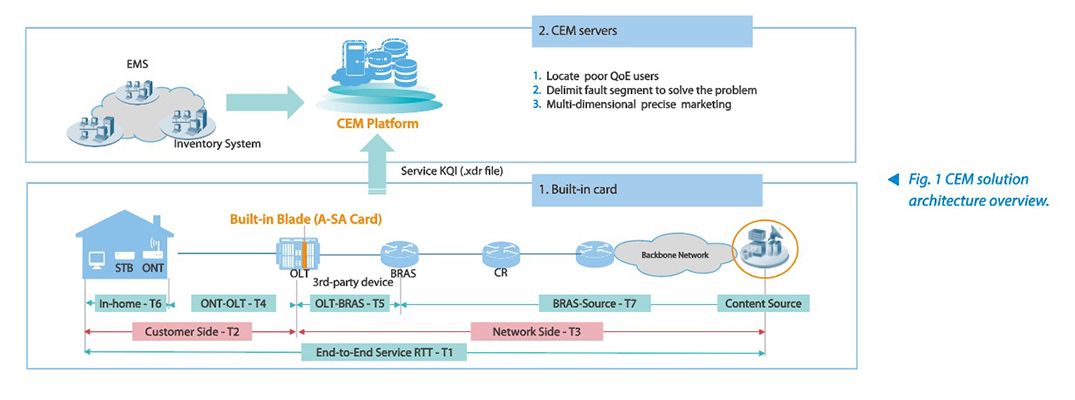
In terms of deployment, the CEM offers significant advantages: the A-SA card is directly embedded in the OLT slot, without requiring additional equipment room space and energy consumption. It supports flexible plug-and-play and elastic scaling. A single card supports 40G traffic analysis and centralized traffic steering for multiple OLTs, offering good scalability and stability.
Through the CEM system, operators can form a closed-loop experience management process—monitoring, analysis, rectification, and verification. Built on enhanced installation and maintenance skills and optimized marketing strategies, it achieves dual improvements in user satisfaction and operational efficiency.
Real-Time Service Perception and Proactive Identification of Low QoE Users
With the help of AI and big data analysis, the CEM system can identify more than 18,000 types of content sources and perform real-time perception and quantitative evaluation of user service experience, achieving an accuracy rate of 85%. The system automatically generates a list of low quality of experience (QoE) users, supporting operators to carry out outbound care or on-site rectification, transforming "passive response" to "proactive optimization". This significantly improves user satisfaction and network stickiness, reducing churn risk.
Since 2021, China Mobile Tianjin has deployed about 150 A-SA intelligent cards on a large scale in multiple regions, covering 450,000 users, and has carried out proactive low QoE rectification based on CEM. After the rectification, its group user satisfaction ranking jumped from 28th to 10th among 33 provinces nationwide, and the churn rate had decreased by 15% year-on-year by 2024.
Rapid Complaint Demarcation and Improved O&M Efficiency
In response to user complaints, the CEM system supports 24/7 service quality backtracking and end-to-end root cause analysis to achieve accurate demarcation of fault segments. It shortens the traditional localization process, which typically takes more than four hours, to within 10 minutes, increasing efficiency by 96%, significantly reducing fault repair time while enhancing user perception.
In 2024, China Telecom Guizhou deployed more than 60 A-SA intelligent cards in places such as Dafang and Weining, covering nearly 100,000 household users. Low-QoE work orders are received through the "Yilian Zhikong" WeChat mini-program, achieving accurate dispatching and on-site rectification. After half a year, the user complaint rate decreased significantly and satisfaction continued to rise.
Accurate User Profiling to Power Differentiated, Precise Marketing
The CEM system builds AI-powered user profiles from multiple dimensions such as service type, traffic characteristics, and experience quality, and automatically generates user tags and value ratings. With these accurate user profiles, operators can identify potential users of various value-added services (such as FTTR, game acceleration, live streaming, private lines, etc.), achieving precise marketing and moving away from the inefficient traditional "wide-net casting" model. This significantly improves the marketing success rate and ARPU.
During the promotion of FTTR services, China Unicom Henan accurately identified target users through more than 1,400 A-SA cards deployed in more than 100 towns across the province. In Jiaozuo, the marketing success rate increased significantly from 3% to 32%, a more than 10-fold increase, which effectively supported the large-scale promotion of FTTR packages and the growth of ARPU.
With "data-driven, AI-empowered, and closed-loop operation" at its core, the ZTE CEM solution drives operators to transform from "network-based operation" to "experience-based operation". In the future, ZTE will continue to deepen the integration of CEM with emerging technologies such as generative AI to achieve more intelligent customer intent recognition and service recommendations, helping operators build a visible, manageable, and operable experience management system, thereby laying the foundation for their long-term competitiveness in the digital economy.
Related Articles

.png)

.png)

.png)

.png)