Language
Advance 50G PON and Develop a 10-Gigabit All-Optical Network
Release Date:2025-11-26
Wang Xinsheng
Amid the rapid evolution and iterative advancement of communication technologies, the global demand for network bandwidth continues to grow at an explosive rate. Since the official release of the XGS-PON standard in 2016, which laid the foundation for the large-scale application of 10G PON technology, ITU-T has initiated research on the next-generation PON technology, aiming to making early arrangements for the future development of networks.
50G PON is the Next Evolution After 10G PON
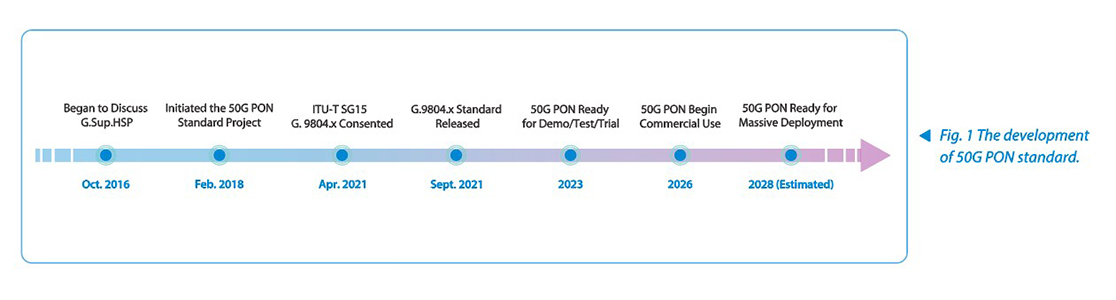
In 2018, ITU-T determined 50G PON as the technological direction after 10G PON and released the 50G PON standard in September 2021. This not only marks the transition of 50G PON technology from a concept to standardization but also lays a crucial foundation for its commercial implementation and large-scale promotion.
50G PON technology is an inevitable outcome driven by the continuous evolution of network service demands and communication technologies. On one hand, the development of new services, especially video services, has led to increasingly higher user requirements for network bandwidth and transmission latency. On the other hand, the digital transformation of government and enterprise sectors is accelerating, and the application scale of scenarios such as telemedicine, industrial intelligent manufacturing, and intelligent security continues to expand—these scenarios not only have ultra-high demands for network bandwidth, but also place higher requirements on network determinism (including latency, jitter, and packet loss rate).
10G PON technology can hardly meet these growing demands, and its performance bottlenecks have gradually become apparent, making the emergence of 50G PON a natural response. With a bandwidth five times that of 10G PON, it provides stable and reliable network support for various high-bandwidth, low-latency services, meeting the application needs of a broader range of scenarios. At the same time, 50G PON supports smooth migration from 10G PON, ensuring maximization of operators' existing network investments, reducing upgrade costs and risks, and injecting new vitality into the digital economy.
Standardization, Characteristics and Application Scenarios of 50G PO
Standardization
ITU-T has made significant contributions to the standardization of 50G PON (Fig. 1). Under the leadership of ITU-T, the G.9804.x series of standards has been successively released and refined, laying a solid standard foundation for the large-scale commercialization of 50G PON. It specifies that 50G PON supports 50 Gbit/s downstream with flexible upstream options of 12.5 Gbit/s, 25 Gbit/s, and 50 Gbit/s based on actual needs.
Compatibility is a core consideration in the design of 50G PON standard. To this end, the 50G PON standard fully takes into account compatibility with previous-generation technologies. By introducing a third upstream wavelength, it enables the coexistence and smooth evolution of three generations of technologies: GPON/EPON, XG(S)-PON/10G-EPON, and 50G PON, significantly reducing the cost and difficulty of network upgrades for operators.
In addition, maintaining the ODN unchanged during the upgrade and evolution process is another key industry concern. This is because ODN accounts for a relatively high proportion of the cost in FTTx network construction, and adjustments are difficult once deployed. Therefore, meeting the optical power budget of already-deployed networks is a basic requirement.
Key Technologies
50G PON continues to adopt the point-to-multipoint (P2MP) topology of TDM-PON, consistent with that of GPON/EPON and 10G PON. This topology offers advantages such as low cost, easy maintenance, and strong scalability, effectively reducing the costs of network construction and operation. Meanwhile, 50G PON realizes bidirectional transmission over a single fiber through WDM technology, which improves network transmission efficiency while making full use of existing fiber resources. To achieve higher performance indicators and meet service requirements of high bandwidth, low latency, and high reliability, 50G PON has made multi-dimensional breakthroughs in core technology fields, providing solid support for realizing its technical advantages.
- Optical interface indicators
In terms of optical interface indicators, the 50 Gbit/s optical interface adopts the OMA-TDEC parameter system, breaking the limitations of traditional optical interface parameter systems, where indicators such as transmit optical power, extinction ratio, and TDEC are independent of each other and set with fixed values. It allows mutual compensation among transmit optical power, extinction ratio, and TDEC indicators of optical modules, ensuring stable signal transmission and improving network reliability and transmission quality.
- Receiver sensitivity
50G PON has introduced digital signal processing (DSP) equalization technology, which processes received signals in real time, compensates for distortions and aberrations generated during signal transmission, and thereby significantly improving receiver sensitivity. To maximize the effectiveness of DSP equalization, the transimpedance amplifier (TIA) and limiting amplifier (LA) need to abandon the traditional limiting amplification mode and adopt a linear amplification design. The linear amplification design can more accurately restore the signal waveform, avoid signal distortion caused by limiting amplification, and provide a higher-quality signal source for DSP equalization. Consequently, the linear burst laser diode driver (LDD), TIA, LA, and burst-mode clock and data recovery (BCDR) circuits have become key chips for 50G PON burst-mode transceivers. They can effectively offset signal attenuation and interference in complex transmission environments, significantly improve reception quality, and ensure that 50G PON maintains stable performance in high-speed transmission scenarios.
- Error correction technology
For error correction, 50G PON adopts low-density parity-check (LDPC) codes. Compared to traditional error correction solutions, LDPC offers stronger error correction capabilities. It can achieve error-free transmission under lower signal-to-noise ratio conditions, significantly improving receiver sensitivity and reducing the bit error rate during signal transmission. At the same time, 50G PON deeply integrates LDPC with DSP technology to enable soft-decision LDPC decoding. Soft-decision LDPC uses the soft information of signals (such as signal amplitude and phase) for error correction, providing higher error correction efficiency and accuracy compared to traditional hard-decision error correction. This further reduces the data bit error rate, ensuring data accuracy in high-speed transmission scenarios and providing strong support for various services with extremely high data reliability requirements.
Application Scenarios
- Smart home
With its high bandwidth and low latency, 50G PON offers users an unprecedented immersive experience. As smart home devices rapidly gain popularity, a large number of smart devices are being densely connected to home networks. These devices generate massive data traffic during operation, placing higher demands on network bandwidth and stability. Leveraging its ultra-large bandwidth advantage, 50G PON can easily carry the massive data generated by concurrent operation of multiple devices, effectively avoiding network congestion, ensuring the smooth operation of various smart devices, and providing a solid network foundation for the full-scale implementation of smart home. It supports the seamless operation of home services—such as online gaming, naked-eye 3D, VR/AR, and cloud storage (NAS)—with instant loading and no lag.
- Enterprise campus
The network performance requirements in government and enterprise sectors are much higher than in residential settings, and 50G PON’s performance advantages are fully unleashed in these sectors, making it a key enabler of their digital transformation. In enterprise office scenarios, 50G PON + Wi-Fi 7 provides ultra-high-bandwidth network connectivity, meeting the concurrent usage of new terminals such as mixed reality (MR) devices. Typical application scenarios include enterprise office, virtual conferences, telemedicine, and intelligent manufacturing.
- 10-Gigabit smart city infrastructure
50G PON can also provide core network support for the construction of urban digital infrastructure, facilitating the development of smart cities. With its advantages of large bandwidth and high reliability, 50G PON can easily carry massive data, enabling functions such as intelligent control of lighting equipment, real-time monitoring and scheduling of traffic flow, real-time analysis of environmental data and early warning, and efficient backhaul of 5G signals. It helps transform urban management toward greater intelligence and efficiency, improving urban operational efficiency and residents’ quality of life. Meanwhile, 50G PON provides high-security private network services, meeting stringent network security and stability requirements of government departments, financial institutions, and other entities.
In recent years, the industry has continued to explore the application scenarios of 50G PON and conducted pilot projects in homes, campuses, factories, parks, commercial buildings, and for 5G small cell backhaul, with expectations for its adaptation to more application scenarios.
ZTE Continues to Innovate in 50G PON Products and Solutions
Standardization Contributions: Deeply Engaging in and Leading Development
As a member of ITU-T and other standardization organizations, ZTE actively participates in and promotes the formulation and refinement of 50G PON-related standards. The company has submitted over 80 50G PON standard proposals, covering key technical fields such as physical layer parameters, low latency, and forward error correction (FEC), many of which have been adopted by standardization organizations.
Technological Innovations: Multidimensional Performance Breakthroughs
In optical modules, ZTE has focused on meeting the key requirements for 50G PON OLT optical modules—specifically the SFP-DD GPON, XG(S)-PON, and 50G PON tri-generational Combo optical modules—through research and innovation in module layout and power consumption reduction. By optimizing the structural layout, the integration of DSP and optical modules has been enhanced, resulting in a 30% size reduction, which facilitates easier deployment in existing network equipment. To reduce power consumption, advanced circuit design and material technologies have been adopted to meet the 32 dB optical power budget requirement. This has reduced the optical module's power consumption by 40%, improving energy efficiency and lowering operators' operational costs.
In chips, ZTE has actively invested in the R&D of key chips for 50G PON burst-mode transceivers, such as linear burst LDD, TIA, LA, and BCDR, improving their performance and stability for complex deployment scenarios. Additionally, the effective integration of LDPC error correction technology with DSP has further enhanced the system's receiver sensitivity and data transmission accuracy, providing comprehensive guarantees for the performance of 50G PON in practical applications.
Industry Cooperation: Advancing Pilots to Support Commercialization
ZTE actively promotes industry cooperation in 50G PON and the maturation of the industrial chain. It has conducted 50G PON-related testing and pilot/commercial trials with over 60 customers, covering scenarios such as homes, enterprise parks, campuses, factories, and 5G backhaul.
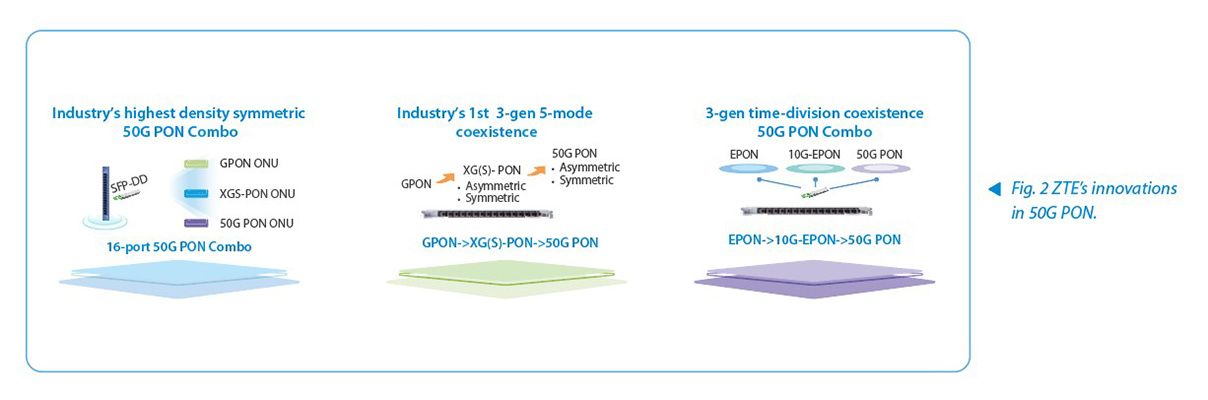
As a pioneer in 50G PON, ZTE firmly adheres to the 50G PON technology direction and continues to innovate. It has launched a series of solutions, including the industry's first precision 50G PON prototype, the first 50G PON + Wi-Fi 7 ONU, the first three-generation five-mode 50G PON Combo, the first 8-port symmetric triple-speed 50G PON Combo solution, the industry's highest-density 16-port symmetric 50G PON Combo, and the first 50G PON three-generation time-division coexistence solution. These solutions support the smooth evolution of existing networks to 50G PON. Meanwhile, ZTE provides a full range of end-to-end OLT and ONU products, leading the industry’s 50G PON development. Fig. 2 shows some of ZTE’s innovations in 50G PON.
50G PON Outlook: Ushering in the New Era of 10-Gigabit All-Optical Networks
The PON technology has gone through a decade of evolution and commercialization. In the past 2-3 years, the focus has been on refining standards, achieving technological breakthroughs, exploring scenarios and improving the industrial chain of 50G PON. With breakthroughs in ASIC technology, 50G PON is expected to enter official commercial use in 2026, and step into the large-scale commercialization by 2028. The international market is expected to lag 2-3 years behind the Chinese market in commercialization.
As 50G PON continues to evolve, its application scenarios are being actively explored. In home scenarios, 50G PON will be deeply integrated with education and healthcare, supporting online education, gaming, high-definition interaction, and remote health monitoring In government and enterprise sectors, it will empower smart factories, digital finance, and promote the digital transformation of industries. In the construction of 10-Gigabit all-optical cities, 50G PON will facilitate the development of fields such as smart transportation and smart energy, contributing to a more comprehensive digital city system.
Related Articles

.png)

.png)

.png)

.png)