Language
Fiber Fingerprint Solution: Enabling AI-Driven Passive Resource Management
Release Date:2025-11-26
Yang Yang
In today's large-scale deployment of fiber-to-the-home (FTTH), the optical distribution network (ODN), as the "last mile" connecting users, has long been trapped in a dilemma of invisible resources, difficult fault localization, and high operation and maintenance costs due to its passive nature.
Transforming ODN Management: From Idle Resources to Intelligent O&M
In traditional ODNs, splitter port information relies on manual recording, with general accuracy below 70%, leading to significant port resource idling or "phantom occupation" (i.e., systems shown as occupied but actually unused). According to operator statistics, port waste caused by distorted resource data reaches as high as 15%-20%. Meanwhile, fiber breaks, weak optical signals, and other faults require hours of manual segment-by-segment troubleshooting, resulting in persistently high customer complaint rates. The lack of accurate data support also hampers network expansion, causing severe redundant construction and negatively impacting operators' return on investment.
With the development of services such as 5G, gigabit optical networks, and industrial internet, demands for high availability, high reliability, and high-quality networks impose new requirements on the evolution of ODNs to the next generation:
- Precise resource digitization: Achieve 100% visibility of splitter port status (occupied, idle, phantom occupied) to support efficient resource scheduling;
- Intelligent and automated O&M: Achieve meter-level fault location accuracy, reducing fault location time from hours to minutes;
- Network elasticity and scalability: Dynamically plan expansion paths based on real-time data to avoid redundant investments.
Facing the urgent demands of global operators for resource digitization, intelligent O&M, and high network elasticity, ZTE has launched the fiber fingerprint solution, leveraging technological innovation to solve the management challenges of passive ODN resources and ushering in a new era of digital and intelligent optical network operations.
ZTE's Fiber Fingerprint Solution: Illuminating the "Dark" ODN
Using comprehensive analytical algorithms for AI analysis, this solution (Fig. 1) automatically visualizes the network topology for efficient management. It accurately guides network optimization, ODN acceptance, and rapid fault localization through precise resource statistics and data analysis.
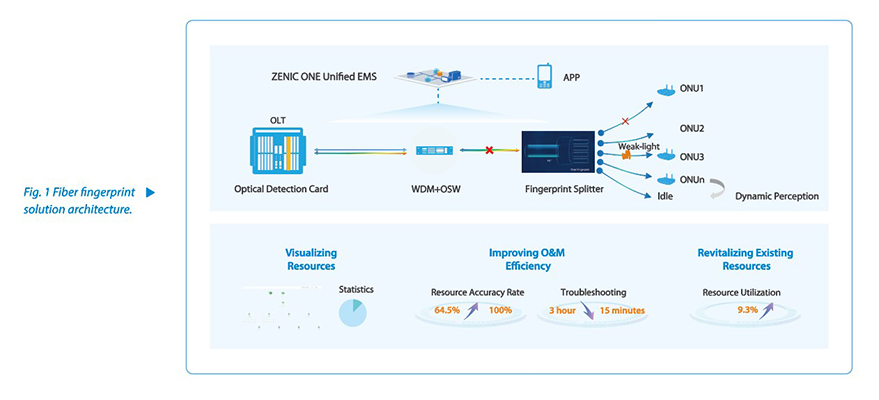
Architecture : Three-Layer Innovation for Intelligent Passive Networks
- Fiber fingerprint identification technology
Passive splitters modulate the characteristics of optical signals, giving each branch distinct optical properties, thereby assigning a unique "digital ID" to every optical path. This enables precise identification of splitter port status (occupied, idle, phantom occupied), improving resource accuracy to 100%.
- Multi-parameter AI diagnostics engine
Equipped with a high-sensitivity optical detection unit, the system continuously collects backscattered and Fresnel reflection signals. Combined with AI algorithms, it analyzes optical path loss, weak light distribution, and fault types (e.g., fiber breaks and connector loosening). It builds an optical-path health database, compares and evaluates the health status of optical cables, and achieves meter-level fault localization. It reduces fault localization time by 90% and provides early warnings of potential failures.
- GIS smart link platform
Deeply integrated with the Geographic Information System (GIS), it dynamically marks the physical location of fault points and generates "one-click navigation" work orders. Resource status is linked with the map, which visually displays the OLT-splitter-ONU topology. Collaboration efficiency across planning, construction and maintenance is improved by 40%, and O&M manpower costs are reduced by 30%.
Functionality: Full ODN Topology Restoration and Rapid Fault Localization
- Automatic visualization of ODN topology and digital resource management
Leveraging the fiber fingerprint solution, the system automatically reconstructs the two-level splitting of PON ports and the ODN-ONU topology. It analyzes and calculates splitter port resource utilization, including occupied, available, and expandable ports, providing guidance for rapid service activation, precise network expansion, and improved resource utilization efficiency.
- Remote fault diagnosis and proactive O&M closed loop
The system localizes fault within minutes and integrates GIS mapping to display fault locations, automatically assigning maintenance tasks to the nearest technician. Additionally, AI analyzes historical data to predict degradation trends—such as increased loss caused by connector aging—triggering preventive maintenance. In terms of business assurance, the pilot areas achieved a 60% reduction in complaint rates, and the time required for user service recovery was reduced to under 30 minutes.
Successful Pilots of Fiber Fingerprint Solution Significantly Enhancing Passive Optical Network O&M Efficiency
The fiber fingerprint solution has been successfully piloted at China Mobile Anhui, China Mobile Zhejiang, China Telecom Guangdong, and in collaboration with Turkcell.
In June 2024, China Mobile Anhui completed a live network pilot of fiber fingerprint solution, enabling ODN topology visualization and precise resource management, providing a model for the digital and intelligent transformation of home broadband networks. After implementation, ODN port-resource data accuracy improved by approximately 30%, revitalizing around 9.3% of idle resources. During service activation, topology visualization reduced the first-attempt service-activation rejection rate by 90%, improving deployment efficiency and reducing manpower waste. During fault maintenance, real-time fault localization and intelligent fault-type analysis reduced average diagnosis time by 90%, significantly shortening fault resolution time and enhancing customer satisfaction.
In September 2024, Shaoxing Mobile deployed the solution in the Shengshi Mingyuan residential area, achieving over 95% accuracy in resource identification, activating 16.1% of previously invisible ports, and reducing fault localization time by 90%.
In February 2025, the solution moved from pilots in China to its European debut: ZTE and Turkcell jointly launched a pilot in Istanbul that demonstrated precise splitter port state identification, intelligent topology presentation, and high-precision fault localization, offering a new paradigm for idle resource management for global operators.
Industry Value and Future Evolution
The fiber fingerprint solution upgrades the ODN from a "dark pipeline" to an intelligent sensing layer that underpins end-to-end digital and intelligent O&M. It maximizes port utilization, saving CAPEX by 15%-20%, and eliminates O&M blind spots, delivering a fault self-healing rate of more than 90% and a 30% reduction in OPEX. Additionally, service activation time is cut from days to hours.
Looking ahead, evolution will focus on continuous AI algorithm optimization, leveraging deep learning to predict network congestion and expansion hotspots. The solution will also integrate with cloud platforms and align deeply with operators' OSS/BSS systems to enable automatic resource scheduling. Another important trend is energy-saving green design, which leverages passive characteristics to reduce energy consumption, aligning with the "Dual Carbon" strategy.
ZTE’s fiber fingerprint solution leverages technological innovation to tackle long-standing challenges in resource management. Through breakthroughs in optical-path identification, AI-based diagnostics, and GIS collaboration, it transforms the ODN from a “cost center” into an “efficiency engine.” With the evolution to 5.5G and F5.5G (next-generation fixed networks), fiber fingerprint ODN will become a cornerstone for building end-to-end autonomous networks, helping operators achieve the ultimate targets of “resource awareness, intelligent operations, and trustworthy networks.”
Related Articles

.png)

.png)

.png)

.png)