Language
AI Empowers Gigabit Broadband, Ushering in a New Era of Smart Home
Release Date:2025-11-26
Chen Qiuji
Amid the rapid global digital transformation, the growing adoption of fiber to the home (FTTH) has significantly reshaped residential network infrastructure. Gigabit broadband is increasingly becoming a standard feature in modern households, providing the foundational bandwidth required for data-intensive applications. However, this expansion comes with considerable challenges for network operators: user growth has plateaued, ARPU remains under pressure, and services are becoming increasingly homogenized. In this intensified competition, a new strategic direction is essential. The integration of AI with gigabit broadband is emerging as a decisive factor, facilitating a shift from conventional connectivity to intelligent, value-added services and marking the beginning of a new chapter for smart home.
From “Connection” to “Experience”: AI Reshaping Home Network Services
Traditional broadband services have centered around the concept of “connection,” with service quality measured solely by bandwidth and network stability. Driven by AI, home network services are undergoing a systematic transformation—from “passive response” to “proactive service.” This shift is chiefly manifested in the areas of connectivity, business, and service.
With network connectivity no longer an issue, users are increasingly seeking autonomy in their networks. Through the deployment of AI algorithms, home networks can proactively detect device types, locations, and business requirements, dynamically optimizing channel allocation, bandwidth management, and antenna strategies to enable seamless roaming, interference avoidance, and fault self-healing. Whether for multi-user online 4K/8K streaming, low-latency cloud gaming, or remote office scenarios, smooth and stable network performance is assured.
Network services are tailored to diverse individual needs. Leveraging large language models and user profiling capabilities,
operators can provide personalized service recommendations and closed-loop solutions for different family members. Examples include customized educational content filtering for children, health monitoring and emergency calling for the elderly, and dedicated office channels for professionals, thereby realizing “personalized strategies” for each user and substantially enhancing user engagement and satisfaction.
Network operation and maintenance is shifting from passive response to proactive management. Real-time monitoring of various terminals, connections, and business indicators enables the prediction of potential risks and the implementation of automated remediation. For instance, when latency fluctuations are detected in gaming, an acceleration mode can be automatically activated; when storage anomalies are detected, early warnings and repair suggestions can be issued in advance. The operating model for home networks is thus transitioning from a reactive “firefighting” approach to a “preventive” approach focused on prediction, intervention, and optimization.
End-Cloud Synergy: A Digital Foundation for Smart Home Broadband
The realization of intelligent home networks requires more than isolated technological advancements; it necessitates the construction of an integrated collaborative system that spans the endpoints, cloud, and network. The "end-cloud synergy" proposed by ZTE (Fig. 1) has emerged as the mainstream technological pathway for driving the deployment of AI-powered home broadband in the industry.
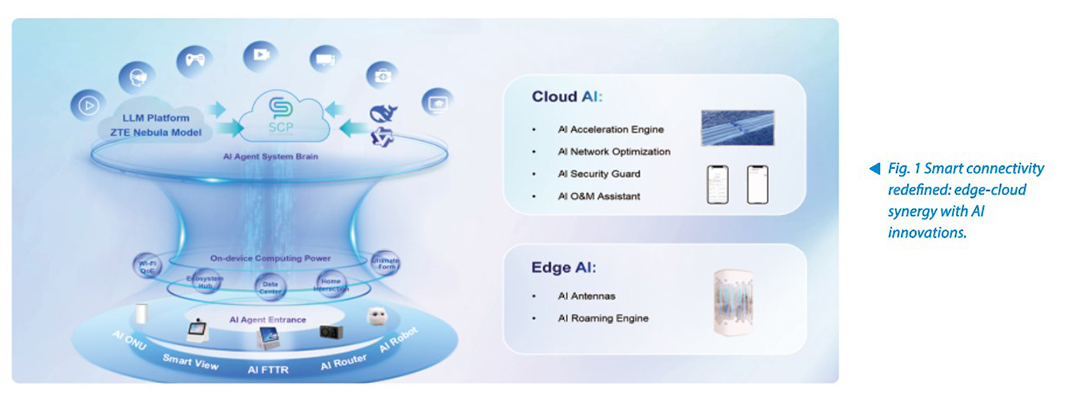
This architecture is centered around the concept of “cloud-based training with edge inference.” On the cloud side, AI platforms such as ZTE's Nebula Telecom Large Model are leveraged to perform
data training, model optimization, and strategy generation to address complex scenarios. At the endpoint, AI chips and lightweight algorithms are embedded to enable millisecond-level local response and closed-loop business processes. The synergy between the cloud and endpoints not only ensures the precision of intelligent decision-making, but also meets the stringent low-latency requirements of real-time services.
Edge AI is pivotal for achieving optimal performance. In practical applications, for instance, “AI smart antennas” can detect terminal signal strength and movement trajectories in real time, enabling microsecond-level adjustments to antenna arrays and beam directions. The “AI roaming engine,” relying on collaborative scheduling algorithms, achieves seamless, packet loss-free switching between multiple access points (APs), thereby completely solving latency and interruption issues encountered when moving between rooms.
Cloud-based AI, meanwhile, is fundamental to enabling globally intelligent services, particularly in upgrading business and operational aspects. For example, “business-level acceleration” uses deep learning to identify service types—such as video conferencing, online gaming, or IoT device communications—in real time and dynamically implements virtual channel strategies to prioritize critical services and reduce latency. The “AI maintenance assistant,” integrating large language models such as DeepSeek, supports multimodal interaction via voice, image, and other formats, rapidly responds to user inquiries like “weak Wi-Fi signal” or “game lag,” thereby doubling operational efficiency and significantly reducing complaint rates.
Diversified AI Terminals: Building a Human-Centric Intelligent Ecosystem
As the direct interface between users and services, the intelligence of terminal devices fundamentally determines the limit of the user experience. ZTE has introduced a series of AI-powered terminals that redefine the “role” of devices within the home environment. Users can select product types according to their preferences, transforming traditional functional hardware into “family intelligent agents.”
The AI FTTR device integrates Wi-Fi 7 with lightweight NAS technology to create a “private intelligent data center” for households. Its AI-driven photo album enables automatic classification and organization of images, and even supports semantic searches such as “find last year’s family photo at the seaside,” greatly enhancing the efficiency of digital content management within the home.
The AI FTTR Pro, an upgraded version, is the industry’s first FTTR device equipped with a display screen. It consolidates six major functions—network management, smart home control, voice assistant, multimedia entertainment, security monitoring, and local storage—thus becoming the true “central intelligent hub” of the entire residence.
The AI Smart View terminal is positioned as a “lifestyle service aggregation platform,” integrating device control, content playback, child monitoring, and wellness services. Notably, it introduces an innovative “scenario-based e-commerce” model, which recommends local lifestyle services or products based on user habits, thereby opening up new monetization avenues for operators.
Home terminals are no longer isolated entities; instead, they leverage network connectivity and AI capabilities to enable data sharing and service collaboration. Collectively, they build an intelligent home ecosystem centered on user needs and capable of continuous evolution.
Value Reconstruction and Model Innovation: A New Path to Sustainable Growth
The advent of AI-powered home broadband not only enhances user experience but also reshapes the value chain of the home broadband industry. Operators can leverage this transformation to shift strategically from “broadband management” to “value operations,” thereby establishing new models for sustainable growth.
Breaking Homogeneous Competition and Enhancing User Loyalty
In traditional broadband markets, users tend to switch providers based primarily on price. However, differentiated services enabled by AI home broadband—such as game acceleration, dedicated remote working channels, and intelligent care—motivate users to remain for the superior experience rather than mere pricing. The irreplaceable nature of these services significantly increases user loyalty and effectively reduces churn rates.
Driving ARPU and the Second Growth Curve
Operators can transition from simple “bandwidth sales” to “service operations” by offering value-added, subscription-based services such as AI cloud storage, intelligent photo album memberships, or e-sports acceleration packages. This creates a recurring revenue structure for sustainable income. Furthermore, AI-driven analytics can precisely recommend scenario-based bundles, such as “home office packages” or “elderly health packages,” allowing operators to mine user value, increase conversion rates, and improve average revenue per user.
Building Ecosystem Advantage for Market Leadership
By integrating AI terminals as entry points, networks as foundational platforms, and cloud-based AI as the central capability, operators are able to orchestrate a closed-loop smart home ecosystem comprised of hardware, connectivity, and applications. This not only establishes long-term competitive advantages but also enables operators to compete effectively with the open market.
The integration of AI with gigabit home networks marks an industry-scale elevation from “connection” to “intelligent home.” This evolution endows household networks with perception, reasoning, and communication capabilities, aligning them to meet the demands of future digital lifestyles centered around people and driven by scenarios. For users, it constitutes a leap in quality of life; for operators, it represents an opportunity to overcome growth limitations and achieve sustainable development.
With the ongoing convergence of “connectivity + computing power + AI,” smart home is entering a new phase characterized by pervasive and proactive intelligence. The future has arrived: Only by embracing change and accelerating innovation can operators carve out new frontiers in the rapidly expanding home broadband market.
Related Articles

.png)

.png)

.png)

.png)