Language
Ultra-High-Speed Optical Transmission Standards
Release Date:2026-03-26
By Wu Chengbin, Zhang Yuanbin
Driven by both the AI computing revolution and the rapid growth of data centers, ultra-high-speed optical transmission continues to evolve toward higher rates and higher bandwidth. The large-scale deployment of single-wavelength 400G WDM systems in operators' backbone networks marks the beginning of commercial adoption of 400G optical transmission. At the same time, with the ongoing standardization of 400G/800G optical transmission standards both domestically and internationally, beyond 1T (B1T) optical transmission and new technologies have become key focus areas for standardization organizations.
Overview of Standardization Organizations for Ultra-High-Speed Optical Transmission
Standardization organizations involved in ultra-high-speed optical transmission include the ITU-T Study Group 15 (SG15), the Optical Internetworking Forum (OIF), IEEE 802.3, and the China Communications Standards Association (CCSA). The relevant organizations and key technologies are illustrated in Fig. 1.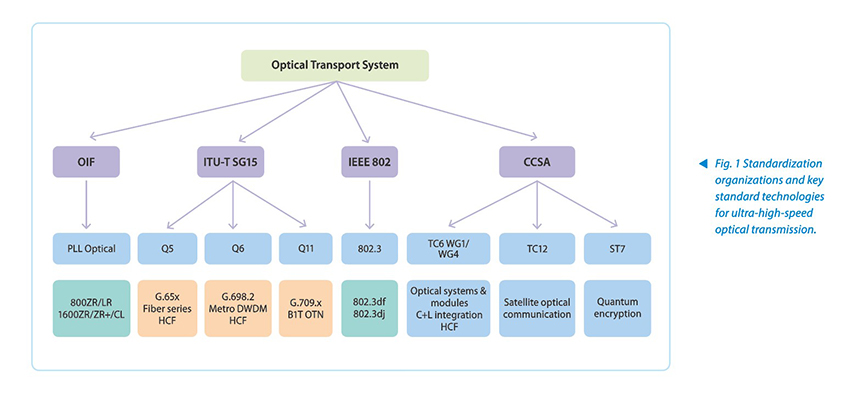
As shown in Fig. 1, ultra-high-speed optical transmission standards mainly include technologies for optical systems, optical modules, B1T OTN, and Ethernet interfaces. The ITU-T SG15 standardizes optical systems and B1T OTN for high-speed optical transmission. Specifically, Question 5 (Q5) of ITU-T SG15 specifies new optical fibers, such as G.654.E and space-division multiplexing fibers. Q6 specifies 800G metro DWDM systems and optical components, while Q11 standardizes the frame structure, multiplexing, and mapping for B1T OTN. IEEE 802.3 specifies 800GE/1.6TE ultra-high-speed Ethernet interfaces, which serve as client-side interfaces for ultra-high-speed optical transmission. The OIF specifies standards for 800G/1.6T ZR/ZR+ optical systems and optical modules based on coherent modulation technology, which are used for line-side interfaces in ultra-high-speed optical transmission and data center interconnects.
Chinese standardization organizations for high-speed optical transmission include CCSA TC6 and TC12. The WDM equipment industry standards specified by the TC6 WG1 working group are widely recognized, reflecting the requirements of China’s three major operators and equipment manufacturers' capabilities. In addition, this working group is involved in standardizing new optical transmission technologies such as C+L integration and hollow-core fibers. Meanwhile, TC6 WG4 specifies optical module standards based on data rate and transmission distance.
Progress on Optical Layer Standards for 800G and Beyond
ITU-T SG15 Q6
ITU-T SG15 Q6 is standardizing 800G metro DWDM systems, with completion targeted for 2026. Committed to standardizing multi-vendor interoperability of DWDM systems, SG15 Q6 has been continuously seeking metrics to assess transmitter quality, which is challenging for coherent modulation-based DWDM systems. Q6 has decided to adopt the ETCC approach and is actively collaborating with OIF and IEEE 802.3 on further research.
At the Q6 meeting held in Paris in June 2025, ZTE proposed initiating the standardization of 1.6T systems, which received broad recognition. Meanwhile, China Mobile proposed a joint study by Q6 and Q5 on hollow-core fibers, which received preliminary approval.
Q6 attaches great importance to standards that reflect its unique value. Technologies such as C+L-band extension and S-band extension, as well as hollow-core fibers and space optical communications, are expected to be considered in future standardization work. The role of Q6 in the standardization of high-speed optical transmission is highly anticipated.
OIF
OIF has been leading the standardization of coherent optical systems and optical modules in recent years, maintaining a strong position among various standardization organizations. OIF released the 800G ZR standard in October 2024, and the 800G LR standard in April 2025, marking the completion of the standardization of 800G coherent optical modules. The 800G ZR interoperability was further demonstrated at OFC 2025.
Since 2024, OIF has successively initiated the 1.6T ZR, 1.6T ZR+ and 1.6T CL projects, signaling the formal entry of OIF into the 1.6T standardization era. The 1.6T ZR project, targeted for completion in Q3 2026, utilizes single-wavelength 1.6T with PM-16QAM modulation for a transmission distance of 80-120 km. The 1.6T ZR+ project adopts dual digital subcarrier modulation, targeting transmission distances of 2000 km (1.2T) and 1000 km (1.6T), using the C+L band. The project is expected to be completed by the end of 2026. In parallel, OIF has launched the 1.6T coherent light (CL) project to standardize and simplify coherent technologies and expand their application scope.
It is worth mentioning that the 1.6T ZR+ project is the first OIF standard to specify multiple spans. This is expected to further enhance the influence of OIF and have a significant impact on the technical direction of 1.6T standardization and ITU-T and IEEE 802.3.
IEEE 802.3
IEEE 802.3 plays a leading role in the specification of Ethernet interfaces and has been standardizing 800G/1.6T Ethernet interfaces. It released the IEEE 802.3df standard based on 100G-per-lane technology, in 2024. At present, IEEE 802.3 is working on the 802.3dj project based on 200G-per-lane technology, with solutions for different distances already determined and draft D2.0 published. This project is expected to be completed in September 2026.
Meanwhile, IEEE 802.3 has started the research on 400G-per-lane technology. With the maturation of this technology, IEEE 802.3 is expected to advance the standardization of 1.6T Ethernet interfaces.
CCSA
In 2024, CCSA TC6 WG1 completed the Technical Requirements for N×400G Ultra-Long-Haul WDM. This standard specifies DWDM optical systems using QPSK modulation above 120 GBd. It meets the ultra-long-haul 400G transmission requirements of China’s three major operators and promotes large-scale commercial deployment of 400G DWDM.
In 2025, the working group started to standardize the Technical Requirements for Metro N×800G Optical WDM Systems and launched research on long-haul 800G optical transmission system technologies, S+C+L band WDM transmission technologies, and 1.6T WDM system technologies. These efforts position China at the forefront of long-haul and high-speed DWDM standardization.
In addition, CCSA TC6 WG4 has basically completed a series of standards for 800G intensity modulation and phase modulation technologies. It has also initiated research and standardization on 1.6T optical modules and C+L integrated key optical components to better support the application requirements of optical system standards.
B1T OTN Standards
ITU-T SG15/Q11 is standardizing B1T OTN, a large-bandwidth OTN interface technology for optimized Ethernet service transport. B1T OTN follows a design philosophy of simplified architecture and industry-wide sharing.
Simplified Architecture
OTUk-based OTN interface technology for 100G and below defines the tributary slot granularity of 1.25G and 2.5G for efficient transport of customer services. For the OTUk interface, the mapping and multiplexing hierarchy adds one additional level with each generation of rate evolution, and the rate evolution itself is not always an integer multiple. For example, the OTU4 bit rate is more than, not exactly 10 times the OTU2 bit rate. As a result, there are multiple mapping and multiplexing levels for 100G and below OTN interfaces, and the interface bit rate continues to increase.
The FlexO-based B100G OTN introduces the OTUCn and FlexO technologies. OTUCn supports 5G tributary slots for customer service transport. FlexO, as an interface technology, introduces the better-performing RS (544, 514) FEC. FlexO also introduces the concept of 100G instance. FlexO interfaces at different rates are all integer multiples of the 100G instance. This approach solves the problem of continuously evolving interface bit rates, but does not address the multi-level multiplexing in traditional OTN.
The B1T OTN interface technology is an extension of the FlexO interface and introduces a FlexO path layer with a 100G tributary slot granularity. To reduce the number of mapping and multiplexing levels, no more than three path layers are designed from the outset. That is, regardless of how the bit rate evolves, B1T OTN supports at most three path layers. While inheriting the advantage of FlexO in avoiding additional bit rate increases when the interface evolves, it solves the multi-level multiplexing issue in traditional OTN, highly simplifying the entire OTN architecture. In addition, in terms of OAM monitoring, it reduces the six-level tandem connection monitoring (TCM) architecture of traditional OTN to a maximum of four levels.
Industry-Wide Sharing
ZR, defined by OIF, is a point-to-point interface technology that uses the FlexO frame structure defined by ITU-T. ZR supports Ethernet as the customer service. B1T OTN is an end-to-end network technology, with Ethernet comprising about 90% of the customer services.
To maintain the advantage of the shared industry chain, a major technical focus in the standardization discussion is to keep the mapping mechanism from Ethernet services to FlexO frames in ZR the same as that from Ethernet services to the new FlexO path layer in B1T OTN. That is, Ethernet clients are first distributed with a 257b granularity and then mapped to the payload area of the service layer using the generic mapping procedure (GMP). The new FlexO path layer in B1T OTN maintains the same payload area and bit rate as the FlexO frame in ZR, while its overhead area is extended to support path monitoring (PM) and TCM monitoring capabilities in accordance with the network technology requirements.
Another important change is the decrease in the interface bit rate. By reducing the number of mapping and multiplexing levels and narrowing the bit-rate differences between different levels, the 100G instance bit rate of the B1T OTN interface increases by no more than 1% compared with that of the ZR interface, enabling the reuse of related components.
In addition to carrying Ethernet clients, B1T OTN maintains backward compatibility and can support the transport of ODU from the traditional OTN interface in the B1T OTN network. To enable efficient service transport and maintain large-granularity scheduling of B1T OTN 100G tributary slots, OTUCn can be used as an entity for aggregating multiple low-rate ODUs, which are then mapped to the new FlexO path layer using bit rate reduction technologies. Fig. 2 shows the functional architecture of the entire B1T OTN network.
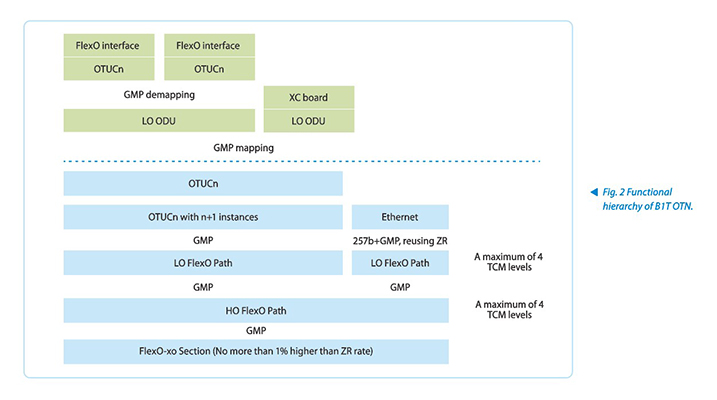
The standardization of B1T OTN achieved a breakthrough at the ITU-T SG15 Plenary meeting in March 2025, with the formal initiation of G.709.1 Amendment 1, which specifies the B1T OTN technologies. The core of this amendment lies in the frame structure design of the new FlexO path layer and the multiplexing relationships between different levels. The standard is scheduled for approval in July 2026, after which the development of standards related to B1T OTN equipment will commence.
Conclusion
The short-reach and metro 800G optical transmission standards have largely been completed by international standardization organizations, while Chinese standardization organizations are focusing on the long-reach application and band extension of 800G DWDM. In terms of B1T, 1.6T high-speed optical transmission has become a key focus for standardization organizations worldwide, including ITU-T, OIF, IEEE 802.3, and CCSA. Technologies such as modulation formats, interface technologies, band extension, C+L integration, hollow-core fibers, and satellite optical communication will be key areas for future standardization.
Related Articles

.png)

.png)

.png)

.png)