Language
Application Outlook for Terabit Hollow-Core Fiber Optical Transport Systems
Release Date:2026-03-26
By Yan Baoluo
During the past two years, the proliferation of generative AI large models has doubled computing demand, necessitating that optical networks—the bedrock of computing infrastructure—evolve toward lower latency, higher bandwidth, and ultra-long distance. Over the last
50 years, optical fiber communication systems based on solid-core single-mode fiber, which operates on the principle of total internal reflection, have reached their technical limits in terms of communication latency, single-fiber capacity, and transmission distance due to inherent limitations in fiber refractive index, loss, and nonlinear effects. A new optical fiber system is urgently needed to break this bottleneck.
Anti-resonant hollow-core fiber, with its three disruptive characteristics—ultra-low latency, ultra-low loss, and ultra-low nonlinearity—is regarded by the industry as the "next-generation transport medium" and has seen rapid development in recent years. Since its proposal by the University of Bath in 2007, this technology has undergone multiple structural evolutions. In 2022, the hollow-core fiber group at the ORC Center, the University of Southampton, UK, optimized a double-nested anti-resonant nodeless fiber featuring five nested tube units (DNANF-5), achieving a minimum loss of 0.174 dB/km, and in 2024, in collaboration with Microsoft, achieved a DNANF-5 with a loss coefficient of 0.08 ± 0.03 dB/km. In the same year, Chinese enterprises reported losses at the 0.1 dB/km level, with single-draw lengths reaching 10 km. At this stage, anti-resonant hollow-core fiber has surpassed solid-core single-mode fiber in loss performance, marking a breakthrough in loss reduction.
Characteristics and Application Potential of Hollow-Core Fiber
Leveraging its three disruptive characteristics—ultra-low latency, ultra-low loss, and ultra-low nonlinearity—hollow-core fiber is expected to provide significant application benefits, such as low latency, enhanced reliability, and reduced networking costs, across numerous optical transmission scenarios. It holds broad application potential in interconnection of intelligent computing clusters, financial high-frequency trading, relay protection services in power systems, ultra-long-distance networking, and next-generation Tbit/s ultra-high-speed long-haul optical transmission systems. Compared with single-mode fiber, hollow-core fiber demonstrates remarkable improvements across multiple performance metrics.
Ultra-Low Latency and Applications
In hollow-core fiber, the light transmission medium is changed from glass to air, resulting in a transmission speed increase from approximately 2 × 10⁸ m/s to nearly the speed of light, which reduces latency by 30% compared to single-mode fiber, equating to a latency reduction of 1.5 µs per kilometer.
In intelligent computing interconnection scenarios, industry benchmarks and remote validation tests have shown that communication latency during data-parallel (DP) distributed training across intelligent computing clusters cannot be fully masked by optimization algorithms, leading to reduced computing efficiency. The latency savings offered by hollow-core fiber can mitigate the latency-induced computing resource waste, providing critical physical-layer support for efficient collaboration in large-scale intelligent computing clusters.
In financial high-frequency trading scenarios, brokerage firms typically place their servers as close as possible to the exchange to minimize communication latency; however, a large number of servers still cannot be deployed in close proximity. Hollow-core fiber and its supporting equipment are expected to trigger a new generation of upgrades in financial dedicated lines. Since 2020, at least two anti-resonant hollow-core fiber cables have been deployed overseas for financial dedicated lines.
By the end of 2024, Microsoft had announced plans to deploy 15,000 km of hollow-core fiber over the next 24 months for data center interconnection and large AI model training. In the power industry, high-voltage power transmission requires synchronization of differential protection information between relay protection devices. The industry generally mandates a unidirectional transmission latency of ≤10 ms to meet the rapid response requirements of relay protection. Hollow-core fiber effectively reduces link latency, ensuring prompt fault response in ultra-long-distance power transmission relay protection.
Ultra-Low Loss and Applications
Solid-core single-mode fiber is fundamentally limited by Rayleigh scattering, making it difficult to achieve a loss below 0.14 dB/km. In contrast, anti-resonant hollow-core fiber has already achieved ultra-low loss coefficients at the 0.1 dB/km level. Furthermore, after being cabled in multiple domestic locations, the average loss of anti-resonant hollow-core fiber can be maintained at 0.15 dB/km within the C-band’s 4 THz range.
In medium- to long-distance backbone and MAN transport scenarios, hollow-core fiber offers a loss coefficient optimization of 0.05 dB/km compared to G.652D fiber. Based on a standard 80 km span model, this translates to a 4 dB improvement in signal-to-noise ratio (SNR), which can revolutionize transmission distance/margin, reduce the number of regenerators/repeaters, and consequently lower networking costs and forwarding latency.
In ultra-long-distance power transmission scenarios, for a similar 300 km single-span transmission, hollow-core fiber can provide nearly 15 dB of performance gain, thereby reducing the networking cost of ultra-long-distance power backbone networks.
Ultra-Low Nonlinearity and Applications
Compared to conventional solid-core single-mode fiber, the nonlinear coefficient of hollow-core fiber can be reduced by three to four orders of magnitude, effectively eliminating the nonlinear limitations that prevent optical communication systems from approaching the Shannon limit. This enables high-power transmission for high-order QAM signals, leveraging the increased power to enhance the SNR at the receiver.
Furthermore, the issue of Raman power transfer, which arises from wavelength band expansion in single-mode fiber, will no longer be a constraint in hollow-core fiber, theoretically supporting ultra-broadband DWDM. It is estimated that, in long-distance transmission scenarios, hollow-core fiber can increase transmission capacity by two to three times compared to single-mode fiber.
In medium- to long-distance backbone and MAN scenarios, long-haul trunk transmission using G.652 single-mode fiber typically employs a 400G QPSK 130+ GBd configuration with 150 GHz spectral spacing. In contrast, hollow-core fiber can support 1.2T 64QAM with three times higher spectral efficiency. When combined with high-power amplifiers, long-distance transmission can still be maintained, enabling optical layer simplification and reduced networking costs. For next-generation 200G+ optical transmission, the ultra-low nonlinearity of hollow-core fiber supports long-distance transmission with 1.6T PS-64QAM using high-power optical amplifiers, extending the reach by nearly 10 times compared to single-mode fiber.
ZTE's Exploration in Hollow-Core Fiber Optical Transport Systems
In 2023, ZTE, in collaboration with a leading Chinese operator, proposed a nonlinear coefficient measurement scheme based on the nonlinear phase shift induced by high-order QAM transmission. By amplifying a 400G 64QAM signal with high-power optical amplifiers, they verified that the Kerr nonlinear coefficient of hollow-core fiber is at least three orders of magnitude lower than that of single-mode fiber after 1 km transmission.
In 2024, with significant advancements in hollow-core fiber loss reduction and single-draw length extension, ZTE, together with a Chinese enterprise, demonstrated for the first time the penalty-free transmission of a 1.2T PS-64QAM signal with a single-wavelength launch power of 3W over 20 km of anti-resonant hollow-core fiber. This also proved the extremely low Raman power transfer in hollow-core fiber, laying a foundation for ultra-high-speed, ultra-broadband, and high-capacity transmission system applications.
Since May 2024, major Chinese operators have successively deployed hollow-core cables domestically. In collaboration with China Telecom, ZTE deployed a 10.4 km, 2-core hollow-core fiber between its Hangzhou Intelligent Computing Center and Yiqiao IDC data center. Utilizing fiber loopback, they demonstrated the first ultra-low latency data center interconnection, featuring a single-wavelength mixed rate of 1.2T and 800G within the C+L bands and a single-fiber capacity exceeding 100 Tbps.
In September of the same year, ZTE assisted China Mobile in demonstrating the first domestic ultra-low-loss (minimum loss reaching 0.13 dB/km) C+L-band 800G transmission over an hollow-core cable between its Wuxi Liyuan and Sunan data centers. During this in-network deployment, the engineering challenge related to CO2 gas absorption was identified, which is now recognized as a critical issue in hollow-core fiber applications that needs to be addressed.
To further explore the potential of hollow-core fiber in high-capacity and long-distance transmission, ZTE conducted a series of laboratory experiments demonstrating single-fiber bidirectional ultra-high-capacity transmission of 377.6T over 100 km in the S+C+L-bands, increasing the current single-fiber capacity record by over 1.5 times. By utilizing self-developed silicon photonic external-cavity nano-packaged high-power S-band tunable lasers, the optical signal-to-noise ratio (OSNR) at the S-band transmitter and receiver sensitivity were significantly improved. Furthermore, the Flex Shaping algorithm was employed to select the baud rate, modulation format, and channel spacing based on channel characteristics. Specifically, 85 GBd PS-144QAM was configured on an 87.5 GHz grid in the C band, 98 GBd PS-144QAM on a 100 GHz grid in the L band, and 49 GBd PS-144QAM on a 50 GHz grid in the S band. To mitigate issues related to filtering and device bandwidth, an optical domain algorithm for equalization and spectral shaping was used for compensation, ultimately achieving the desired metrics.
Regarding long-distance transmission capability, a world record was demonstrated in the laboratory for single-wavelength transmission exceeding 1 Tbps over 10,000 km in hollow-core fiber. This represents an increase of at least 10 times in transmission distance compared to single-mode fiber at the same data rate. This achievement is due to the ultra-low nonlinear characteristics of hollow-core fiber and the use of high launch power to enhance the SNR after transmission. During ultra-long-distance transmission, inter-modal interference, in-band non-flatness, and filtering effects also become prominent. To address these issues, ZTE has carried out optimization of hollow-core fiber specifications and algorithms. Thus, high-order QAM modulation, high-power optical amplifiers, and channel impairment compensation algorithms are particularly crucial for unlocking the full transmission potential of hollow-core fiber systems. ZTE is actively researching these devices and algorithms, focusing on evaluating the feasibility and necessity of metrics required for engineering applications.
Hollow-Core Fiber Application Challenges and Outlook
Although hollow-core fiber almost comprehensively outperforms solid-core single-mode fiber in key metrics, a significant number of issues remain to be resolved before its commercial deployment. Gases such as CO2 and water vapor within hollow-core fiber produce characteristic absorption peaks at specific frequencies, which exhibit varying widths and non-uniform distributions. During the transmission of service light, the spectrum will experience "dips," greatly impacting signal modulation-demodulation and clock stability, thereby restricting the usable range for wavelength division multiplexing (WDM) spectrum (see Fig. 1).
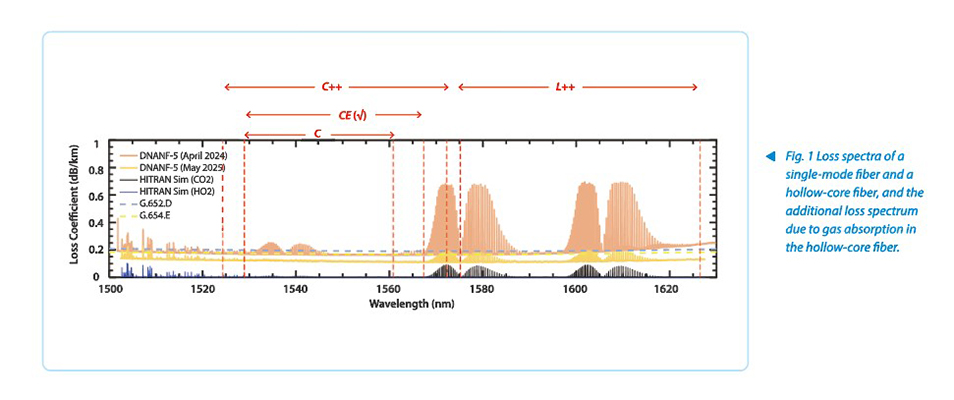 Gas absorption characteristics can be semi-quantitatively analyzed by leveraging the HITRAN database in conjunction with gas pressure, temperature, and molecular density within the hollow-core fiber environment. Currently, there is an urgent need for fiber manufacturers to improve their fiber drawing processes and for equipment manufacturers to conduct research on gas absorption compensation algorithms.
On the other hand, the light guiding mechanism of anti-resonant hollow-core fiber does not inherently support the complete elimination of higher-order modes. Various mechanical factors such as fiber connection points, bending, and coiling can also lead to the excitation of these higher-order modes, causing inter-modal interference. This effect becomes increasingly pronounced during ultra-long-distance transmission and requires focused optimization.
In terms of O&M, hollow-core fiber presents several challenges. Its backscattering coefficient is 30 dB lower than that of single-mode fiber, resulting in a 14–15 dB reduction in the measurable dynamic range of existing optical time domain reflectometers (OTDRs). Furthermore, pressure differences at splice points can cause external gas to be drawn into the hollow core, creating gas density variations that produce "bulges" in reflection peaks at the splice points, which in turn expand detection blind zones. To compensate for the gap, simultaneous optimization of both optical detection devices and algorithms is required.
At the current stage, the structure of hollow-core fiber is not yet standardized, and its widespread adoption is limited by factors such as manufacturing processes and production capacity. Consequently, its current price is 2000 times higher than that of single-mode fiber, hindering large-scale deployment. ZTE remains committed to collaborating with upstream and downstream industry partners to drive hollow-core fiber systems from technical verification towards commercial deployment in the future.
Related Articles

.png)

.png)

.png)

.png)