Language
Next-Generation Optical Communication Architecture: 400G/800G Full-Band OTN
Release Date:2026-03-26
By Chen Yong
The rapid development of new-generation information technologies, such as 5G, cloud computing, big data, and AI, is driving an exponential growth in data traffic. Consequently, traditional optical networks are facing bottlenecks in bandwidth capacity, transmission latency, and intelligent O&M. To meet future demands for ultra-large capacity, high efficiency, and intelligent transport, all-optical network architecture, combining full-band OTN (C+L band) with ultra-high-speed 400G/800G, has become a key direction for next-generation optical communication networks.
400G/800G Full-Band OTN Solution
The ZTE 400G/800G full-band OTN network solution adopts a three-layer architecture—"full-band OTN + high-speed optical modules + intelligent scheduling and control"—to build a future-oriented all-optical network platform. As shown in Fig. 1, full-band OTN consists of the electrical layer, the optical layer, and the network control layer. The electrical layer primarily includes full-band OTN equipment and 400G/800G optical modules, enabling high-speed, high-reliability data transmission and encapsulation. The optical layer is characterized by the need for amplifiers and OXC system components to support C+L band integration, providing up to 12 THz bandwidth for ultra-large capacity transmission. The network control layer, composed of an SDN controller and an intelligent scheduling system, enables wavelength-level service scheduling, resource optimization, and automated O&M.
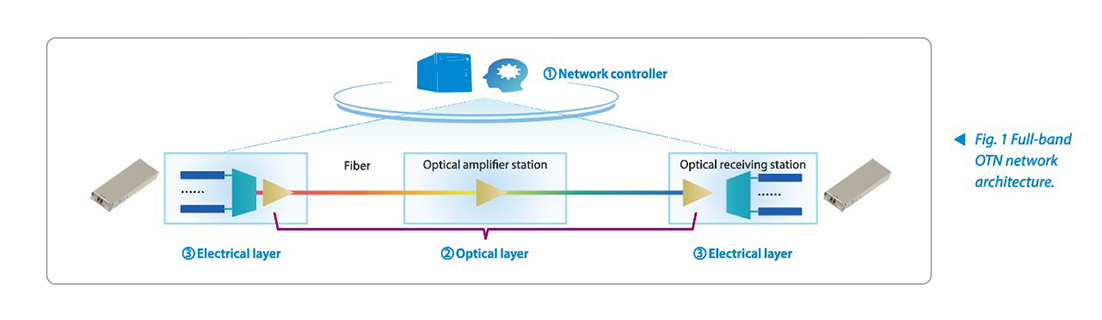 The full-band OTN optical layer, based on core components such as wavelength division multiplexing (WDM), wavelength selective switches (WSS), and coherent optical modules, establishes intelligent scheduling and efficient transmission mechanisms for wavelength-level services across a full spectrum range (12 THz). It adopts dense WDM (DWDM) technology with a 150 GHz channel spacing, supporting up to 80 wavelengths (40 wavelength channels each in the C-band and L-band) with high capacity. Leveraging WSS, it achieves dynamic configuration and flexible scheduling of wavelength-level services, enhancing network intelligence and scalability. In addition, C-band/L-band erbium-doped fiber amplifiers (EDFA) or Raman amplification are used to compensate for optical signal attenuation during fiber transmission, supporting stable long-distance transmission of high-speed signals. With its large capacity, high performance, and flexible scheduling capabilities, full-band OTN lays a solid foundation for next-generation high-speed optical communication networks.
The full-band OTN electrical layer supports flexible containers such as ODUflex and OTUCn, efficiently meeting the demands of 400G/800G high-speed services. It provides multi-granularity service scheduling at both wavelength and sub-wavelength levels for precise on-demand bandwidth allocation, while supporting unified transport for multiple services including IP, Ethernet, and storage. In addition, the layer supports flexible OTN (FlexO) interfaces, enabling adaptation to optical modules of different rate levels and enhancing networking flexibility and transmission efficiency. The 400G/800G high-speed optical modules utilize coherent modulation technology to significantly improve spectral efficiency and transmission performance, meeting the growing demand for high-bandwidth services. These modules support various transmission distances, covering short-distance data center interconnection (DCI), medium-distance metro transmission, and long-distance backbone network applications. Furthermore, support for C+L full-band operation improves modular integration and facilitates flexible deployment and O&M, helping operators build high-performance and scalable next-generation optical communication networks.
The network control layer focuses on intelligent scheduling and control and adopts an SDN architecture to achieve network virtualization and automated service deployment, thereby improving the flexibility and management efficiency of network resources. By introducing AI algorithms, it enables link quality prediction, rapid fault location and self-healing, as well as dynamic optimization of network resources, significantly enhancing network reliability and operational efficiency. In addition, it supports seamless integration with business support systems (BSS) and operations support systems (OSS) to achieve unified end-to-end service management and orchestration, improving network intelligence and O&M automation capabilities, thereby helping build efficient, elastic, and adaptive networks.
Solution Evolution
The evolution for 400G/800G full-band OTN optical networks can be divided into three main stages.
- Initial stage (2024–2026): This stage focuses on 400G modules and C+L integrated optical path scheduling. The feasibility of C+L band transmission technology will be verified through backbone network applications, laying the technical foundation for the full-scale implementation of full-band OTN.
- Mid-term stage (2027–2029): During this stage, 400G full-band OTN will be deployed at scale. Optical modules, optical path scheduling, and amplifiers will all support C+L full-band integration. Unified scheduling and collaboration across C and L bands will significantly enhance network bandwidth and scheduling flexibility.
- Mature stage (post-2030): 800G modules will gradually be deployed across all scenarios, while AI-driven intelligent scheduling technology will mature. The network will evolve toward full intelligence, enabling converged transport and efficient scheduling of multiple services. The goal is to build a high-bandwidth, low-latency, and adaptive next-generation optical network to support the future digital economy and emerging services.
Full-band OTN networks offer several significant advantages. In terms of bandwidth capacity, a single link can support a capacity of up to 12 THz, enabling 80-wavelength 400G/800G transmission. With appropriate wavelength planning and inter-channel interference control, it can further evolve to an 80-wavelength Terabit (T-bit)-scale capacity. Regarding flexibility, the intelligent scheduling system enables precise scheduling of network services at both wavelength and sub-wavelength levels, improving resource utilization and scheduling flexibility. From a cost-efficiency perspective, modular deployment reduces network upgrade and expansion costs. As the industry chain matures and economies of scale develop, the unit cost of full-band high-speed optical modules and band extension technologies will continue to decrease. Regarding intelligent O&M, the network supports SDI and AI-driven scheduling and operations, significantly enhancing automation. Furthermore, an evolvable O&M architecture design ensures a seamless transition from existing networks toward full-band OTN.
Deployment Strategy
For future 400G/800G full-band OTN network solution deployment, ZTE recommends the following strategies:
- Phased deployment: Prioritize the deployment of 400G high-speed optical modules in backbone networks, combined with C-band channel expansion to enhance transmission capacity. As service demands grow, gradually introduce the L-band to achieve C+L band integration, ensuring efficient utilization of spectrum resources and reducing initial investment.
- Modular upgrades: Utilize pluggable optical modules (e.g., CFP2 packaging for long-haul backbone and metro networks, and QSFP-DD/OSFP packaging for short-reach DCI) together with scalable OTN equipment to support on-demand expansion. This approach significantly reduces upgrade costs and cycles while enhancing network flexibility.
- Proactive intelligent O&M: Prioritize the deployment of SDN controllers and AI-driven O&M platforms to enable real-time network perception, automatic fault recovery, and intelligent traffic scheduling, thereby enhancing network automation and operational efficiency.
- Multiservice unified transport: Establish a unified transmission platform that supports the flexible scheduling and transport of various services, including IP, Ethernet, OTN, and SDH, within a single network, increasing resource utilization and reducing network complexity and operational costs.
The combination of full-band OTN (C+L band) and 400G/800G/1.6T+ high-speed optical modules is a key enabler for next-generation all-optical networks. This solution provides high bandwidth, high flexibility, and enhanced intelligence, supporting various scenarios such as large-capacity backbone networks, metro networks, DCI, and enterprise private lines. In the future, as the cost of coherent optical modules decreases, AI scheduling algorithms mature, and standard protocols improve, full-band OTN is expected to accelerate adoption across industries, laying a solid foundation for the rapid growth of the digital economy.
Related Articles

.png)

.png)

.png)

.png)