Language
From Concept to Implementation: Current Status and Future Trends of Integrated C+L Technology
Release Date:2026-03-26
By Shang Wendong, Wu Nishan
In 2025, the widespread adoption of AI-enhanced and AI-native applications has triggered a surge in global network traffic. This shift is driving network infrastructure upgrades toward ultra-high bandwidth and ultra-low latency, while accelerating the deployment of intelligent traffic scheduling systems. Simultaneously, the large-scale development of computing power networks has posed new challenges to the capacity of underlying backbone optical transmission networks.
Currently, there are two primary approaches to increasing single-fiber transmission capacity in optical transport networks: improving single-wavelength rates and expanding spectrum. Improving single-wavelength rates relies primarily on optical digital signal processing (oDSP) and forward error correction (FEC) algorithms to enhance the reception performance of higher-order modulation formats. Meanwhile, C+L band expansion can double the number of channels compared to the original C-band, thereby doubling system capacity. As a result, single-wavelength 400G/800G/1.6T C+L systems are being deployed at scale in computing power network scenarios.
Current Status of C+L Integration
In addition to ensuring Tbit-level ultra-large bandwidth, computing power networks also need to support flexible scheduling and ultra-high reliability. The introduction of C+L integrated solutions enables operators to efficiently manage data floods while ensuring high speed and large capacity. Such solutions achieve full-band, non-blocking scheduling across the extended C+L spectrum, support wavelength independence on the optical branch side, and facilitate the construction of more agile and flexible optical network facilities.
The evolution path of C+L integrated systems starts from separate C/L band architectures and progresses through three stages: wavelength selective switch (WSS) integration, WSS/optical transponder unit (OTU) integration, and WSS/OTU/erbium-doped fiber amplifier (EDFA) integration (Fig. 1). Their ultimate form structurally resembles existing C-band systems, with device costs expected to be reduced by 30% compared to separated C+L architectures, board integration doubled, and equipment footprint significantly reduced. Once C- and L-band EDFAs are integrated, the need for protective guard bands between them is eliminated, enabling full-frequency availability. OTU and WSS can evolve toward full-frequency switching across the 12 THz C+L range, further improving spectral utilization. A unified EDFA/WSS can balance power between the C and L bands, enhancing system performance tuning and operational efficiency. Moreover, integrated C+L systems no longer require C/L-band multiplexing/demultiplexing devices, reducing cross-band loss and further enhancing transmission capacity.
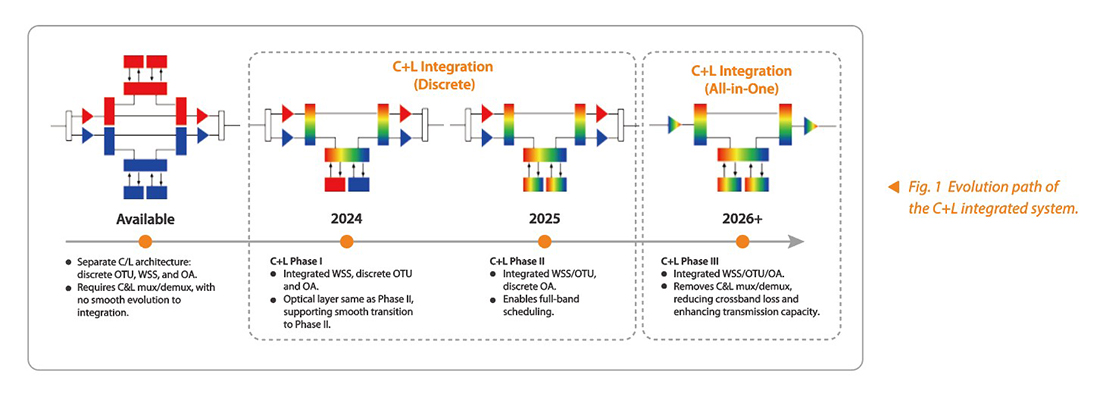
In C+L integrated optical network solutions, the OTU and WSS support arbitrary tuning and scheduling across the full 12 THz C+L spectrum, simplifying system architecture and maximizing the all-optical switching capabilities of reconfigurable optical add-drop multiplexer (ROADM). In wavelength switched optical network (WSON)-based relay recovery scenarios, C+L integration allows the relay boards in the recovery resource pool to be allocated across the entire network, enhancing resilience against multiple failures.
The ultimate form of C+L integration, achieved through the comprehensive adoption of integrated WSS, OTU, and EDFA devices, eliminates the need for C/L band multiplexing/demultiplexing components, simplifying optical-layer networking. However, integrated EDFA technology and mass production remain uncertain, as integrated erbium fiber is still under research. Specific strategies will depend on future technological breakthroughs.
C+L Integration Technologies and Products
The core technologies driving C+L integration are liquid crystal on silicon (LCoS), integrated tunable laser assembly (ITLA), and erbium fiber. While integrated LCoS and ITLA have already achieved breakthroughs and are widely deployed in 400G networks, integrated erbium fiber technology still faces significant challenges. Integrated EDFA is not yet ready for commercial use.
C+L Integrated WSS
Fig. 2 shows the C+L band LCoS in the integrated WSS. Compared with discrete WSS, integrated WSS compresses the pixel size for single-channel spacing, leading to channel bandwidth narrowing. This issue can be addressed both optically and algorithmically. On the optical path side, increasing grating lines enhances dispersion and splitting; and adjusting lens position or focal length, or adding auxiliary lenses, can compress the 12 THz divergence angle and the LCoS spot size. On the algorithmic side, optimizing LCoS shaping algorithms and improving resolution (2.4k/2.9k/3.3k) can further enhance bandwidth.
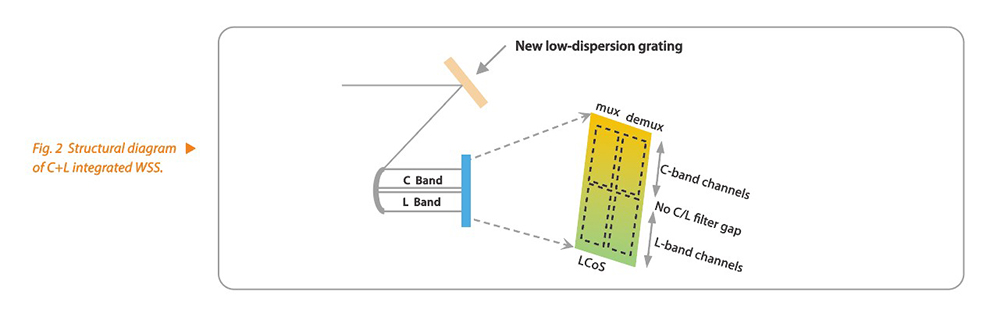
Currently, 12 THz C+L integrated WSS products are being introduced, and WSS-centered optical cross-connect (OXC) devices are already in large-scale commercial use in 400G networks. As the basic unit of intelligent all-optical networks, the C+L integrated OXC—combined with coordinated control scheduling, global intelligent power management, and optical labeling—enables one-stop intelligent deployment, simplified power adjustment, service tracking, and automatic scheduling, driving computing power networks toward greater intelligence.
C+L Integrated OTU
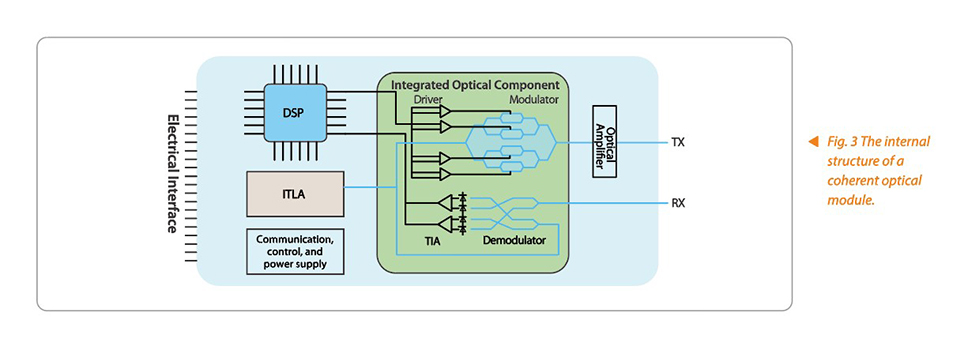
The C+L integrated OTU consists of oDSP, ITLA, modulators/demodulators, and optical amplifiers (Fig. 3).
- Analog and DSP chips
The core technologies for integrated OTUs align closely with existing C-band solutions, necessitating only marginal DSP-level compensation. The 400G/800G modulation/demodulation and DSP recovery algorithms are already mature.
- Integrated ITLA
The integrated ITLA adopts either a dual-chip integration scheme (C/L dual chips + low-loss optical switch) or a monolithic external cavity scheme (a single gain chip based on an optimized quantum well structure + a multi-ring resonator based on SiN waveguides). Among these, the commercially mature solution is the monolithic external cavity integrated ITLA, as shown in the schematic diagram in Fig. 4.
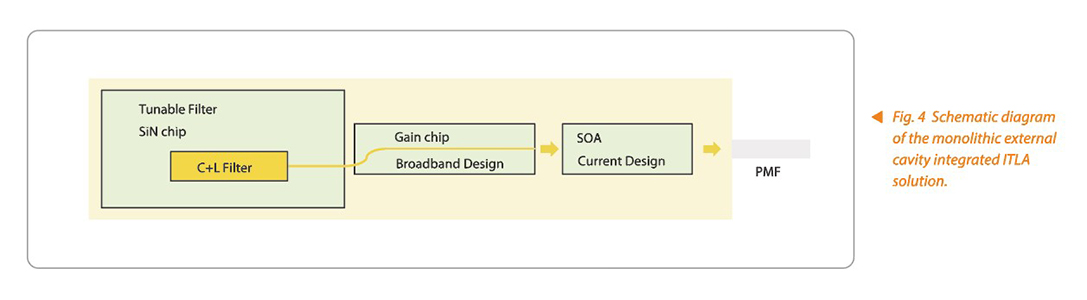 ZTE has achieved industry-leading performance with a 30 kHz narrow linewidth, C+L integrated 240-channel tunable laser, supporting 400G/800G/1.6T coherent transmission systems and meeting operators’ CL240 evolution needs.
- Integrated modulators and detectors
Mainstream approaches include silicon photonics (SiPh) and indium phosphide (InP). Silicon-based approaches support wide wavelength ranges with minimal wavelength dependence, offering performance comparable to discrete C/L band integrated coherent receiver modules (ICRMs). InP-based approaches, however, exhibit wavelength-dependent losses and responsivity differences. Integration using InP is expected to be more costly, requiring optimization in device materials, structural design, and algorithmic compensation.
- C+L integrated amplifier
Compared with integrated WSS and OTU, integrated EDFA technology and products remain immature. As the critical device for the ultimate form of C+L integration, the integrated EDFA is a major focus for future development. Challenges include erbium fiber design and fabrication, as well as amplifier system design. Greater industry-wide collaboration is needed to advance integrated EDFA research and commercialization.
Applications of C+L Integration
In 2025, ZTE continued to deepen its efforts in C+L integrated optical network technology, launching an exclusive full-band OTN solution and introducing integrated 400G/800G/1.6T C+L optical modules. These innovations increased system capacity by 25% while reducing spare part types by half, with multiple live-network validations conducted jointly with domestic and international operators.
In March 2025, ZTE and China Telecom completed the world’s first C+L band integrated 80×800G WDM trial on live network. Based on China Telecom’s backbone ROADM network, the trial validated the transmission capability of 800G C+L integrated OTU modules, optical-electrical scheduling within the 12 THz ultra-wide spectrum, and WSON wavelength recovery.
In May 2025, the two parties completed the world’s first live-network trial of 400G/800G mixed-rate ROADM, verifying the coexistence of 800G and 400G wavelengths in computing power core regions. Combined with hybrid WSON technology, the trial confirmed the reliability of all-optical scheduling. Results showed that existing 400G networks can be smoothly upgraded to support 800G wavelengths, achieving stable coexistence and uninterrupted wavelength rerouting recovery.
Future Outlook for C+L Integration
In backbone WDM scenarios, mature integrated C+L 400G solutions will dominate in the short term, with 800G deployments limited to specific high-rate demand scenarios. For metro/DCI core high-traffic scenarios, 800G upgrades and new builds are expected to surge in 2026.
Currently, major operators and vendors are advancing C+L integrated optical networks through standards development, product R&D, and pilot deployments. Continuous iteration of high-speed coherent optical modules and new wide-spectrum optical amplifiers will inject momentum into integrated optical networks, supporting the evolution and upgrade of computing power networks.
Related Articles

.png)

.png)

.png)

.png)