ZTE Chief Strategy Officer Wang Xiang Highlights Embodied AI Pathways at MWC Barcelona 2026
- Share:
-


-


-


- AI is undergoing a critical paradigm shift from generative AI to physical AI, evolving from "disembodied" intelligence in the digital world to "embodied" intelligence deeply integrated with the physical world
- Focused on cost and efficiency, ZTE flexibly combines Sensing, Communication, Computing, AI and Control to drive the rapid industrial adoption of embodied intelligence from points to lines to full scale
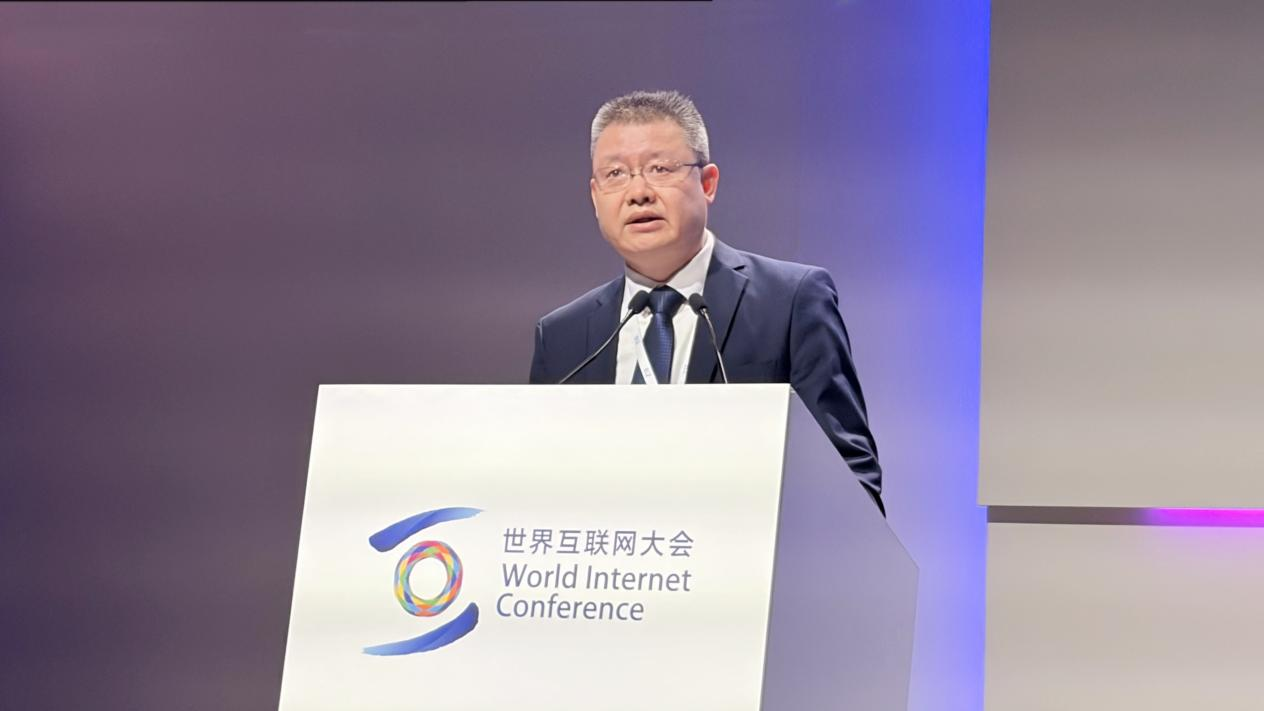
Barcelona, Spain, March 9, 2026 - ZTE Corporation (0763.HK / 000063.SZ), a global leading provider of integrated information and communication technology solutions, announced that Wang Xiang, Senior Vice President and Chief Strategy Officer delivered a keynote at World Internet Conference (WIC) during MWC Barcelona 2026, outlining ZTE's vision for embodied AI and its industrialization pathway.
In his keynote speech titled "Human–Machine Symbiosis, Intelligence Igniting a New Journey", Wang Xiang presented ZTE's systematic approach to embodied AI, built on the synergy of Sensing, Communication, Computing, AI, and Control and the "Point-Line-Plane" deployment path pioneered at the company's Binjiang manufacturing base. He underscored how cost and efficiency optimization are driving the industry toward scaled commercialization.
Embodied AI: The Optimal Vehicle for Physical AI, Facing Three Major Challenges
Wang Xiang pointed out that AI is undergoing a critical paradigm shift from generative AI to physical AI, evolving from "disembodied" intelligence in the digital world to "embodied" intelligence deeply integrated with the physical world. Embodied AI, as the optimal vehicle for this transformation, is advancing beyond technical validation into scaled commercialization, emerging as the core driver of the physical AI era. It is not only the bridge connecting digital intelligence with the physical environment, but also a source of enormous value across industrial manufacturing, logistics, services, and other sectors, with the market projected to exceed USD 40 billion by 2030.
Yet the path to scaled commercialization is not without obstacles. Wang Xiang noted that the complexity and precision of industrial scenarios present three major hurdles: the difficulty of agile single-point deployment in dynamic workstations, the challenge of coordinating heterogeneous agents into efficient production lines, and the lack of seamless integration between intelligent production lines and enterprise business operations.
In practice, this means that enabling a single robot to operate quickly and flexibly in dynamic environments remains prohibitively costly; coordinating heterogeneous clusters of robots efficiently faces real-time challenges in communication and scheduling; and allowing intelligent production line data to truly drive business decision-making is hindered by significant delays and breakpoints. Only by overcoming these barriers can embodied AI evolve from "toy" to "tool", from "demonstration" to "productivity", and achieve the leap from "point" to "chain".
Tackling Industry Challenges: Advancing Embodied AI via the Point-Line-Plane Strategy
In response to these systemic challenges, Wang Xiang explained that ZTE has taken its Binjiang manufacturing base—China's first "5G Fully Connected Factory"—as a practical blueprint to explore the "Point-Line-Plane" pathway for advancing Embodied AI applications. Through functional optimization and flexible combination, ZTE extends deployment from a single industry to replication across many sectors, thereby accelerating the commercialization and maturity of Embodied AI.
At the "point" level, ZTE synergizes Sensing, Communication, Computing, AI, and Control to create embodied single-unit applications. With full-stack solutions integrating in-house R&D and ecosystem collaboration, these five core elements are standardized, modularized, and made plug-and-play, enabling rapid assembly of versatile embodied agents for key scenarios, addressing specific tasks such as material handling, equipment inspection, and quality testing. At the same time, by combining the proprietary automotive-grade SoC Lanyue A1 with the industrial-grade OS OpenNewStar, ZTE achieves SoC & OS synergy, delivering 4x faster picking speed and advanced motion control capabilities to ensure deterministic and efficient perception-decision-execution loops. In addition, the full-stack simulation platform helps overcome data scarcity, enabling algorithms to migrate rapidly from simulation to real-world deployment.
At the "line" level, the company leverages its Co-Sight Super AI Agent as a powerful orchestration tool to seamlessly connect the intelligent nodes with diverse functions. Drag-and-drop orchestration enables minute-level application building, solving collaboration challenges among heterogeneous agents and forming production lines tailored to specific products.
At the "plane" level, ZTE relies on its Digital Nebula 4.0 platform, which provides rich large-model capabilities, one-stop development tools, and a transactional architecture. By aggregating more than 100 applications, it enables integrated factory business flow design that links production, logistics, quality and other end-to-end data flows. This allows intelligent production lines to be deeply embedded into enterprise workflows, driving real-time decision-making.
This model has already delivered measurable impact. At the Binjiang base, per-capita output value rose 81%, production line adjustment cycles shortened by 20%, and delivery cycles fell 30%.
The approach has since been replicated across more than 18 industries—including metallurgy, mining, transportation, power, and ports—working with over 1,000 partners to create 24+ product categories and 100+ scenario applications. In doing so, ZTE has embedded embodied intelligence across thousands of sectors, accelerating its transformation from demonstration to productivity.
Consolidating the Foundation of Five Core Elements through Proprietary R&D and Ecosystem Partnership
Wang Xiang highlighted that to support this pathway, ZTE has consistently built core competitiveness around five dimensions: Sensing, Communication, Computing, AI, and Control. The company adheres to a balanced approach of proprietary R&D and ecosystem partnership, combining ultimate synergy with open innovation.
In sensing and communication, ZTE leverages an internet platform + MEC to widely integrate ecosystem sensors, while advanced 5G/5G-A, MEC, and OTN technologies deliver end-to-end deterministic connectivity, building the "highways" and "neural networks" for agents.
In computing and AI, ZTE provides an open computing hardware foundation that supports diverse, on-demand compute, achieving five-dimensional synergy across chip, standard, architecture, algorithm, and delivery. The "1+N+X" large model portfolio spans foundational models, domain models, and applications, lowering adoption barriers across industries.
In control and orchestration, hardware-software synergy strengthens motion control, while the Co-Sight Super AI Agent and Digital Nebula platform enable rapid orchestration and seamless integration of embodied intelligence into enterprise operations.
Wang Xiang stressed that the advancement of embodied AI is not the endeavor of a single enterprise but a collective effort across the industry.
Positioned as both a core technology innovator and an ecosystem enabler, ZTE will continue to drive independent innovation in key technologies while promoting standardized hardware, platform software, modular solutions, and open ecosystem. Working hand-in-hand with global partners, ZTE is committed to strengthening foundational technologies, fostering open collaboration, and ushering in a new journey of human-machine symbiosis to co-create a brighter digital future.


.png)

.png)

.png)

.png)