Language
Fujian Mobile and ZTE Collaborate on a Home Broadband Agent for FTTx Network O&M
Release Date:2026-11-26
By Zhu Zhenghua
As a leading provincial operator under China Mobile Group, China Mobile Fujian Branch (Fujian Mobile) is committed to advancing the Digital Fujian strategy by upgrading its gigabit optical networks. Rapid business expansion, increasingly diverse home service scenarios, and rising user expectations are exposing the growing limitations of the traditional operating and maintenance (O&M) model.
- The diversity of home terminals, network configurations, and value-added services has significantly increased the complexity of network operations.
- Users' expectations for network quality and service responsiveness continue to rise, while customer complaint volumes remain persistently high.
- Troubleshooting involves multiple steps and is time-consuming, making it difficult to meet users' expectations for shorter mean time to repair (MTTR).
- The lack of precise, end-to-end fault location methods leads to low efficiency in root cause identification.
- Most faults require on-site maintenance, increasing operating costs and negatively affecting users' perception of service quality.
To address these challenges, Fujian Mobile needs to build an intelligent and proactive O&M system to quickly identify, accurately pinpoint, and efficiently resolve network quality issues. It also needs to establish a comprehensive mechanism covering complaint response, fault location, rapid repair, and closed-loop review to ensure timely responses and efficient issue resolution.
Home Broadband Agent Overview
Fujian Mobile, together with ZTE, has developed a proactive home broadband quality management system that incorporates a home broadband agent. The agent is an intelligent decision-making and automated processing system designed for home broadband complaint and service optimization scenariosр. It leverages big data, structured algorithms, and large language models (LLMs), supported by AI OLT smart boards and network management systems. Unlike conventional O&M models that rely on manual inspections or rule engines, it enables a shift from passively responding to complaints to proactively preventing them by providing 24-hour advance warnings of potential complaints, significantly improving the user experience.
The agent is built on a fine-tuned version of ZTE's Nebula Telecom Large Model and incorporates a dedicated knowledge base for home broadband complaint scenarios, integrating tens of millions of home broadband complaint cases and network fault data. It supports advanced semantic understanding, intent recognition, and root cause reasoning. Unlike general-purpose LLMs, it can accurately interpret vague user complaints, simulate network experts' diagnostic reasoning, and rapidly localize the root causes of network faults.
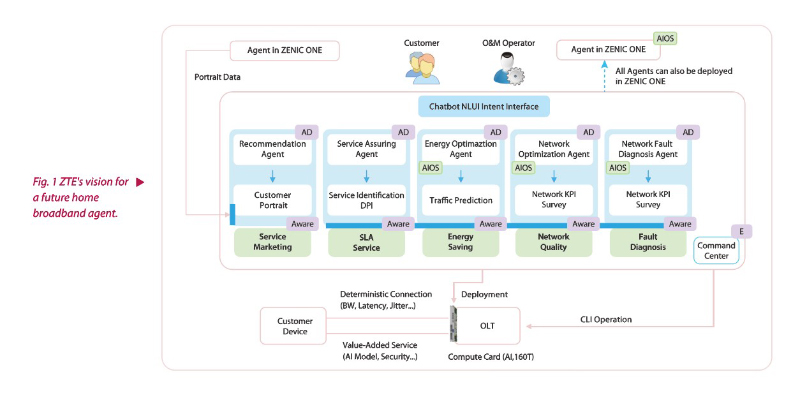
The agent improves question-answering (Q&A) accuracy in all-optical network O&M and also features a natural language-driven intelligent orchestrator. Once workflows from various O&M scenarios, including analysis, diagnosis and optimization, are fed into the system, the agent can replicate expert knowledge, significantly reducing the time required to generate customized reports. In the future, the agent will be expanded to incorporate multiple modules, as illustrated in Fig. 1.
Solution Highlights
Leveraging ZTE's technological strengths in big data, LLMs, and communication networks, the agent addresses key limitations of traditional complaint handling. Through intelligent complaint handling, precise fault location, and proactive service, it is ushering home broadband services into a new era of AI empowerment.
- Deep Customization of LLMs for the PON Domain
Based on open-source models, ZTE developed a dedicated PON-domain LLM by incorporating an 88 GB corpus of the original PON domain data and extracting a 20 GB high-value dataset. As a result, Q&A accuracy for PON domain O&M increased from 65% with general LLMs to 85% with the domain-specific model.
- Intent-Driven O&M
An architecture combining an intent interface and an AI agent has been created based on natural language processing, integrating Text-to-SQL, Text-to-API, and knowledge graph technologies, revolutionizing the traditional O&M model that relies on programming or complex operations. O&M personnel can now define diagnostic workflows and customize reports solely through natural language, without requiring coding skills.
- Proactive Prediction and Optimization
Different from traditional solutions that focus on fault recovery, this solution enables full-link proactive O&M through AI. It identifies instantaneous traffic spikes through machine learning-based time-series analysis and uses an LSTM model to predict 10G-PON bandwidth requirements, proactively avoiding congestion and capacity shortages. Furthermore, the agent monitors users and content sources with poor quality around the clock and automatically corrects soft faults such as Wi-Fi configuration errors. This shifts O&M from post-complaint handling to pre-complaint intervention, transforming the traditional O&M model.
Proactive O&M Practice in Fujian Mobile
Since 2024, Fujian Mobile has deployed over 150 smart OLT boards in nine cities in Fujian Province, including Quanzhou, Longyan, Fuzhou, Zhangzhou, Xiamen, Nanping, Putian, Ningde, and Sanming, covering nearly one million households and helping improve user satisfaction with its broadband service. In 2025, data collected by these smart boards was integrated into the home broadband agent for analyzing users experiencing poor service quality, as well as those who had filed complaints. Currently, the home broadband agent has been deployed within Fujian Mobile's existing network, delivering significant improvements in the following areas:
- Improved complaint-handling efficiency: The intelligent agent replicates expert experience to generate customized O&M reports, reducing report-generation time from one month to one minute. The number of service tickets has dropped by 20%. The average complaint processing time has been reduced from 25 minutes to five minutes, while both the overall complaint resolution time and MTTR have been reduced by 30%.
- Improved network root cause identification: In PON networks, the accuracy of root cause identification reaches 85%, significantly improving fault-handling efficiency. The agent shifts O&M from passive troubleshooting to proactive early warning and optimization, enabling network quality issues to be addressed in advance.
- Reduced repetitive tasks and O&M costs: O&M labor costs have been reduced by over 40% by minimizing repetitive tasks such as manual triage, work order dispatch, and reviews. By preventing duplicate dispatches and ineffective on-site visits, the solution further reduces costs.
In the future, as this solution is more widely adopted, home broadband networks will shift from human-driven, passive operations to AI-driven, proactive self-governance. As collaboration among 50G-PON, 10-gigabit optical networks, FTTR all-optical networking, and edge computing deepens, intelligent OLT boards and LLMs will continue to evolve, enabling network self-optimization, fault self-healing, and service self-response. These advances will help the industry build a new smart home broadband ecosystem with the goal of zero on-site visits, zero complaints, and zero waiting time.
Related Articles


