Language
The 50G-PON Slowdown: Aligning Next-Generation Broadband with AI-Era Demands
Release Date:2026-11-26
By Sun Peiqin
Redefining the "Slowdown"
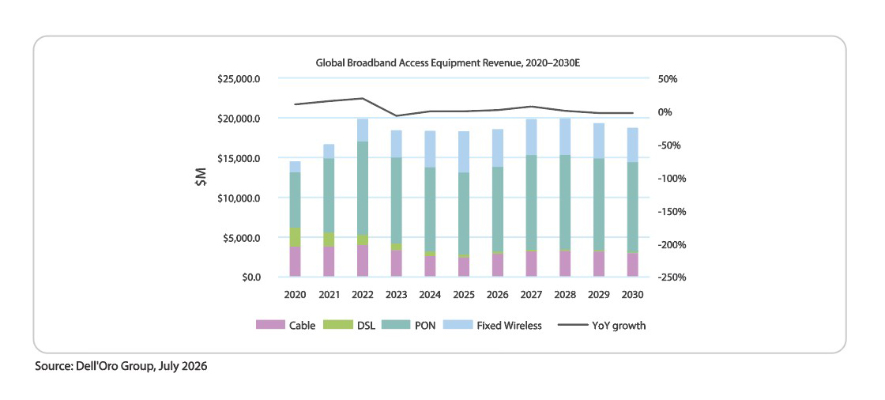
In early 2026, Dell'Oro Group revised its global broadband access equipment forecast downward, projecting a CAGR of just 0.3% from 2025 to 2030, with the market peaking at US$18.8 billion in 2028 before contracting. This outlook reflects operators' concerns over slowing average bandwidth growth and the challenge of sustaining margins in an increasingly competitive landscape. The 50G-PON rollout is progressing at a slower pace, with XGS-PON expected to remain dominant through the end of the decade.
This is not a technological failure. 50G-PON's core capabilities—single-wavelength 50 Gbps throughput, sub-100-microsecond latency, and 99.999% reliability—have already been field-validated. Rather, the global deceleration reflects a timing mismatch between the technology and the market signals operators are responding to, which remain anchored in the consumer-broadband paradigm, where ARPU growth has softened and demand for multi-gigabit residential services has yet to scale. This timing gap, however, makes the slowdown valuable: it opens a window to align 50G-PON not with yesterday's bandwidth race, but with the emerging demands of the AI era.
AI-Era Demands: Redefining 50G-PON's Value
The true value of 50G-PON has yet to fully materialize in the residential broadband market. Beyond this market, its potential is taking shape across four distinct demand domains emerging across the global economy.
- The Enterprise Market: From Office Connectivity to Production Control
Enterprise networking has been fundamentally transformed. The era of "good enough" connectivity for email, file sharing, and cloud desktops is giving way to demands for deterministic, ultra-reliable, and jitter-free communication across manufacturing, agriculture, energy, ports, and mines.
Key performance indicators have shifted: microsecond-level deterministic latency, 99.999% reliability, bounded jitter, and hard network slicing. 50G-PON's TDM heritage offers deterministic forwarding akin to legacy private lines—a physical-layer guarantee difficult to replicate wirelessly. Applications like remote autonomous mining, industrial AOI, real-time digital twins, and telesurgery ask not "how fast" but "how predictable."
Singapore's Singtel initiated a 50 Gbps XGS-PON trial in late 2025, positioning next-generation PON as the backbone for AI-driven enterprise and residential smart services. This is not merely a bandwidth upgrade but a capability upgrade for the AI-enabled enterprise.
- New Digital Economies: The Content Creation "Bandwidth Black Hole"
Beyond the enterprise, emerging content-centric industries are consuming bandwidth at an unprecedented rate, reshaping the upstream/downstream traffic ratio access networks were designed around.
Live streaming and MCN operations now demand upstream bandwidth in the hundreds of megabits per second. A single 4K stream requires 15–25 Mbps; leading MCN agencies simulcasting across multiple platforms can consume 500 Mbps or more. With 8K and 16K broadcasting becoming increasingly viable, demand for bandwidth is accelerating.
Cloud gaming and metaverse applications consume five to seven times the bandwidth of conventional streaming. According to an IIM report, high-bit-rate media traffic accounted for 9% of total streaming duration in 2024, rising to 14% in 2025. Grand View Research reports that the global live commerce market was valued at US$172.9 billion in 2025 and is projected to grow at a CAGR of 41% from 2026 to 2033.
What these digital economies have in common is high upstream bandwidth demand, pronounced traffic burstiness, and latency sensitivity. The traditional broadband model is ill-suited to these "producer users." 50G-PON's symmetric bandwidth (up to 25/50 Gbps upstream) and dynamic bandwidth allocation (DBA) mechanisms are architected for this shift—a structural transition from download-optimized to upload-empowered.
- Compute Center Traffic: How AI Training Reshapes Flow Patterns
Fiber broadband remains a primary medium connecting compute centers to the outside world, though access networks remain dominated by residential subscribers and widespread congestion has yet to emerge. Nevertheless, the trajectory is clear: in AI-leading markets, XG-PON and XGS-PON shipments are rising steadily. According to the IIM report, global ONU shipments reached 872 million units in 2025, up 12.3% year over year, with XG-PON/10G-EPON accounting for 38% of the total. XGS-PON optical module shipments are projected to sustain a CAGR of 8–10% through 2030, and 10G PON OLTs accounted for more than 65% of total OLT deployments by early 2026—marking the access network's formal entry into the 10G era.
What is driving this shift? AI training and inference are reshaping data flows between compute centers and the edge. Traffic is no longer predominantly downstream-heavy and steady-state; instead, it is characterized by high peak bandwidth (e.g., that required by trillion-parameter models), bidirectional traffic symmetry (training upstream, inference downstream), extreme burstiness (e.g., during job initialization and checkpoint synchronization), and pronounced peak-valley cycles. According to a January 2026 TrendForce report, global AI server shipments are forecast to grow 28.3% year over year in 2026, with GPU-based servers accounting for an estimated 69.7% of shipments—and the data generated by these servers will need to traverse the access network.
50G-PON's 50 Gbps capacity and DBA agility are well suited to this asymmetric, burst-prone regime. Today's absence of congestion does not obviate tomorrow's need—the steady rise in XG-PON shipments suggests that operators are already preparing for future demand.
- Data Center Internal Networking
In addition to residential access, a new opportunity is emerging inside the data center. According to Omdia, PON in the data center and fiber LAN segments is gaining traction as a growth area. PON can provide a dedicated, secure out-of-band management channel for data center administrators, enabling device access and control even when the primary network fails. With hyperscale data centers multiplying globally, this represents a market opportunity for millions of PON ONTs per year, at significantly higher margins than those for residential CPE.
For both vendors and operators, this is a win-win. Vendors gain a high-margin customer segment beyond the saturated residential market. Operators can leverage their PON expertise to offer managed services to enterprise and data center clients. 50G-PON, with its deterministic low latency and hard isolation, is the natural fit for this demand.
- The China Factor: Scale as a Catalyst for Global Maturity
China's role is pivotal to 50G-PON's global trajectory. The global 50G-PON market was valued at US$227 million in 2025 and is projected to reach US$2,126 million by 2032, growing at a CAGR of 38.2% during the 2026–2032 forecast period, with China emerging as a critical proving ground for the technology.
Chinese operators and vendors have jointly advanced both technology and deployment. ZTE introduced a three-generation coexistence solution for EPON networks, and in June 2026, China Telecom completed the world's first multi-vendor interoperability validation across three PON generations. China’s Ministry of Industry and Information Technology initiated 168 10G optical network pilots in 2025; by April 2026, 136 had passed review, marking the shift to scaled deployment. Supply chain localization has reached approximately 90%, with second-generation equipment ready for mass deployment.
China's vast market and diverse application ecosystem—from smart factories to AI compute access—provide a unique "living laboratory." This process of refining technology through scale and validating business models through diversity is accelerating global supply chain maturity, reducing technical risks and cost barriers for deployments elsewhere.
Market Dynamics
50G-PON cannot overlook the role of FWA and LEO satellite technologies. According to Omdia's fixed broadband analysis, both technologies are gaining traction globally, with multiple avenues for capacity expansion. As traffic growth moderates, they remain well positioned in markets where FTTP is unavailable and wireline broadband is costly.
Where does this leave 50G-PON? FWA and LEO deliver "sufficient" bandwidth with speed and flexibility. However, fiber offers advantages in terms of determinism, jitter control, security, and service-level guarantees.
50G-PON's advantage is not speed but predictability. Industrial control, trading platforms, telemedicine, and automated production do not necessarily need "as fast as possible"; they need "as promised, every time."
Operators should pursue a differentiated strategy: focus not on price per megabit, but on value per SLA for enterprise and vertical-industry applications.
A Slowdown for Precision
The global deceleration in 50G-PON deployment is not a cause for concern; it is a tuning interval that aligns technological capabilities with market demand. The AI era does not require the fastest possible pipe, but an intelligent access layer that is accountable, schedulable, and isolable—one that guarantees performance rather than merely promising it. 50G-PON is built for this role. Sustained XG-PON shipment growth signals that operators are preparing, even if they have not yet deployed 50G-PON at scale. The question is not whether 50G-PON will find its market, but when and for which applications.
International operators should use this window to experiment with vertical industries and deterministic service models rather than engage in the "speed race." The real opportunity lies in competing on certainty, the dimension that truly matters in the AI economy. When the market is ready, 50G-PON will be the connectivity foundation for the AI-enabled enterprise. The slower pace we see today is not a delay; it is an opportunity to get it right.
Related Articles


