Language
ZTE Helps AIS Build a Benchmark Video Platform in Thailand
Release Date:2026-11-26
By Shan Changliang
When Thailand's largest mobile operator, Advanced Info Service (AIS), set out to rebuild its video platform, several challenges lay ahead: supporting millions of subscribers, ensuring carrier-grade stability, delivering a consistent experience across screens, and building an architecture that could evolve for many years. In collaboration with ZTE, AIS built a benchmark video platform in Southeast Asia.
A Video Platform Built for the Next Decade
For AIS, video is no longer a value-added service bundled with a mobile plan. It has become the anchor of its converged home and mobile entertainment strategy. The platform needs to bring live TV, on-demand content, catch-up TV, network PVR, and third-party OTT apps together.
However, the legacy model was showing its limitations. Traffic spikes caused service interruptions, new features took too long to launch, disaster recovery relied on manual switchover, and upfront capital expenditure was high. AIS needed a platform that could handle traffic surges reliably, scale on demand, and accelerate service launches from quarters to weeks.
ZTE's answer was a hybrid-cloud, microservices-based video platform deployed across AIS’s private and public cloud environments, and unified under a single operations plane. Four capabilities set ZTE apart.
- Hybrid Cloud Designed for Zero Interruption
The first differentiator was the architecture. ZTE designed the platform as a hybrid cloud spanning AIS's two private data centers and public cloud, with microservices running on Amazon EKS and the distributed data bus (DDB) and unified gateways (UGW+) shared across availability zones. The design principle was simple: no single point of failure should ever impact users.
The numbers tell the story. The platform targets 99.999% availability. Auto-scaling is fully automated, with virtual machines expanding in roughly five minutes, database capacity in three minutes, and containers in one minute—so sudden traffic spikes during live events can be absorbed before users notice.
Disaster recovery is equally impressive, with a recovery time objective (RTO) of under 30 seconds and a recovery point objective (RPO) of under one second. These capabilities enable rapid, seamless failover, with subscribers experiencing no perceptible interruption. Compared with traditional models, this represents a major leap forward.
Hybrid cloud also transformed the economics. ZTE introduced a pay-as-you-grow (PAYG) model in which the private cloud handles baseline workloads, the public cloud accommodates traffic spikes, and AIS pays incrementally for the resources it uses. Elastic resource provisioning means that additional cloud resources can be requested within minutes. System components can be scaled and upgraded independently, allowing the team to roll out upgrades and expand capacity online without taking the service down. That translated directly into a lower total cost of ownership (TCO), faster time to market, and a higher level of reliability.
- A Multi-Screen Experience that Feels Native Everywhere
A great video platform delivers a consistent experience wherever people watch. ZTE's second differentiator was its comprehensive, multi-screen client portfolio covering a wide range of devices commonly used in Thai households, including set-top boxes (STBs), Chromecast, iOS and Android phones, PCs, tablets, and smart TVs.
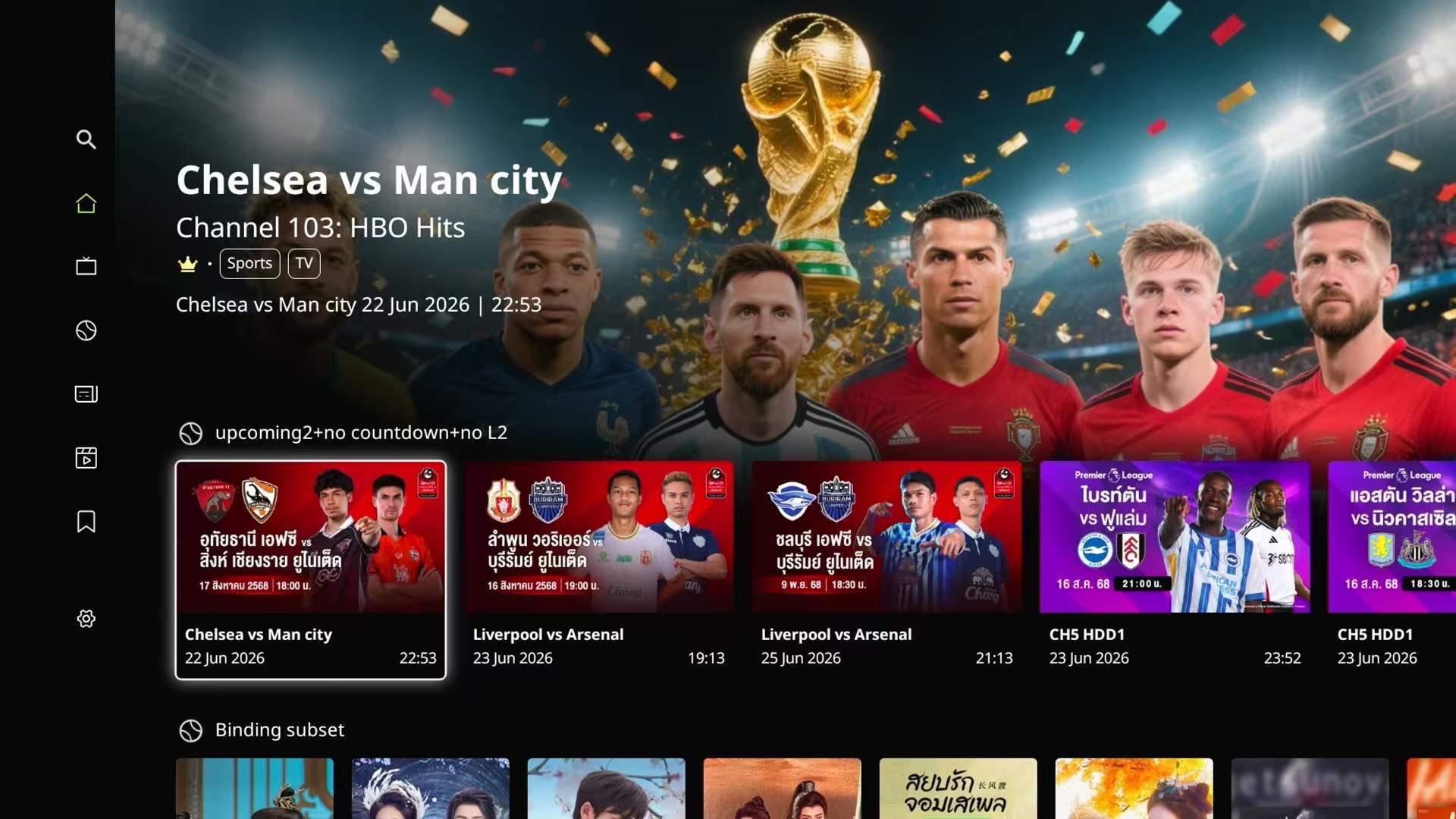
Each screen is designed around its own interaction model rather than a one-size-fits-all UI. On TV, the focus is on ultra-high-definition (UHD) viewing and intelligent interaction, with immersive video backdrops, floating rating cards, and waterfall-style layouts that put content first. On mobile, the design prioritizes smooth streaming and natural touch interaction, with highlight-focused layouts and one-tap social sharing. On PC, the interface emphasizes information density and keyboard-and-mouse efficiency, with column-based browsing and quick access to recordings. Across all three, ZTE's design language centers on three key words: Smooth, Specific, and Social.
The feature set is comprehensive. It includes live TV, VOD, time-shifted TV, and start-over. Picture-in-picture and multi-view let sports fans follow multiple matches, while bookmarks, favorites, and multi-user profiles personalize the experience for each household member. Built-in search and recommendations surface the right content.
Crucially, the platform natively integrates YouTube, Netflix, and third-party apps, and supports casting via Chromecast and AirPlay. Built-in social sharing features for Facebook, X (formerly Twitter), and LINE—a leading messaging app in Thailand—turns viewing into a shared activity. The result is that wherever AIS subscribers are and whatever device they use, the service feels built for that screen rather than ported to it.
- An Open, Standardized Platform that Aggregates Everything
Openness was another key strength of ZTE's platform. Modern video platforms depend on their ability to aggregate content, advertising, notifications, and payment services across dozens of external systems. ZTE built the platform around industry-standard interfaces, enabling rapid, customized integration without proprietary lock-in.
On the content side, the platform brings together leading global OTT services—including Netflix, YouTube, Disney+, and Prime Video—alongside AIS's own live and on-demand content libraries.
On the business side, it integrates with AIS's BSS stack, including super duper payment gateway (SDPG), billing, and direct carrier billing (DCB) to enable one-click subscriptions. Authentication ties into the AIS ID system, while analytics from MaxMind and ad serving through Google Ad Manager give AIS the tools for precise, data-driven operations. Push notifications are delivered through Apple Push Notification service (APNs) and Google Firebase Cloud Messaging (FCM).
Security and monetization are equally enterprise-grade. DRM and watermarking protect premium content, while server-side ad insertion (SSAI) delivers a broadcast-quality ad experience. The platform's modular architecture—comprising CMS, BMS, Search, Recommendation, Ad, MES, Campaign, EZMON, CFMS, and monitoring—allows individual modules to be upgraded without affecting the overall service, while enabling innovative new services to be incubated and launched quickly. ZTE also integrated components from its partners across CDN, advertising, and IoT. This openness meant that the platform would not become a closed silo, but rather serve as an integration hub for the entire digital entertainment business.
- A Roadmap to the Smart Home
Looking ahead, AIS aims to evolve its video platform, laying the foundation for its converged smart home vision. ZTE's roadmap provides a clear path.
The platform is designed to integrate home IoT services under a unified layer, with the TV and STB acting as the smart home hub. ZTE's roadmap includes an AI voice-enabled STB, bringing high-quality audio, voice assistance, and 4K video player together in one device. Control is multi-modal: voice, the mobile phone as a remote control, and a smart display that brings information and control into the living room.
Beyond connectivity, ZTE and AIS are co-innovating on revenue-driving services. Cloud gaming on TV turns the STB into a console. Online shopping with scan-to-order merges entertainment and commerce. Watch Party lets friends and family chat while watching live sports together—a feature tailor-made for Thailand's passionate football audience. On the AI front, the roadmap includes automated highlight clipping, AI image-quality enhancement, and AI dubbing, all of which are expected to reduce production costs and expand content reach.
The collaboration extends beyond the video platform itself, enabling the service to grow from a video product into a one-stop smart home solution.
Conclusion
The project demonstrates what can be achieved when architecture, experience, openness, and a foward-looking roadmap come together. ZTE addressed AIS's key requirements—million-level capacity, stability, multi-screen consistency, and long-term evolution—with a single, coherent strategy. Hybrid cloud delivers reliability and cost efficiency; multi-screen clients provide a consistent user experience; open standard interfaces enable content and business aggregation; and the smart home roadmap lays the groundwork for the future.
Related Articles


