Language
The Operator’s Next Act
Release Date:2026-11-26
Editor's Note: At ZTE’s 15th Global Summit and Users Congress 2026 held in Kuala Lumpur, Carl Raymond R. Cruz, President and CEO of Globe Telecom in the Philippines, discusses the shifting role of operators in the digital economy and shares how Globe Telecom is unlocking more value from its existing network, customers, data, and partnerships.
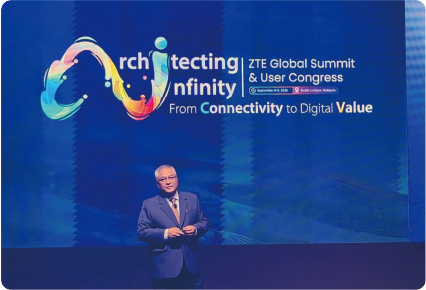
We are living through a pretty remarkable shift. The world is becoming more connected, more digital, and increasingly intelligent. Every year, there are more devices, more data, more services moving through our networks. And now AI is changing not just what people consume, but how businesses operate and how customers interact with companies.
At the same time, the customer experience is moving away from the network itself. People care less about the technology underneath. They care about what it enables—speed, simplicity, relevance, trust.
And that creates an interesting moment for the telco industry, and begs the question:
What must a telecom operator become to remain relevant and competitive in the next digital era?
The Digital Economy Is Expanding on Rails Built by Telcos
Today, and as we look towards the future, the demand for connectivity keeps on growing.
Mobile traffic is expected to be 2.5 times higher by 2031. The value created around connectivity is also expanding. McKinsey estimates roughly US$100 trillion of “digitally influenced economic activity” by 2030. At the same time, AI is moving very quickly into enterprise software. Gartner expects a significant share of enterprise applications to incorporate agentic AI by 2028. And all of these run on connectivity foundations built and continuously upgraded by telcos.
This is where I think telecom has a problem. We built the rails. We continue to carry the traffic. And we continue to fund the infrastructure behind it. But much of the value is being captured somewhere else.
You can see it in three numbers. First, traffic keeps rising while the economics of basic connectivity continue to compress. Second, traditional telcos tend to trade at around 5 to 7 times EV multiples, while technology companies can trade at 15 times or more. And third, over the last two decades, telco shareholder returns grew about 29%, compared with 235% across global sectors. That is a very large gap. So this is not simply an industry-growth issue. It is a value-capture issue.
We have been very good at enabling the digital economy. We need to get better at capturing the value it creates. That's the shift.
Leading Operators are Converging on Five Capabilities
We looked at a number of leading operators around the world. They don't all look the same. But five capabilities keep showing up: intelligent infrastructure; AI-enabled enterprise; outcome and ecosystem platforms; trust; and active capital and asset management.
Different operators are stronger in different areas. But the direction is remarkably similar. The network becomes more intelligent. The organization becomes more AI-enabled. The customer relationship becomes broader as leading telcos expand the scope of where they play. Trust becomes part of the proposition. And capital becomes much more deliberate.
Put those together, and you get a different kind of operator. A trusted digital orchestrator.
Not less telecom. More value from telecom.
Globe Telecom Is Following this Same Blueprint for Its Next Act
At Globe, we see the same opportunity. And we are taking a fairly simple approach: start with the assets we already have—our network, our customers, our data, our partnerships, and our ability to invest.
Then ask a much harder question: how do we create and get more value from each of them? For us, that means three things: intelligent infrastructure, trust-backed platforms, and fit-for-purpose scale. Let me show you what that looks like in practice.
- With Intelligent Infrastructure…
Let's start with the network. Better infrastructure is not just about having more sites; it is about creating a better customer experience—and then turning that experience into more usage and more value.
Globe has been recognized by Ookla for network consistency and 5G coverage, and we're seeing the commercial effect: 5G traffic is up 23%, with average traffic per user up 45%, and our 5G customers generate around a 10% ARPU premium versus non-5G users.
But intelligent infrastructure goes beyond monetization. It means using AI to predict problems before they happen, so we can replace components before they fail and prevent downtime; using AI to optimize how we deliver our services; and dynamically combining terrestrial and satellite networks when customers need it.
So the relationship is becoming pretty clear; quality drives usage, intelligence helps us sustain quality, and usage drives value. That is what we mean when we talk about intelligent infrastructure.
- AI Access Leads to Adoption, and Adoption Drives Outcomes
At Globe, we don't want AI to be something that a small specialist team uses. We want it to become part of how the organization works. Today, around 90% of Globe has access to AI, with more than 260 use cases and more than 250 active builders. And we're seeing practical improvements already, with selected workflows moving faster, including API development and debugging.
The important number isn't 90%. The important thing is what happens after 90%. People start using the tools. They learn. They build. And the organization gets faster.
That is when AI starts to matter.
- Reach Creates Engagement. Engagement Drives Outcomes
Then there is the customer side. Globe has something that many companies would love to have: reach. And we are using that reach to address very real needs.
For households, 1.1 million GFiber Prepaid customers are getting access to affordable, reliable home connectivity—helping drive a four-point increase in household fiber penetration over the last two years. For connectivity, 2.2 million customers have had their mobile lifeline extended through Starlink Direct-to-Cell, a first in the Philippines. And in underserved communities, we have provided 400,000 free Bayanihan SIMs across 180 GIDA sites, delivering a 73% ARPU lift versus baseline.
Then there is financial access: 11.5 million GCash borrowers. 21.8 million insured users. 17.9 million savers. Different needs. Different moments.But the idea is the same. Reach creates engagement. Engagement creates outcomes.
This is what an ecosystem can do when connectivity is used not just to connect people, but to help them live, work and participate more fully.
- Building a Secure Foundation for the Digital Economy
There is one thing underneath all of this. Trust.
We have blocked 967 million scam and spam messages and deactivated more than 244,000 fraud-linked SIMs. We are also working with government to strengthen the country's defenses against fraud and illicit activity.
Why make such a big deal of this? Because the more digital the economy becomes, the more important trust becomes. Customers need to know that their identity is protected, their transactions are protected, and their data is protected.
Trust is not separate from the digital experience. It is part of it. And for an operator, that can become a real source of differentiation.
- Scaling Assets Through Smart Partnerships
The last piece is capital. We cannot build the next operator by owning everything. So we are becoming much more deliberate about what Globe keeps in its balance sheet. We have transferred 88% of our tower portfolio into a specialist model, are scaling our data-center business with STT GDC, with capacity targeted at more than 30 megawatts, and through NCS, our enterprise technology capability has grown from around 150 people to more than 1,200.
The principle is straightforward: Keep the things that differentiate us. Partner where someone else can scale faster, better or more efficiently. That gives us more capability without turning every opportunity into a balance-sheet decision.
Technology Is not the Destination. Uplifting Lives Is
And this is where I want to finish. Because none of this is really about technology. Technology is the tool. The destination is what it does for people.
For Globe, that means three things: democratize connectivity—making it possible for more people to participate through mobile, fiber, and satellite; democratize financial access—giving people more ways to pay, save, borrow and protect themselves; and increasingly democratize intelligence—giving more people (our employees included) and more businesses access to the benefits of AI.
That is how I think about the operator's next act. Not becoming a technology company. Not trying to become everything. But becoming a trusted digital orchestrator—connecting the assets we have, using intelligence to create better outcomes, and earning the trust to play a bigger role in people’s lives.
The real opportunity for telecom is not simply to carry the next wave of digital demand. It is to help more people participate in it. To help create a Philippines where families’ dreams come true, businesses flourish, and the nation is admired.
To create a Globe of Good.
Related Articles


