ZTE's "Connectivity + Computing" Strategy Drives Growth, with Nine-Month Revenue Up 16% YoY to RMB 116.84 Billion and Computing Revenue Share Reaching 38%
- Share:
-


-


-


- Revenue gains in the Computing and terminal businesses, together with higher revenue from international markets, drove overall operating revenue growth
- In Q3, operating revenue reached RMB 38.81 billion, up 34.0% year-on-year, while net profit attributable to shareholders of the listed company rose 394.5% year-on-year to RMB 1.31 billion
- Leveraging its end-to-end, full-stack AI capabilities, ZTE delivers AI infrastructure solutions designed to optimize TCO through compute-network synergy and system-level optimization
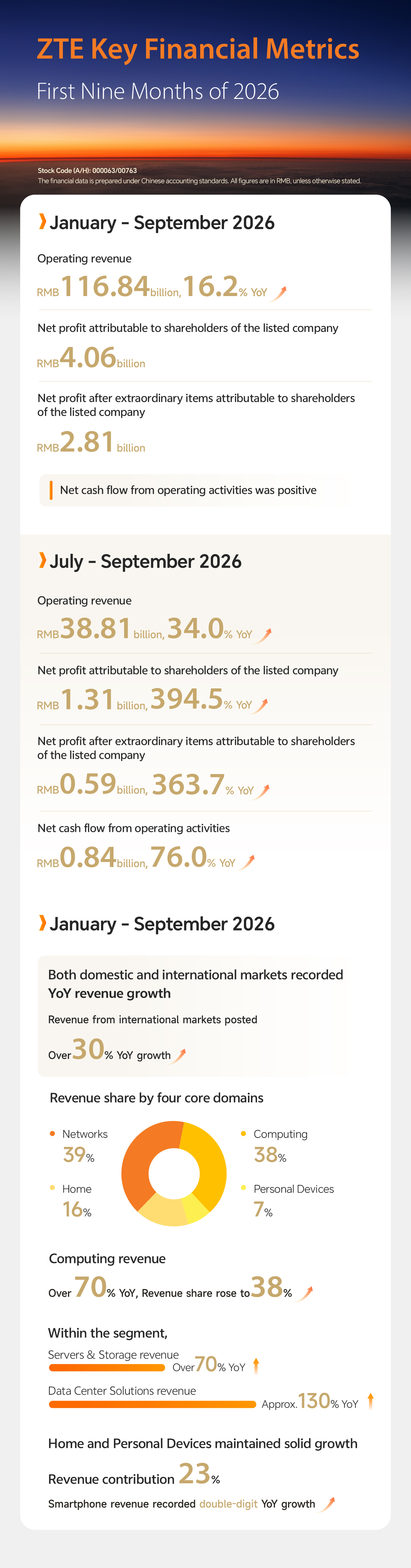
Shenzhen, China, October 26, 2026 – ZTE Corporation (0763.HK / 000063.SZ), a global leading provider of integrated information and communication technology solutions, today announced a revenue of RMB 116.84 billion in the first nine months of 2026, an increase of 16.2% year-on-year.
According to ZTE's results announcement, during the period, the net profit attributable to shareholders of the listed company reached RMB 4.06 billion, and net profit after extraordinary items attributable to shareholders of the listed company amounted to RMB 2.81 billion. Net cash flow from operating activities was positive.
In the third quarter, both operating revenue and net profit achieved year-on-year growth. Operating revenue reached RMB 38.81 billion, up 34.0% year-on-year. The net profit attributable to shareholders of the listed company reached RMB 1.31 billion, an increase of 394.5% year-on-year. Net profit after extraordinary items attributable to shareholders of the listed company reached RMB 0.59 billion, up 363.7% year-on-year. Net cash flow from operating activities totaled RMB 0.84 billion, growing 76.0% year-on-year.
Since the beginning of 2026, ZTE has remained focused on AI as a strategic priority and continued to advance its "Connectivity + Computing" strategy, working with global industry partners to build intelligent, resilient digital infrastructure for the AI era. The company has pursued coordinated development across its Networks, Computing, Home and Personal Devices, while accelerating its expansion in international markets. These efforts have further diversified the company's revenue mix and helped mitigate the impact of lower communications infrastructure investment by domestic carriers. During the first three quarters, growth in the Computing and terminal businesses, together with higher revenue from international markets, drove further expansion in the company's overall operating revenue.
The Computing business continued to gain momentum, with revenue increasing by over 70% year-on-year and its share of total revenue rising to 38%. Within the business, servers and storage revenue rose more than 70% year-on-year, while data center solutions revenue increased by nearly 130% year-on-year. Home and Personal Devices maintained solid growth, collectively contributing 23% of total revenue. Both domestic and international markets recorded year-on-year revenue growth. Revenue from international markets grew by over 30% year-on-year, supported by ongoing 5G deployments, fiber network upgrades, and rising demand for AI computing infrastructure, as well as closer collaboration with Chinese enterprises in their global operations.
On the profitability front, the company's gross margin remained under pressure due to shifts in industry cycles and changes in its business mix. In response, ZTE continued to focus on its core business areas and pursue breakthroughs in key technologies, while further strengthening expense discipline. The net profit attributable to shareholders of the listed company posted strong year-on-year growth in the third quarter.
As the AI industry accelerates its shift toward inference, competition is increasingly moving from scaling raw computing capacity to optimizing end-to-end token efficiency. Leveraging its end-to-end, full-stack AI capabilities, ZTE delivers AI infrastructure solutions designed to optimize TCO through compute-network synergy and system-level optimization, enabling higher effective inference performance at a lower cost per token. These capabilities help AI factories shift from simply scaling computing capacity to improving effective inference output and overall system efficiency.
For Networks, ZTE continues to lead in 5G, core networks, optical transport and fixed broadband technologies. To meet the evolving connectivity requirements of the AI era, the company is accelerating the integration of AI and networks and advancing the development of next-generation communications networks.
As 6G moves toward commercialization, ZTE is drawing on its integrated capabilities across standards, chipsets, architectures and algorithms to develop a comprehensive portfolio of core 6G technologies, guided by two strategic priorities: the deep integration of 6G and AI, and the integration of space and terrestrial networks. The company has accumulated more than 5,000 core 6G patents and continues to advance technological innovation, validation of key technologies and ecosystem collaboration. These efforts further strengthen ZTE's long-term competitive advantage in network evolution.
For Computing, large-scale AI computing clusters are rapidly scaling to tens of thousands and even more than 100,000 accelerators. Leveraging an open, decoupled and elastic architecture, ZTE enables flexible scaling and system-level coordination, helping customers build AI factories optimized for TCO throughout their lifecycle.
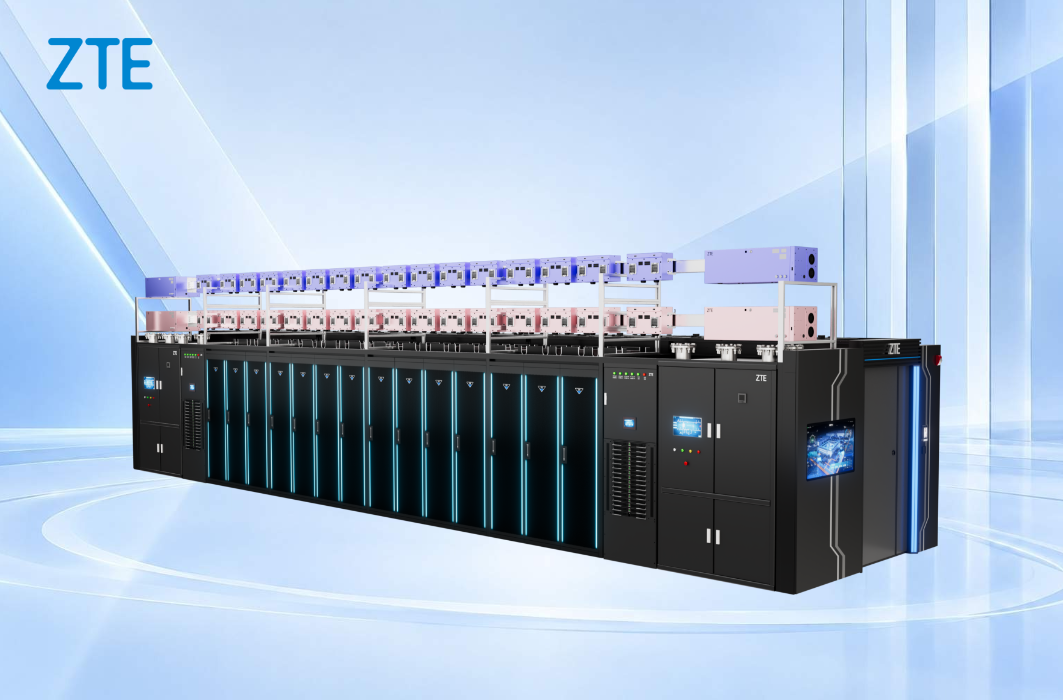
ZTE continues to advance R&D in critical core technologies, with multiple self-developed chips already deployed commercially at scale. The OEX SuperPod features an orthogonal, backplane-free interconnect architecture that supports multi-chip coordination. A single system can accommodate up to 128 GPUs, while clusters support elastic scaling to the 100,000-GPU scale. For high-density AI computing scenarios, ZTE has developed an energy-efficient AIDC solution featuring compute-power synergy and source-grid-load-storage integration, enabling unified orchestration of computing, power and thermal resources.
ZTE's computing products have achieved broader deployment and increased market share across China's internet, financial services, power and public sectors. The company is also working more closely with Chinese enterprises with global operations, including internet companies and leading manufacturers, to serve growing demand in emerging markets.
In the Home and Personal Devices domains, ZTE continues to advance the intelligent transformation of its product portfolio and expand into new use cases, capturing opportunities as AI reshapes the device market.
For Home, ZTE follows a three-pillar strategy: connectivity as the foundation, AI at the core, and screens as the interface. Connectivity provides a reliable, high-performance whole-home network foundation; AI serves as the intelligence core across devices and services; and screens act as key interfaces through which users access intelligent home services. Building on this framework, ZTE offers a portfolio of AI smart displays, AI set-top boxes and IP cameras that supports a range of home scenarios, including entertainment, health and wellness, security and family care.
Shipments of ZTE's home terminal products exceeded 100 million units for the second consecutive year, while the company maintained the world's No. 1 market share for the fifth consecutive year. ZTE also ranked No. 1 globally in Wi-Fi 7 product shipments. Cumulative shipments of its FTTR products exceeded 40 million units, while cumulative shipments of its AI smart displays surpassed four million units, ranking first among proprietary brands in China's carrier market. The company further strengthened its position in the online router market, with its market share on JD.com rising to 17%.
For Personal Devices, ZTE is accelerating the development and commercialization of AI agent-powered devices. The nubia NaviX Ultra, the world's first AI agent smartphone, has officially gone on sale. It features the Doubao Mobile Assistant, built on a system-level agent architecture to support a shift from conventional app-by-app interaction toward agent-assisted task execution under user authorization. The device represents ZTE's latest exploration of the core capabilities of AI agent smartphones and new models of human-device interaction, helping pioneer the emerging AI agent smartphone category. ZTE will continue to enhance the capabilities and user experience of its AI agent smartphones, with user security and privacy protection as foundational priorities. The company will accelerate the adoption of AI across personal devices at scale, advance the commercialization of AI agent smartphones, and make the benefits of AI accessible to a broader range of users.
In international markets, ZTE launched the nubia Neo 5 GT Special Edition, featuring a dual active air-and-liquid cooling system, as well as the nubia Neo 5 Max, a new large-screen PadPhone form factor. The Neo 5 series continued to gain strong traction in gaming markets across Southeast Asia and Latin America.
In mobile internet products, ZTE maintained the No. 1 global market share in 5G FWA & MBB for the fifth consecutive year. In China, the company introduced TOPFLOW, a purpose-built solution for professional livestreaming, and launched its new U15 series of portable Wi-Fi devices, integrating power-bank functionality to enhance connectivity and convenience in outdoor scenarios. In international markets, global sales of the U10 series of portable Wi-Fi devices exceeded three million units.
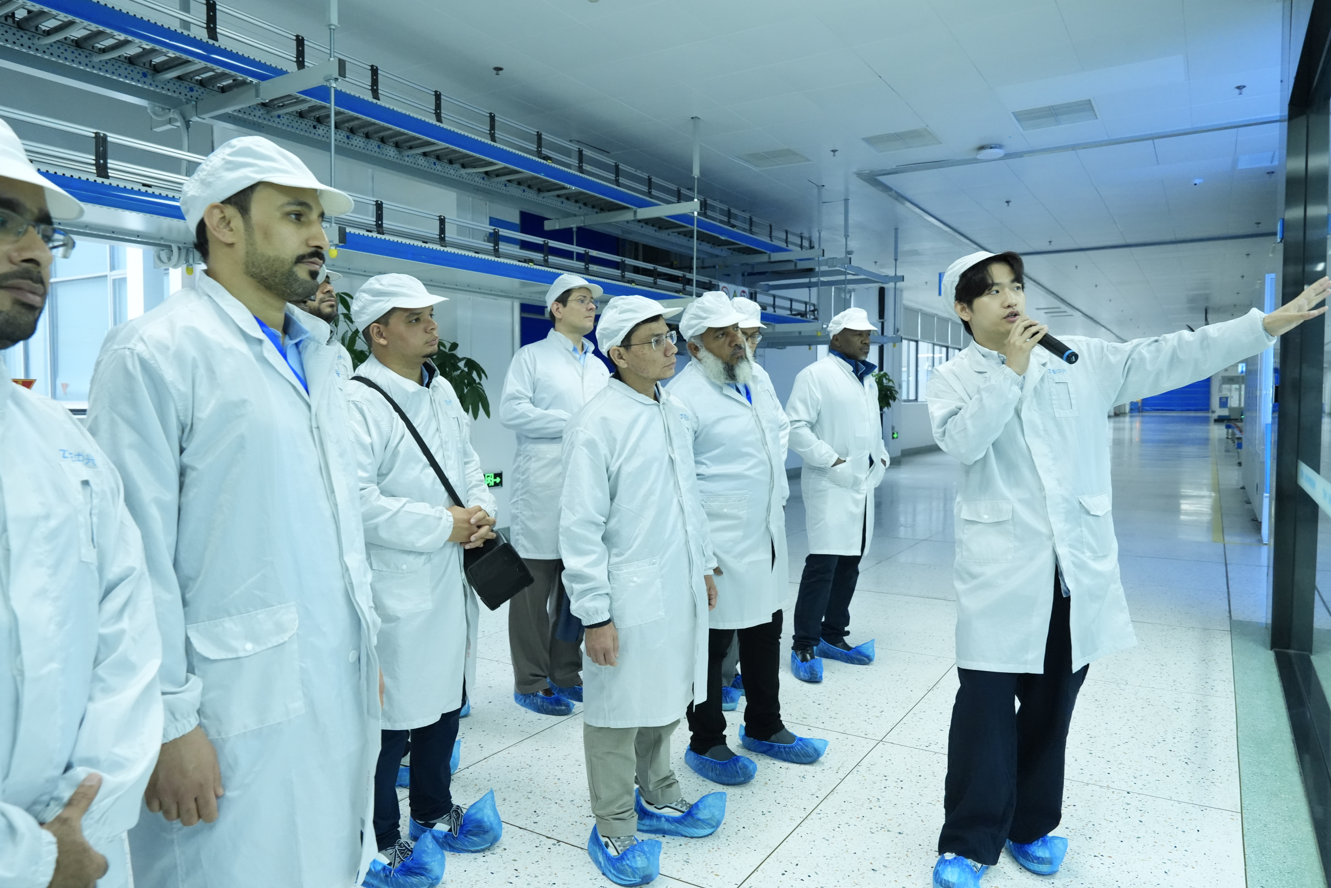
As an early mover in "AI + Manufacturing", ZTE draws on its five smart manufacturing bases to advance intelligent, green and integrated manufacturing, while enhancing collaboration across its manufacturing and supply chains. Powered by multi-agent collaboration, the company has developed 25 representative use cases in advanced manufacturing.
ZTE also shares the resources and expertise of its benchmark factories and delivers integrated smart manufacturing solutions to external customers. To date, the company has supported more than 60 leading enterprises across industries and delivered over 100 intelligent transformation projects. The company was recognized with the 2026 Ram Charan Management Practice Award for AI Application Practice.
Among these initiatives, ZTE's Nanjing Binjiang Factory has entered a new phase of "Smart Binjiang", centered on an industrial large model and the Co-Claw enterprise-grade AI agent platform. More than 80 AI agents have been deployed across end-to-end manufacturing and operational management processes, enabling a shift from human-issued instructions toward agents capable of sensing, analyzing, making decisions, executing tasks and continuously optimizing operations.
Looking ahead, the global ICT industry will continue to present both opportunities and challenges. ZTE will remain focused on AI as a strategic priority and further advance its "Connectivity + Computing" strategy. Leveraging its end-to-end, full-stack capabilities and partnerships across the global ecosystem, the company will continue to build intelligent and resilient digital infrastructure that is secure, reliable and optimized for TCO.
Together with industry partners, ZTE will foster an efficient, inclusive and sustainable AI computing ecosystem, unlock the value of AI Tokens at scale, and enable intelligent transformation across industries, supporting the high-quality growth of the digital economy.