ZTE and Industry Partners Drive L4 Autonomous Networks at MWC 2026, Pioneering the Era of Agentic AI in Network Operations
- Share:
-


-


-


- ZTE, together with industry partners, advanced the commercialization of L4 highly autonomous networks through Agentic AI
- ZTE unveiled the "2026 Autonomous Networks White Paper", enabling end-to-end intelligent operations via the Agentic AI architecture powered by large models, agents and digital twins
Barcelona, Spain, March 5, 2026 - ZTE Corporation (0763.HK / 000063.SZ), a global leading provider of information and communication technology solutions, successfully hosted the roundtable forum on "Agentic AI for Highly Autonomous Network Operations" at MWC Barcelona 2026, with participation from industry partners including TM Forum and Telenor, advancing toward L4 highly autonomous networks and accelerating the shift from pilots to large-scale deployment.
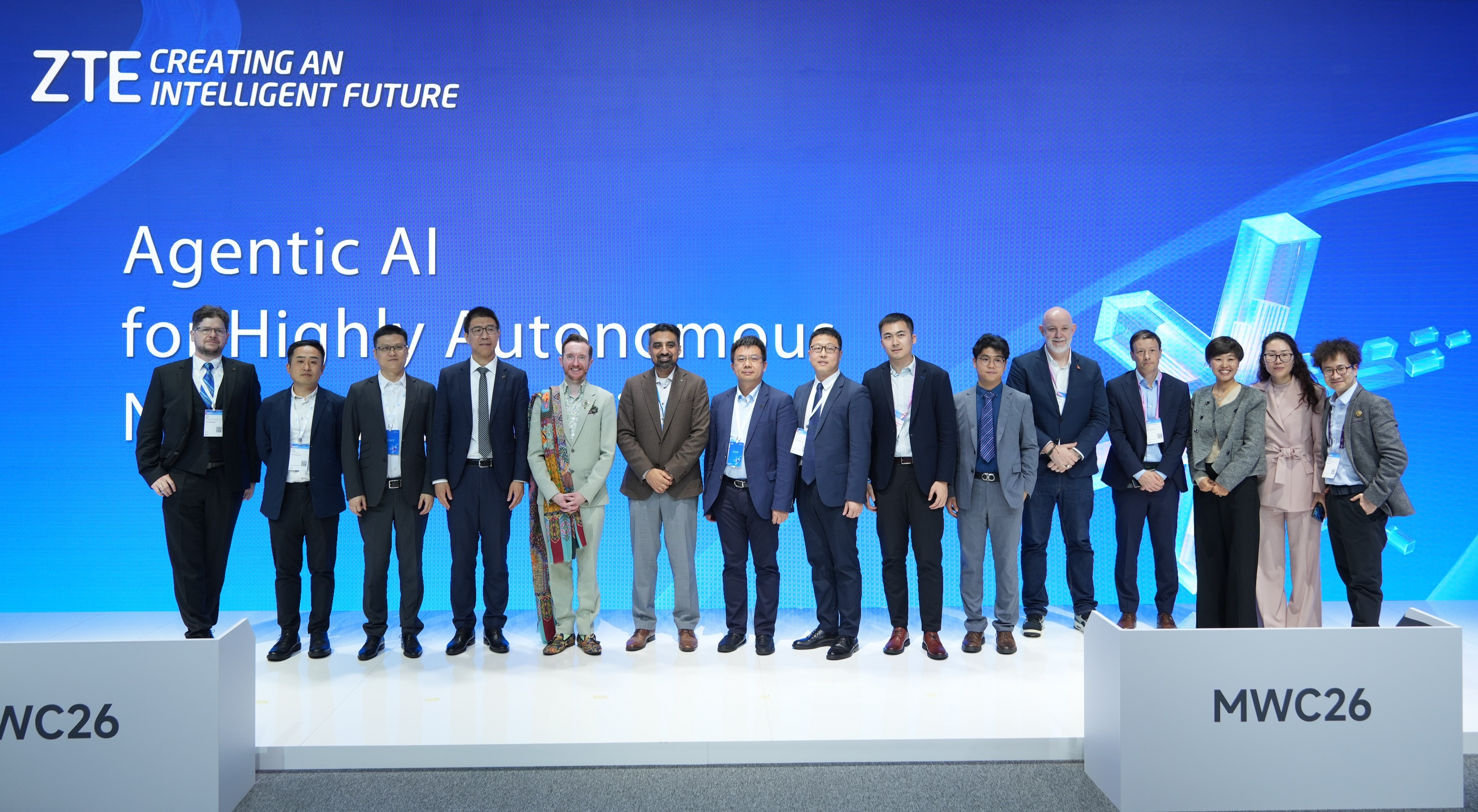
In 2025, industry-wide collaboration drove significant progress in L4 autonomous networks, advancing standards development, architecture design, and key scenarios implementation. The technical feasibility of the L3-to-L4 transition, particularly closed-loop operations, has been verified. Entering 2026, global operators are entering a critical phase of L4 deployment, marking a pivotal shift from operational efficiency to value-driven outcomes in user experience, business agility, and commercial growth.
Aaron Boasman-Patel, Vice President of TM Forum, emphasized growing industry consensus: standardization and open architecture are essential for scaling Agentic AI. Only through unified interface specifications, evaluation frameworks, and trusted collaboration mechanisms can technical and ecosystem barriers be overcome, enabling seamless multi-vendor integration.
Afnan Ahmed, Director of Technology Strategy and Architecture at Telenor, emphasized the importance of standardized autonomous network rating levels, stating, "The true value must be validated and demonstrated through real-world network implementations underpinned by a standardized rating system." Sharing insights from Bangladesh project, he highlighted how collaboration with partners has driven the evolution of the O&M model from AI-assisted to autonomous decision-making. This shift has significantly improved efficiency and established a strong foundation for progressing toward highly network autonomy.
Dai Yanbin, Deputy General Manager of Data Intelligence and Service Products at ZTE, stated: "Scaling is about lowering interconnection barriers and enabling replicable closed loops." To this end, ZTE is actively collaborating with industry partners to advance the A2A-T protocol, establishing a unified multi-agent collaboration framework that enhances efficiency, reliability, and security in intelligent operations, and fosters a sustainable, evolving ecosystem.
ZTE officially released the 2026 Autonomous Network White Paper, outlining a clear industrial roadmap and introducing its advanced AIR Net solution. Centered on "value-driven, intrinsic intelligence, autonomous decision-making, and automated closure", the solution integrates large models, intelligent agents, and digital twins to deliver three core upgrades:
· Architecture Evolution: Building a new Agentic AI architecture powered by data engines, AI large model engines, and digital twin engines, enabling intelligent agent deployment across network elements, networks, and services. It achieves deep integration of networking and AI, combines edge-level autonomy with global coordination, and drives autonomous network evolution and business closure.
· Capability Deepening: Upgrade intelligent hardware capabilities at the network element level to enable real-time sensing and remote control. Leverage the A2A-T protocol within the Agentic AI architecture to enhance single agent autonomy and enable seamless multi-agent collaboration, supporting cross-domain and cross-layer orchestration. By integrating large models, knowledge graphs, and digital twins, AIR Net builds an end-to-end intelligent chain, achieving full autonomy in fault management, network optimization, and user experience assurance.
· Value Reconfiguration: It enables a comprehensive value-effectiveness closed loop, connecting Key Performance Indicator (KPI) to Key Business Indicator (KBI), Key Effectiveness Indicator (KEI), and Key Capability Indicator (KCI). Through full-stack AI and process reshaped, it ultimately achieves end-to-end, work order-free network operations, accelerating the monetization in 5G-Advanced, industrial internet, and emerging verticals.
Powered by the "1+N Model Matrix" and the "Co-Sight 2.0 Intelligent Agent Factory", AIR Net has developed two categories of industrial-grade intelligent agents: copilot-type and expert-type, possessing productivity upgrade for mass-producibility, controllability, and value-addability. It has achieved benchmark deployment of 21 L4 autonomous network scenarios.
Going forward, ZTE will deepen strategic collaborations with industry partners to scale L4 autonomous networks and co-create an open, intelligent ecosystem for the future of telecom.
For "ZTE Autonomous Networks White Paper", please kindly download here.


.png)

.png)

.png)

.png)