ZTE and China Telecom Unveil DGN Innovation Solution to Forge Differentiated Connectivity Foundation for Mobile AI Era
- Share:
-


-


-


- ZTE and China Telecom jointly release DGN (Differentiation-driven Generative Network), marking a key pillar and milestone leap toward the Full-Scenario Intelligent Network
- DGN integrates native intelligence and multi-user distributed MIMO technology, efficiently delivering guaranteed differentiated connectivity experiences for both consumer and industrial users, and laying a solid network foundation for the development of multi-modal AI services
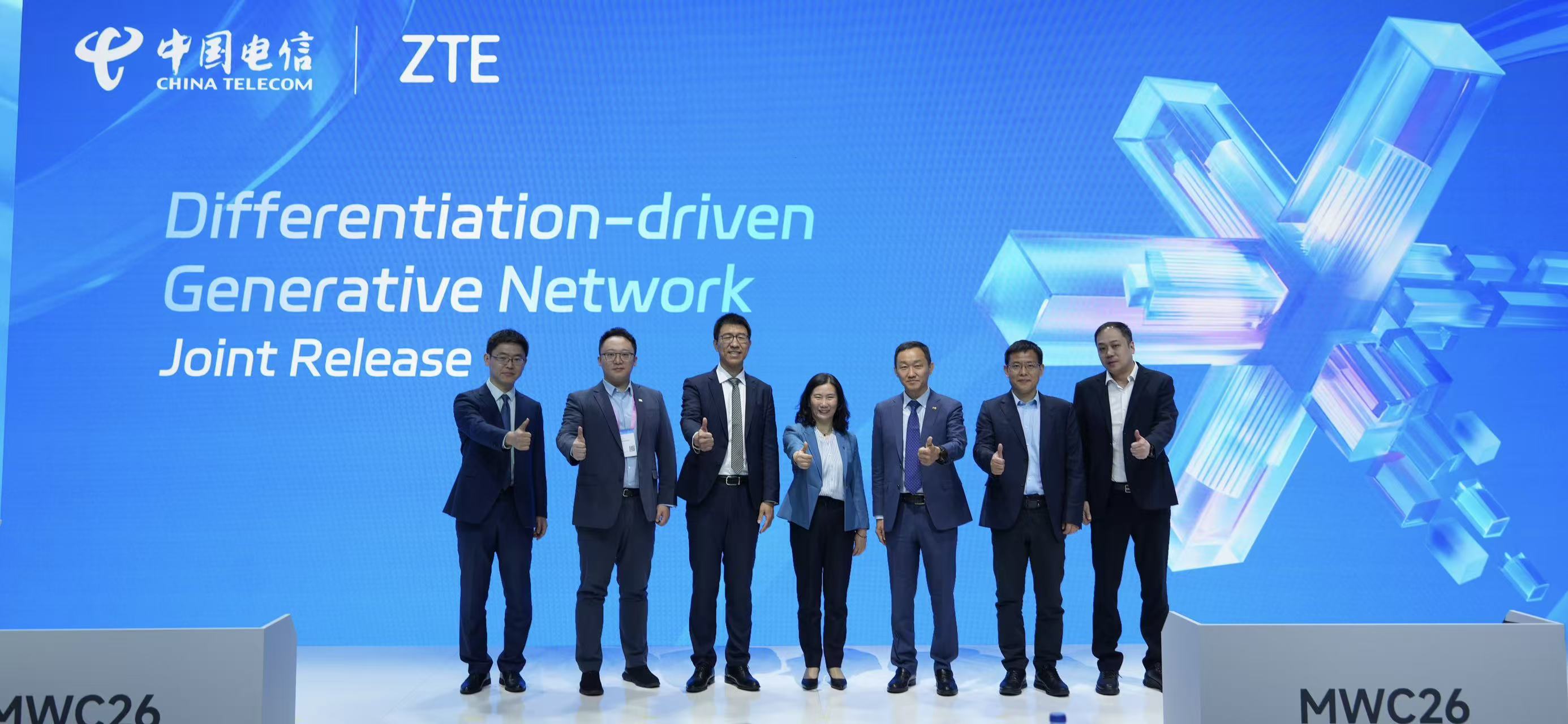
Barcelona, Spain, March 9, 2026 - ZTE Corporation (0763.HK / 000063.SZ), a global leading provider of integrated information and communication technology solutions, in partnership with China Telecom, has released an AI powered 5G-Adavanced solution, the Differentiation-driven Generative Network (DGN) solution, at MWC Barcelona 2026. DGN efficiently ensures differentiated connectivity experiences for both consumer and industrial users, laying a solid network foundation for the advancement of multi-modal AI services.
As the mobile AI era accelerates, business scenarios become increasingly diversified, experience demands grow more segmented, and network traffic surges. 5G networks are facing dual challenges of consistent user experience and capacity improvement. Multi-modal applications such as AI glasses, cloud gaming, and embodied intelligence impose higher diversified requirements on network latency and uplink/downlink rates. Meanwhile, performance pressure in cellular overlapping areas and network edges becomes prominent. Traditional capacity expansion methods including site adding and carrier deployment feature high costs and long cycles, failing to match the rapidly growing demand for differentiated connectivity.
Huang Lilian, General Manager of Network department and Sharing Department of China Telecom, stated that the accelerated integration of AI and 5G-A has opened a new chapter of high-quality development for operators. The development of multi-modal AI services not only brings dual challenges to mobile network services and capacity, but also creates a historic opportunity for intelligent network upgrading. China Telecom and ZTE have continuously deepened the "AI+" strategy, committing to jointly build a self-evolving "full-scenario intelligent" network. The UGN solution jointly released in 2025 serves as an important cornerstone in this evolution, enabling a user-centric leap in network capabilities, breaking through performance bottlenecks at cellular boundaries, and ensuring consistent user experience. The launch of the DGN solution marks a key support and milestone leap towards the "full-scenario intelligent" network. In the future, the two parties will further advance and expand cooperation to comprehensively enhance 5G-A network capabilities, building an accessible intelligent foundation for the mobile AI era.
Zhang Wanchun, Senior Vice President of ZTE, introduced that the in-depth integration of 5G and AI is reshaping the global industrial landscape. The UGN solution launched by both parties in 2025, as the first chapter of the "full-scenario intelligent" solution series, ushered in a new era of deep integration between communications and intelligence. The newly released DGN solution is the second important chapter of the series. With breakthroughs in key algorithms for multi-cell radio resource orchestration and joint signal processing, it fully taps the potential of existing network resources, achieves optimal allocation of resource utilization efficiency, and precisely matches the diversified service demands of all scenarios. ZTE will continue to work with China Telecom and global industrial partners to deepen core technologies, break through key bottlenecks, and empower industrial upgrading through innovation.
The DGN solution achieves network quality and efficiency improvement through two core technological breakthroughs. First, intelligent collaboration of time-frequency-space multi-dimensional resources: relying on multi-cell and multi-user joint scheduling technology, combined with spatio-temporal service profiling, it realizes millisecond-level time-frequency-space resource allocation to precisely adapt to service differences and dynamic traffic changes. Second, multi-cell joint signal processing: through uplink and downlink multi-cell joint processing technology paired with a distributed native intelligence architecture, it greatly improves spectrum efficiency and network capacity.
At present, the DGN solution has completed field verification in the Yangtze River Delta region including Zhejiang and Shanghai, achieving remarkable results in all scenario tests. Under the premise of unchanged network resources, spectrum efficiency is increased by 21.5% and network capacity by over 20%. In service applications, the DGN solution effectively breaks through network bottlenecks for multi-modal applications: interaction response of AI smartphones is accelerated by 50%, human-machine collaboration for intelligent industrial inspection via AI glasses becomes smoother, page latency of cloud gaming is reduced by 43%, and fluency of 1080P HD video is improved by 68.45%, efficiently meeting diversified connectivity demands in various scenarios.
Looking ahead, ZTE and China Telecom will join hands with global industrial partners to promote technological innovation and industrial collaboration, continuously improve the "full-scenario intelligent" network system, enhance the differentiated services and large-capacity connectivity capabilities of 5G-A networks, build a solid communication foundation for intelligent life and intelligent production, and jointly create a smarter future.


.png)

.png)

.png)

.png)