Language
ZTE AIR RAN: Building Mobile Infrastructure for the AI Era
Release Date:2026-01-22
By Gu Jun
The rapid evolution of generative AI (GenAI) and the democratization of AI applications are accelerating the transition from the mobile Internet Era to the mobile AI Era. The deep integration of AI with 5G and 5G-Advanced (5G-A) has become the core driver for industrial transformation and societal development.
Aligning with this trend, ZTE has proposed a strategic transformation “From Connection to Connection + AI.” This strategy is embodied in the AI reshaped solution (AIR Solution)—an integrated suite comprising AIR RAN, AIR Core, and AIR Net. This solution builds a new generation of mobile infrastructure centered on an AI-native architecture and end-to-end intelligent agent collaboration. This article focuses on the technical innovations and application practices of the AIR RAN solution, exploring its future potential driven by the synergy between network agents and service agents, and demonstrating its core value in reshaping mobile infrastructure for the AI era.
AIR RAN: Unlocking Three Core Values with Dual-Brain Intelligence
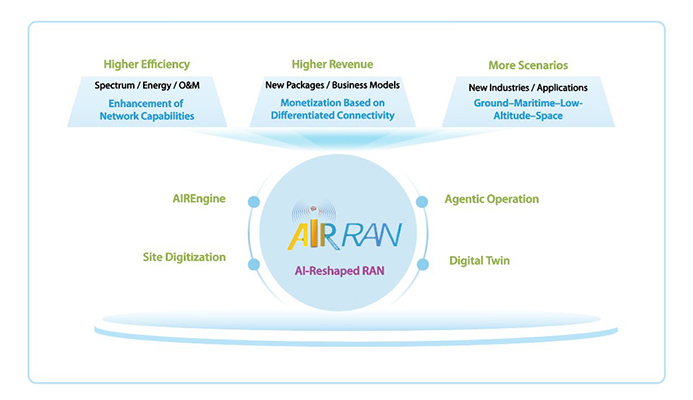
ZTE’s AIR RAN solution centers on the deep fusion of AI and the radio access network (RAN), dedicated to creating an intelligent, digitalized mobile access infrastructure. The solution leverages a dual-layer intelligent architecture—comprising the Site Infrastructure Layer and the Network Service Layer—integrated with a "dual-brain" collaboration model. This continuous evolution provides comprehensive support for enhancing network efficiency, optimizing service experiences, and expanding application scenarios.
Site Infrastructure Layer: Continuous Breakthroughs in Digitalization
At the site layer, AIR RAN reshapes traditional wireless sites using AI, driving the digital and intelligent transformation of hardware across the board. Digitized hardware eliminates data blind spots, providing a solid foundation for intelligent applications through high-precision data acquisition.
Simultaneously, ZTE has introduced the intelligent computing board as the site's smart engine, providing computational support for localized AI inference and real-time decision-making. The synergistic upgrade of sensing and computing capabilities significantly elevates the intelligence level of the site.
ZTE has accumulated a portfolio of leading technologies and products in the field of AI and RAN integration. The industry's first NodeEngine computing base station achieved a breakthrough in endogenous base station computing power. This was followed by the UniEngine all-scenario hyper-converged device and the AIREngine base station intelligent computing engine, which further deepened the application of AI at the base station and enhanced adaptability across diverse scenarios. These innovations have set a benchmark for the industry in AI and RAN integration.
Network Operation Layer: A Paradigm Shift to Autonomous Services
At the network layer, AIR RAN utilizes AI to drive a paradigm shift in wireless network operations and maintenance (O&M), moving from a "machine-assisted human" model to a "human-assisted machine" model, also known as agentic operations.
The network agent serves as a new service entry point, reshaping mobile network services through multimodal human-machine interaction, autonomous multi-objective strategy planning, and autonomous multi-agent collaboration. To overcome the costs and risks associated with trial-and-error strategy iteration in physical networks, digital twin technology establishes a precise mapping between the physical and digital worlds, enhancing the accuracy and efficiency of network decision-making.
Based on this digital-intelligent foundation, AIR RAN is dedicated to realizing three core values:
- Network efficiency enhancement: Optimizing spectral efficiency, energy efficiency, and O&M efficiency through intelligent technologies.
- Service experience optimization: Boosting average revenue per user (ARPU) through differentiated experience assurance.
- Scenario expansion & innovation: Supporting new applications such as AI agents and embodied AI, spanning multi-dimensional scenarios across ground, water, low-altitude, and space.
Unleashing Potential in Three Dimensions: AIR RAN’s Scenario Exploration
Focused on real-world scenarios and value creation, AIR RAN has carried out extensive practices across network efficiency, service experience, and scenario expansion, demonstrating the immense potential of AI-driven mobile infrastructure.
Network Efficiency: A Comprehensive Upgrade in Energy, O&M, and Spectrum
In terms of network efficiency, AIR RAN focuses on three major objectives: maximizing energy savings without compromising experience, improving quality and efficiency using large language models (LLMs) and multi-agent systems, and enabling "soft expansion" where the network follows service demand.
- Energy efficiency upgrade: The intelligent energy-saving solution employs a dual-layer computing synergy between the network management LLM and the base station small model, forming a closed loop for traffic prediction, strategy optimization, and performance evaluation. The solution dynamically adjusts energy-saving parameters to balance performance and efficiency. In live deployments, this approach significantly extended the activation time of energy-saving strategies, reducing daily network power consumption by approximately 15%. This translates into substantial cost savings while ensuring a high-quality user experience, serving as a reference for sustainable development.
- O&M efficiency upgrade: AIR RAN reshapes the O&M paradigm through the enhancement of base station intelligence, intelligent upgrades of operation and maintenance center (OMC), and the collaborative application of telecom LLMs. Technologies involving multi-agent collaboration and "large + small model" synergy significantly improve fault diagnosis and resolution. For instance, through hazard identification, alarm correlation, and root cause diagnosis, the system quickly pinpoints issues and generates work orders, allowing personnel to access analysis results directly. LLM-powered troubleshooting agents further assist in handling complex faults through multi-turn dialogue and multi-modal analysis, reducing the mean time to repair (MTTR) by approximately 20%. In optical module quality assessment scenarios, hazard identification capabilities drastically reduce alarm volume, significantly enhancing network stability.
- Spectrum efficiency upgrade: Addressing the continuous growth in mobile capacity demand, AIR RAN overcomes the technical bottleneck of traditional FMM SSCG (Sector Split), which was limited to a maximum of four cells, by increasing the number of split cells to six, while supporting adaptive intelligent adjustment. Compared to traditional 4T macro sites, the 6-cell solution delivers a capacity gain of up to 4.6 times, significantly boosting spectral efficiency and network carrying capacity to provide robust support for high-traffic scenarios.
Service Experience: Differentiated Assurance for Commercial Value Growth
Differentiated experience assurance is key for operators transitioning from traffic monetization to experience monetization. AIR RAN leverages AIREngine's service sensing, network insight, and intelligent resource allocation capabilities to help operators launch customized 5G packages.
For example, in scenarios like live video streaming and cloud gaming, AIREngine significantly improves user experience through precise bandwidth allocation and latency optimization. In real-world applications, video users saw increased uplink/downlink throughput, and gaming users experienced reduced latency. This led to a package conversion rate of 20%, effectively driving sales of new 5G plans. This end-to-end experience assurance scheme has become a critical path for operators to realize network monetization.
Scenario Expansion: Intelligence Across Diverse Environments
The combination of AI and 5G/5G-A is extending mobile networks beyond the ground to water environments, low-altitude airspace, and even space.
- Ground: 5G and AI synergy facilitates the digital upgrade of B2B scenarios, bringing deterministic assurance capabilities into core production areas.
- Water & low-altitude: AI combined with integrated sensing and communication (ISAC) technology achieves precise target recognition, laying the foundation for the "low-altitude intelligent IoT" and "water intelligent IoT," and catalyzing innovative applications like drone delivery and low-altitude security.
- Space: Digital twin technology can precisely simulate space environments to support the planning and operation of satellite networks, guaranteeing ubiquitous intelligent services.
Dual-Domain Symbiosis: Building an Integrated Network–Service Growth Engine
The arrival of the mobile AI era is driving a transformation in business models from app-based entry points to AI agents. Service agents are generally categorized into two types: terminal-based "digital assistants" and entity-based "embodied AI."
Digital assistants facilitate intent-driven interaction via voice commands, simplifying user operations; embodied AI performs complex tasks through physical entities like robots in industrial manufacturing and healthcare. These service agents impose more diverse requirements on the network, such as high uplink bandwidth and low latency, further driving the evolution of the network agent service paradigm.
ZTE creates generative network services centered around service agents through its "experience assurance agent" technology, combining intent understanding, service recognition, and strategy generation. This paradigm shifts from traditional rule-based deterministic services to dynamic, on-demand response services, effectively supporting scenarios like smart travel for digital assistants and object recognition for embodied AI. Through collaboration between network agents and service agents, AIR RAN autonomously enhances uplink experience and reduces air interface latency, providing solid support for the ubiquity of intelligent applications.
ZTE’s AIR RAN solution is not only a milestone in the evolution of mobile network technology but also a strategic cornerstone for mobile infrastructure in the AI era. Looking ahead, ZTE will continue to work with industry partners to deepen the integration and innovation of AI and 5G/5G-A, driving the collaborative evolution of network agents and service agents.
Technologically, ZTE will continuously optimize the AI-native architecture to enhance the intelligence of the compute-network convergence agents. In terms of applications, ZTE will expand into emerging scenarios such as the low-altitude economy, water monitoring, and satellite communications. Ecologically, ZTE aims to build an open and cooperative innovation ecosystem, working with partners to create an intelligent and inclusive future.

.png)

.png)

.png)

.png)