ZTE HI-OTN Achievements Earn Dual Top-Scored Paper Recognition at OFC 2026
- Share:
-


-


-


- At OFC 2026, ZTE achieved dual recognition for its breakthroughs in both a real-time 1.2 Tb/s S-band silicon photonics transceiver and long-haul multi-AIDC LLM training field trials, as both received Top-Scored Paper honors, an award granted to the top 10% of submissions
- These achievements are advancing next-generation optical networks by reinforcing ZTE’s HI-OTN solution as a foundation for ultra-wide spectrum transmission and distributed intelligent computing, which drives the development of efficient, green, and intelligent infrastructure

Los Angeles, America, March 20, 2026 - ZTE Corporation (0763.HK / 000063.SZ), a global leading provider of integrated information and communication technology solutions, announced today that it has made significant progress in optical network research. Two core papers have been selected as Top-Scored Papers at the Optical Fiber Communication Conference and Exhibition (OFC) 2026 in the United States, an honor granted only to the top 10% of accepted submissions. These two research achievements respectively demonstrate the industry's highest-speed real-time S-band silicon photonics coherent transceiver and large language model training across multiple AI data centers (AIDCs) over long-haul optical networks, validated in real-world field trials. Together, they mark ZTE's dual breakthroughs at the forefront of exploring ultra-wide spectrum transmission and supporting distributed intelligent computing in core optical network technologies.
At OFC 2026, the world's largest and most influential event in the optical communications industry, more than 16,700 professionals and over 700 enterprises gathered to showcase cutting-edge innovations across the full optical ecosystem. The Top-Scored Paper distinction is conferred following rigorous evaluation by the OFC Technical Committee, recognizing contributions with outstanding innovation, technical depth, experimental validation, and industry impact.
In the digital era, emerging applications such as generative AI model training and inference are accelerating the evolution of optical networks toward higher speed, larger capacity, longer reach, and lower latency. To address industry challenges and enhance resource utilization and service orchestration, ZTE pioneered the HI-OTN solution and has successfully deployed the industry's first commercial C+L 12 THz integrated scheduling optical transmission system, laying a solid foundation for both cutting-edge research and real-world implementation. The two papers selected as Top-Scored Papers at OFC 2026 represent important outcomes of ZTE's continued deep engagement in core optical network technologies.
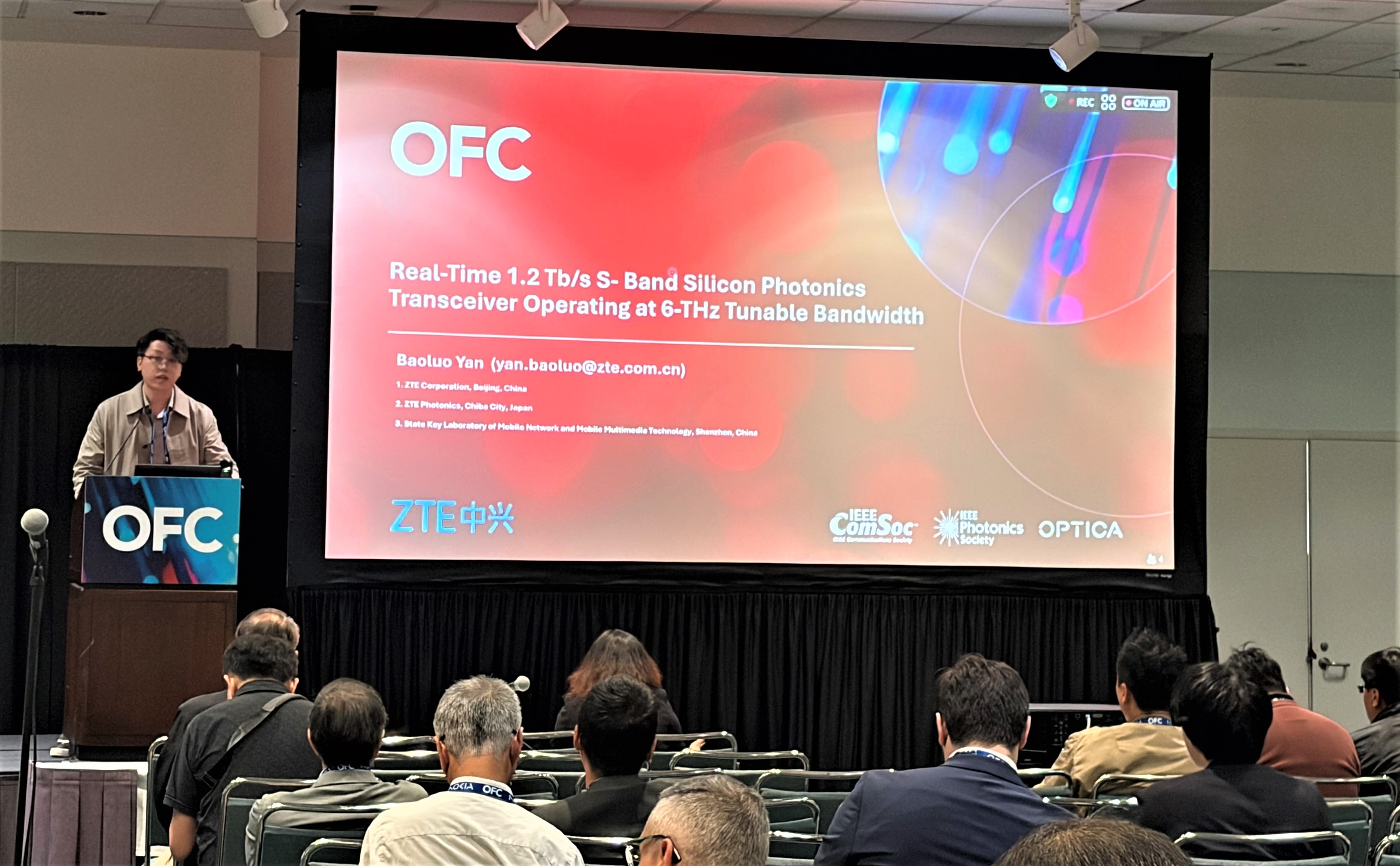
The paper entitled Real-Time 1.2 Tb/s S-Band Silicon Photonics Transceiver Operating at 6-THz Tunable Bandwidth achieved three major technical breakthroughs. First, it developed the industry's first real-time coherent transceiver in the S-band, setting a record speed of 1.2 Tb/s. Second, by leveraging the wavelength-insensitive characteristics of silicon photonics (SIPh) transceivers, it enabled compatibility between the S-band and C+L bands, overcoming the limitations of traditional spectral transmission. Third, ZTE independently designed and nano-packaged an S-band Integrated Tunable Laser Assembly (ITLA), which delivers 17.5 dBm output power across a 6.4 THz bandwidth with a linewidth below 30 kHz, ensuring high-quality signal transmission. The nano-packaged ITLA can be flexibly integrated into mainstream coherent optical modules such as Octal Small Form Factor Pluggable (OSFP) and C Form-factor Pluggable 2 (CFP2). Ultimately, the demonstration of the 6 THz real-time coherent transceiver in the S-band achieved signal quality comparable to existing C/L-band systems under unrepeatered transmission conditions. This achievement breaks through long-standing spectral bottlenecks and provides core technical support for the large-scale application of ultra-wideband optical networks.
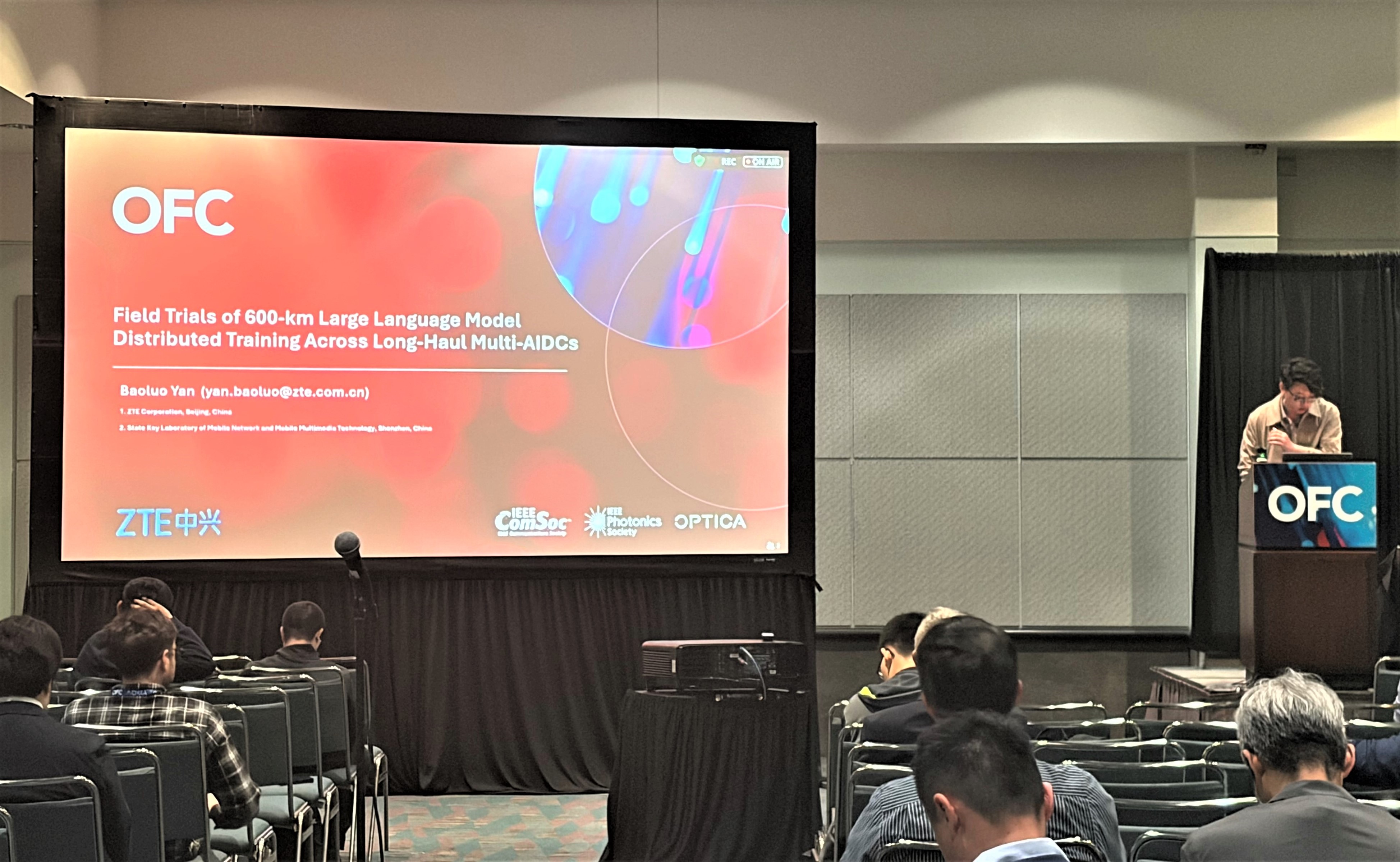
The other paper, Field Trials of 600-km Large Language Model Distributed Training Across Long-Haul Multi-AIDCs, focuses on analyzing the practical requirements of intelligent computing services in the OTN domain and addressing the challenges of cross-domain distributed AI clusters. As constraints on power supply and data center space become increasingly prominent, cross-regional distributed clusters are emerging as an industry trend. ZTE conducted real-world trials spanning three AIDCs, training the Large Language Model Meta AI 2-70B (LLaMA2-70B) with 1,024 Graphics Processing Units (GPUs). In this typical scenario, the company accurately constructed a compute transmission demand model and implemented a 16-channel 800G ultra-high-speed optical transmission solution. Through live network operation, the trials revealed the core requirements of large model training for optical network bandwidth and latency, with results confirming that long-haul transmission latency has become a key factor affecting GPU cluster efficiency. The team also evaluated the potential of hollow-core fiber, a new optical fiber technology that significantly reduces latency, and verified its ability to mitigate efficiency degradation and lower network energy consumption, providing essential data support and practical insights for the optimization of future cross-domain intelligent optical network architectures.
Winning dual Top-Scored Paper honors at OFC 2026 reflects global recognition of ZTE's core optical networking capabilities and validates its "Technology-Driven Innovation" strategy. Looking ahead, ZTE will continue to advance the industrialization of S-band optical devices and deepen research into cross-domain intelligent optical network optimization, helping to build an efficient, green, and intelligent next-generation computing infrastructure.

.jpg)


.png)

.png)

.png)

.png)