Language
Grameenphone Partners with ZTE to Launch an Agentic AI Pilot for Network Fault Management
Release Date:2026-06-05
By Ru Le
Grameenphone, a subsidiary of the multinational telecom group Telenor, is Bangladesh's largest telecom operator, with approximately 85 million subscribers and about 45 percent market share. Since March 4, 2025, ZTE has assumed full responsibility for Grameenphone's end-to-end network operations and maintenance (O&M).
Following the takeover, ZTE analyzed live network data and found that wireless network faults accounted for over 70% of all network incidents, making them the primary focus of the NOC. Consequently, both parties decided to prioritize the deployment of an autonomous network pilot targeting cross-domain and wireless fault management, with a focus on wireless cell outages and base station outages. The initiative covers more than 4,000 ZTE-managed 4G sites in the region and introduces two AI agents—the cross-domain fault expert and the wireless fault Copilot—to empower key fault management processes (Fig. 1).
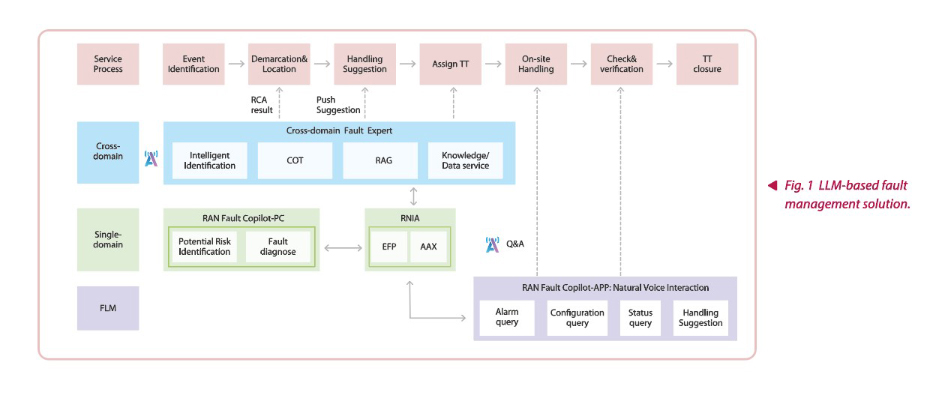
l In the fault identification phase, the cross-domain fault expert employs a hybrid large-small model architecture, where the small model handles dynamic data aggregation and the large model generates concise event summaries, enabling minute-level fault identification.
l In the root cause localization phase, the cross-domain fault expert leverages chain-of-thought (CoT) reasoning over multi-dimensional data from engineering, environment, equipment, and network management systems, constructing a knowledge graph to support root cause identification, generate fault conclusions, and autonomously infer fault propagation paths.
l In the handling recommendation phase, based on CoT reasoning, optimal fault handling recommendations are provided. For faults caused by wireless equipment, the wireless fault agent can be invoked to trigger automatic restart and recovery to achieve self-healing. For faults that cannot be self-healed, the cross-domain fault expert automatically analyzes the faults and dispatches work orders to the first-line maintenance (FLM) personnel for on-site handling.
l In the on-site operation phase, the wireless fault Copilot brings fault knowledge, backend data, and atomic capabilities to mobile devices. Upon arrival at the site, FLM personnel can use the Copilot app for real-time voice interaction and fault information queries. The Copilot presents site topology, the root cause, and corresponding solutions through multimodal visualization. After handling the fault, FLM personnel can query and verify the repair status on site, significantly reducing troubleshooting complexity, enabling one-time task completion, and improving FLM fault handling efficiency.
By embedding large model and agent capabilities into the existing network O&M system, minute-level intelligent identification of wireless cell and site service outage faults can be achieved, with fault localization and root cause analysis accuracy exceeding 90%. Through agent collaboration, manual workload is reduced, driving more efficient fault closure. The solution is expected to achieve a 70% increase in Q&A efficiency, a 3% reduction in wireless fault tickets, and a 20-minute reduction in wireless fault MTTR. Additionally, with the introduction of these two agent applications, the autonomous level of Grameenphone's wireless fault management scenario will be elevated to L3+.
At MWC 2026, Grameenphone and ZTE signed a Memorandum of Understanding (MoU) to strengthen collaboration on large-model and agent technologies aligned with TM Forum’s latest autonomous network specifications and Grameenphone’s three-year network development goals.
Looking ahead, ZTE and Grameenphone will further expand their autonomous network collaboration by leveraging the AIR Net advanced autonomous network solution to comprehensively scale up high-value scenarios in wireless network fault management. They will accelerate the deep integration of the cross-domain fault expert and wireless fault Copilot into Grameenphone’s live network O&M operations, maximizing business value for Grameenphone.
Additionally, the two parties will collaborate on other high-value autonomous network use cases, including wireless network optimization, customer complaint handling, and core network change management, deploying a series of AI agents—including network optimization experts, customer complaint experts, and core network fault experts. Leveraging the agentic AI architecture and A2A-T protocol, the collaboration will strengthen single-agent closed-loop and multi-agent collaboration capabilities to enable cross-domain and cross-layer intelligent orchestration, significantly improving network operational efficiency and ensuring optimal user experience. Meanwhile, they will jointly incubate TM Forum-related Catalyst projects to validate and promote key autonomous network technologies, providing a replicable AI-enabled blueprint for the global telecommunications industry.
Related Articles

.png)

.png)

.png)

.png)