Language
Agentic Telecom LLM: A New Driving Force for L4 Autonomous Networks
Release Date:2026-06-05
By Gao Yanqin, Du Yongsheng
AI is rapidly evolving from general-purpose generative LLMs toward agentic AI systems equipped with autonomous decision-making, environmental interaction, and multi-agent collaboration capabilities. In professional scenarios such as telecom networks, which feature strong engineering attributes, strict constraints, and closed-loop operations, agentic capabilities have become key to technology deployment and value creation.
Meanwhile, autonomous networks are transitioning from L3 to L4 autonomy. A dual-model collaborative architecture, combining agentic telecom LLMs and domain-specific structured data models, is becoming a key technical path toward L4 autonomy and self-governance.
Paradigm Shift of Autonomous Networks: Toward Agentic L4 Closed-Loop
AI systems are undergoing a profound paradigm shift from passive response to proactive execution, and from single-model inference toward multi-agent collaborative evolution (Fig. 1). Autonomous agentic AI frameworks such as Manus, Co-Sight, and OpenClaw are emerging, enabling capabilities such as goal decomposition, persistent memory, tool invocation, and environmental adaptation, marking the advent of the agentic AI era.
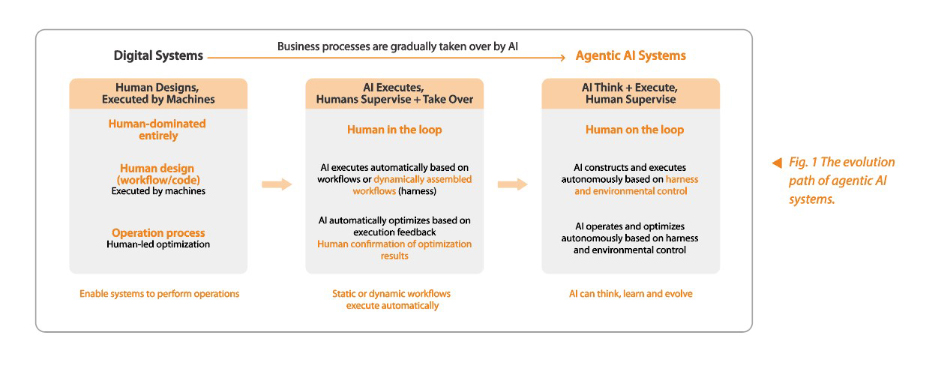
Agentic AI systems centered on LLMs and agents are also shifting from traditional object- and service-oriented design toward capability- and agent-oriented design. Under this paradigm, reusable reasoning becomes a new factor of production; iterative evolution drives intelligent growth; and collaborative interaction enables deep integration between models and real-world environments. The key challenge is to enable continuous intelligence evolution while ensuring rigorous and reliable agentic execution.
For autonomous networks to advance to L4, they must achieve unattended operation and predictive automatic closed-loop control in target task scenarios. This requires six key capabilities: autonomous perception, intelligent analysis, cross-domain decision-making, automatic execution, effect verification, and continuous evolution. Traditional LLMs can hardly satisfy both unstructured intent understanding and highly reliable structured data processing in the communications field, nor meet the requirements of low latency, high security, and lightweight deployment in production scenarios.
Therefore, agentic LLMs for communication production environments should adopt a dual-model collaborative architecture. In this framework, the agentic LLM is responsible for intent understanding, knowledge reasoning, natural interaction, and task planning, while the structured data model handles highly structured information such as network topology, KPI indicators, signaling flows, and configuration rules. Together, they form a reliable autonomous network core and provide a new paradigm for achieving the L4 generational leap.
Core Technologies of Agentic Telecom LLMs
Autonomous networks must support intent-driven policy coordination across RAN, FN/BN, Core, and cloud-edge domains, while ensuring stable convergence within minutes to hours. This requires unified cross-domain intent semantics, constrained policy solving, replayable execution traces, and KQI/KPI-based closed-loop verification. Therefore, agentic AI for autonomous network scenarios must meet strict requirements such as low cost, low latency, high reliability, easy deployment, and iterability. Under these constraints, an integrated solution is formed through lightweight design, domain-specific optimization, dual-model collaboration, and multi-agent autonomous cooperation (perception–analysis–decision–execution–verification). Combined with controllable tool-based scheduling and a continuous evolution mechanism, it supports the practical engineering deployment of L4 autonomous network capabilities.
Key technologies of agentic telecom LLMs include:
- Autonomous agent planning for communication scenarios
Decompose tasks based on communication protocols, signaling, and O&M processes, supporting a closed loop of perception–decision–execution–feedback and the autonomous generation of execution logic for NE interaction, scheduling, and fault handling.
- Multi-agent communication and collaboration
Define standardized communication interfaces and negotiation mechanisms for cross-domain and cross-NE agents, supporting task division, state synchronization, and resource scheduling.
- Agent-based communication context awareness and memory
Perceive network status, session links, and topology in real time, support both short-term session memory and long-term experience accumulation, and adapt to continuous communication sessions and dynamic scheduling requirements.
- In-depth integration of telecommunication domain knowledge
Incorporate communication protocols, 5G/6G architecture, O&M specifications, and signaling flows to construct high-quality annotated data and domain knowledge.
- Trustworthiness, controllability, security, and compliance
Establish agent communication authentication, data encryption, and behavior auditing mechanisms to meet telecom security, privacy, and regulatory requirements.
- End-edge-cloud collaborative deployment architecture
Adapt to the telecommunication network architecture, with cloud-based training and iteration, as well as lightweight inference locally or at the edge, balancing model capability with deployment resource constraints.
- Scenario-based closed-loop iteration
Continuously improve task execution in real-world scenarios such as intelligent O&M, agent collaborative communication, fault self-healing, and network optimization.
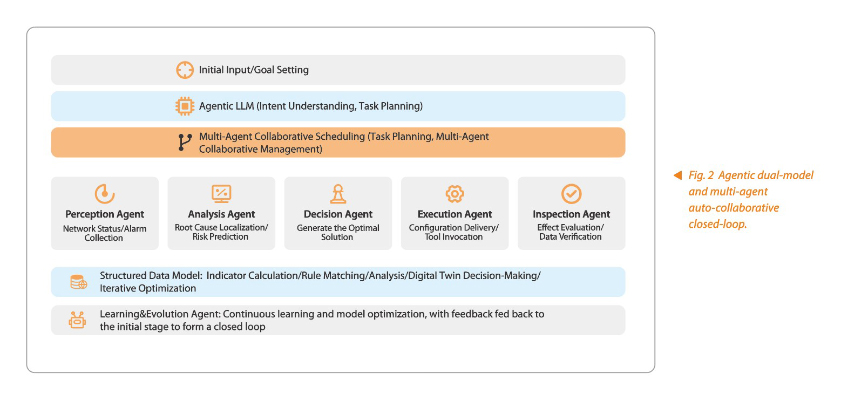
A dual-model collaboration mechanism is established between the agentic LLM and the structured data model. The LLM handles natural language intent parsing, execution flow planning, and decision semantic output, while the structured data model performs predictive analysis, decision evaluation, and rule matching based on structured network information. A unified scheduling engine enables low-latency interaction between the two models, ensuring that both decision accuracy and response efficiency meet requirements in production scenarios.
A closed-loop mechanism supports real-time network data backflow, incremental training, performance evaluation, and automatic iteration. Simulation verification using digital twins effectively mitigates model degradation and hallucination issues. Long-term memory modules accumulate fault cases, optimization solutions, and collaboration experience, enabling continuous model evolution toward L4 network self-optimization, self-healing, and self-evolution.
Next-Generation Autonomous Network Operation Mode Based on Agentic Models and Its Application Scenarios
Centered on LLMs and agents, an agent architecture with autonomous closed-loop control, exploration, and continuous evolution can be established to support multi-agent distributed collaboration and full-process autonomous closed-loop operations in next-generation autonomous networks (Fig. 2). Perception agents collect network status in real time; analysis agents perform root cause localization and risk prediction; decision agents generate cross-domain optimization schemes; execution agents invoke automation tools to complete configuration delivery and resource scheduling; verification agents conduct closed-loop evaluation on execution effects; and learning agents realize knowledge accumulation and continuous model iteration.
 Typical application scenarios include:
- Autonomous network fault healing: Perception agents capture real-time alarms such as base station outages, link congestion, and poor-quality cells. The LLM interprets fault types and impact scope, while the structured data model quickly correlates topology, metrics, and historical cases to locate root causes. Execution agents trigger cell handovers, parameter adjustments, link switching, and other operations, reducing fault recovery time by more than 80%.
- Cross-domain intelligent resource scheduling: For high-concurrency scenarios such as major sports events and concerts, agents across radio, bearer and core networks collaborate. The LLM parses service assurance intents, while the structured data model performs traffic prediction, timeslot allocation, and routing calculation to optimize global resource configurations, ensuring peak-period user experience.
- Intent-driven automatic service provisioning: Users specify bandwidth, latency and reliability requirements in natural language. The agentic LLM converts them into network-executable instructions, while the structured data model completes resource verification, network slicing orchestration, and configuration generation, enabling one-click activation and reducing provisioning time from days to minutes.
- Autonomous energy consumption optimization: Based on traffic patterns and equipment loads, agents dynamically adjust base station power, board status, antenna tilt, and other parameters to reduce energy consumption while ensuring user experience, achieving a balance between energy savings and network performance.
This operational mode eliminates process breakpoints and data silos in traditional O&M, shifting the network from reactive response to proactive prediction and autonomous governance, providing a feasible engineering path for L4 autonomous networks.
Vision for L4 Autonomous Networks Based on Agentic AI
Agentic telecom LLMs will reshape the capability boundaries of autonomous networks, driving L4 autonomy from pilot verification to large-scale commercial deployment. Future autonomous networks will achieve full-scenario closed-loop operations, global collaborative intelligence, and full life-cycle self-evolution, significantly reducing operating costs while improving network reliability and service provisioning efficiency.
From an industrial perspective, agentic telecom LLMs will help establish standardized agent protocols, an open tool ecosystem, and domain-specific model foundations. They will accelerate collaboration among operators, equipment vendors, and technology providers, and promote the maturity of L4 autonomous network standards and their global implementation. Toward 6G, they will serve as core intelligent units for space-air-ground-sea integrated networks, supporting the vision of future networks with ubiquitous connectivity, extreme experience, and native intelligence.
Agentic AI is far more than a simple technological upgrade; it represents a paradigm shift from digitalized and intelligent networks to autonomous networks. With agentic telecom LLMs as the core engine, autonomous networks will advance to L4 autonomy, opening a new chapter in the intelligent transformation of the communications industry.
Related Articles

.png)

.png)

.png)

.png)