ZTE Reports Record-High H1 2026 Revenue of RMB 78.0 Billion, with Computing Revenue Share Exceeding 35%
- Share:
-


-


-


- Revenue growth was driven by double-digit increases in Computing, Personal Devices, and international markets
- Computing revenue grew by over 55% year-on-year, with its share of total revenue rising to 35.1%
- ZTE leverages its full-stack AI capabilities to drive synergy across networks, computing and terminals, accelerating the commercial adoption of AI from infrastructure to end-user applications
Shenzhen, China, August 21, 2026 – ZTE Corporation (0763.HK / 000063.SZ), a global leading provider of integrated information and communication technology solutions, today announced record-high revenue of RMB 78.03 billion for the first half of 2026, an increase of 9.0% year-on-year.
According to ZTE's results announcement today, during the period, the net profit attributable to shareholders of the listed company reached RMB 2.75 billion, and net profit after extraordinary items attributable to shareholders of the listed company amounted to RMB 2.22 billion. In the second quarter, both operating revenue and the net profit attributable to shareholders of the listed company increased sequentially, while net cash flow from operating activities turned positive.
ZTE continues to advance its "Connectivity + Computing" strategy, developing AI infrastructure with optimized end-to-end TCO. Guided by its "All in AI, AI for All" principle, the company leverages its full-stack AI capabilities to drive synergy across networks, computing and terminals, while building an integrated value chain spanning token production, services and circulation. Together, these efforts help to accelerate the commercial adoption of AI from infrastructure to end-user applications.
During the reporting period, ZTE sustained its revenue growth, primarily driven by double-digit increases in Computing, Personal Devices, and international markets, which helped offset the impact of reduced capital expenditure in communication infrastructure by domestic carriers.
Computing revenue grew by over 55% year-on-year, with its share of total revenue rising to 35.1%. Within the Computing business, server and storage revenue rose by nearly 60% year-on-year, while data center solutions revenue increased by over 90%. Home and Personal Devices continued to grow steadily, collectively contributing 23.9% of total revenue. International markets revenue grew by 33.1% year-on-year, driven by ongoing 5G rollouts, fiber deployments, and rising demand for AI computing infrastructure, alongside deepened collaboration with Chinese enterprises with global operations.
On the profitability front, industry cycle transitions and the evolving revenue mix have placed pressure on gross margins. In response, the company remained focused on strategic priorities, while maintaining disciplined control over selling and administrative expenses.
R&D expenses in the first half totaled RMB 10.93 billion. As of the end of June, the company had filed approximately 98,000 patent applications worldwide, with more than 50,000 granted. Patent applications in the semiconductor sector totaled approximately 6,100, with over 3,700 granted. Nearly 6,000 patent applications were related to AI, of which more than 50% had been granted.
International Markets Achieved Rapid Expansion; Government & Enterprise Business Maintained Robust Growth
ZTE continued to advance its global operations while deepening its presence in the domestic market. For the reporting period, domestic and international revenue reached RMB 50.16 billion and RMB 27.87 billion, accounting for 64.3% and 35.7% of total revenue, respectively.
Across its three business segments, the company continued to solidify its core Operator Network operations, while accelerating the development of its Government & Enterprise Business as well as the Consumer Business.
In the first half, Operator Network generated revenue of RMB 31.77 billion, accounting for 40.7% of total revenue. While domestic revenue remained under pressure amid continued declines in telecommunications infrastructure investment, the company's established position in China's network equipment market remained solid. The company continued to deepen engagement with its existing customer base, maintaining stable market shares in core wireless and wireline products, while capturing opportunities arising from the build-out of intelligent computing resource pools to drive rapid growth in computing-related revenue.
Internationally, the company achieved rapid revenue growth by sharpening its focus on key countries and major telecom operators, deepening its presence across Asia-Pacific, Europe, Latin America, and the Middle East & Africa, and strengthening cooperation in wireless communications and fiber broadband.
Rising intelligent computing investment by leading domestic internet companies and industry customers, together with opportunities arising from Chinese enterprises expanding overseas, continued to drive strong demand for computing products such as servers and storage. Government & Enterprise Business recorded revenue of RMB 27.63 billion, up 43.5% year-on-year and representing 35.4% of total revenue, making it a key engine of the company's revenue growth.
Consumer Business reported revenue of RMB 18.63 billion, growing 8.1% year-on-year, accounting for 23.9% of total revenue. In the domestic market, ZTE continued to expand its AI device portfolio, sustaining revenue growth. In international markets, leveraging both carrier partnerships and brand-led retail channels, the company continued to deepen local channel penetration and expand its open-market presence. Together, these efforts drove double-digit revenue growth across home terminals, smartphones, and mobile internet devices, contributing to higher global sales volume and stronger brand influence.
Advancing End-to-End, Full-Stack AI Capabilities; Fostering a New Ecosystem for the AI Token Economy
As the focus of the AI industry shifts from model training to inference applications, competition is increasingly moving from the scale of computing capacity to token efficiency. By deepening the integration of connectivity and intelligent computing, ZTE delivers AI solutions designed to optimize TCO, enabling stronger inference performance with lower token consumption, thereby reducing unit costs. This helps accelerate the deployment of AI applications and support the high-quality development of the AI token economy.
For Networks, while navigating fluctuations in the domestic investment cycle, ZTE remained committed to its global strategy, with core products such as 5G and all-optical networks holding leading positions in both global market share and product ratings. With AI-native capabilities at the core, the company deepened the convergence of AI and networks, advancing the scaled deployment of 5G-Advanced (5G-A), 10-gigabit all-optical networks, network intelligence, and private networks for vertical industries to accelerate the build-out of next-generation communication networks.
As part of its forward-looking 6G development, the company continued to advance two strategic priorities — Space-Air-Ground Integrated Network (SAGIN) and the native convergence of AI and communications — while progressing along four evolution directions, strengthening its competitive edge in the long-term evolution of networks.
For Computing, amid the AI-driven surge in computing demand, the company developed end-to-end, full-stack intelligent computing solutions that reduce costs and improve efficiency through coordinated system-level optimization across chips, servers, software, and energy, helping customers build AI factories with optimized TCO.
Together with industry partners, ZTE launched the OEX-architecture SuperPod, featuring a backplane-free design that enables multi-chip collaboration and open decoupling, thereby supporting diverse computing ecosystems. For its sustained innovation and real-world deployments in intelligent computing, ZTE was named to the SAIL list at the World Artificial Intelligence Conference (WAIC) for the second consecutive year.
To meet the energy-efficiency demands of high-density intelligent computing, the company unveiled a highly optimized AIDC solution featuring compute-power synergy and source-grid-load-storage integration, supporting the development of green and efficient AI factories.
The company's servers and storage, data center switches, and data center solutions have achieved scaled deployments and market share gains across internet, finance, power, and public sectors in China, while accelerating expansion into emerging markets such as Southeast Asia and Latin America.
In the Home and Personal Devices domains, ZTE integrated AI capabilities across its products and expanded their use cases, creating new paradigms for human-device interaction. During the reporting period, both Personal Devices and smartphone revenue in international markets posted double-digit growth year-on-year.
For Home, ZTE has end-to-end capabilities spanning from a full portfolio of terminal products to integrated solutions, continuously enhancing the smart home experience for users. Shipments of the company's home terminals exceeded 100 million units for the second consecutive year, while the company maintained the No. 1 global market share for five consecutive years. It also ranked No. 1 globally in both PON CPE shipments and IP set-top box market share. Cumulative shipments of AI smart displays exceeded three million units, Wi-Fi 7 products achieved scaled deployment in premium markets across Europe and Asia, and the company's home router brand reached an online market share of 16%.
For Personal Devices, ZTE launched the nubia NaviX Ultra, the world's first AI agent smartphone, marking a milestone in the development of AI agent devices. The device received the SAIL Award at the 2026 World Artificial Intelligence Conference. Its launch reflects the evolution of AI smartphones from feature-level AI integration toward native AI agent capabilities, helping transform the smartphone from a tool requiring manual user input into an intelligent assistant capable of carrying out tasks on users' behalf under their authorization.
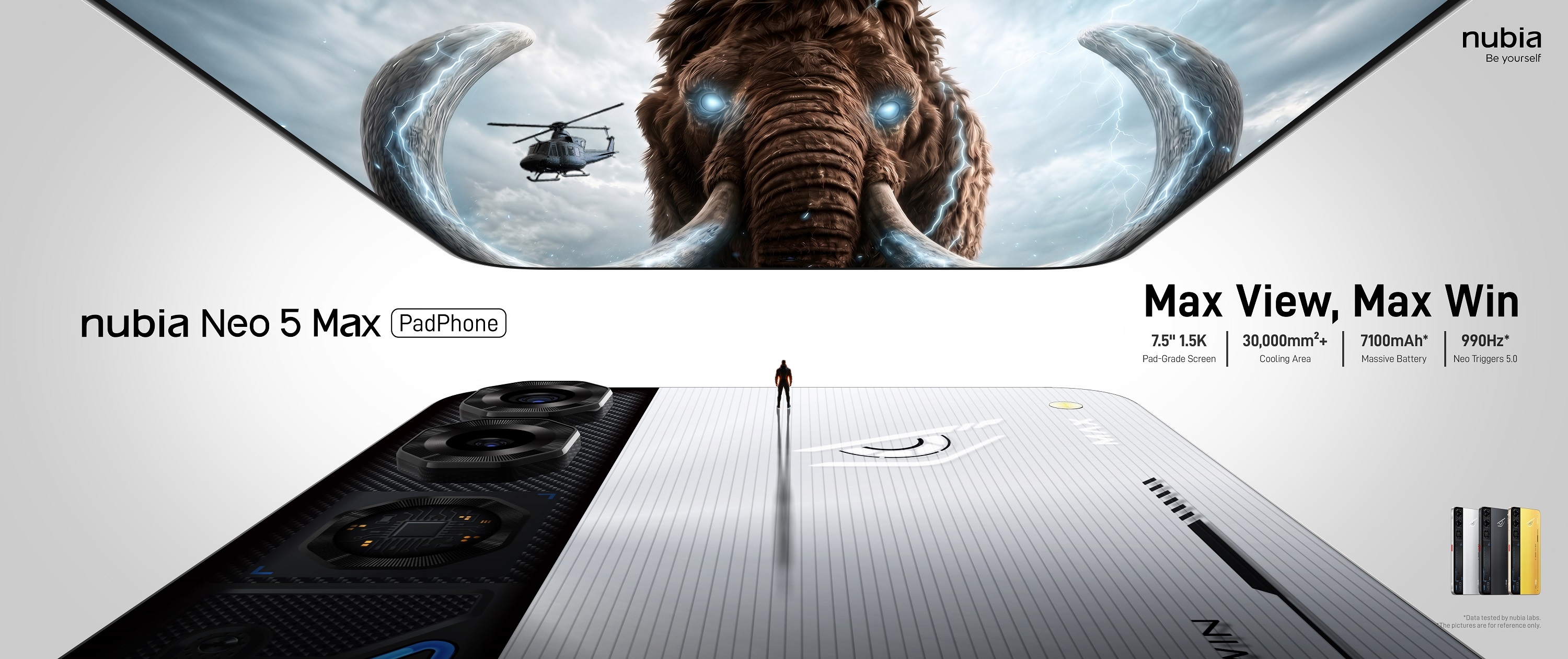
The company continued to deepen its presence in gaming smartphones, focusing on the diverse lifestyles of younger consumers in international markets. It launched the nubia Neo 5 series, which is being rolled out across Southeast Asia, Latin America, Europe, and the Middle East. Compatible with NeoVerse ecosystem accessories such as game controllers, earbuds, portable speakers, and cooling attachments, the series is designed to enhance the mobile gaming experience.
In addition, its AI companion pet iMoochi won iF DESIGN AWARD 2026. The product is now available in Japan and China, and is expected to launch in Thailand. In mobile internet products, ZTE maintained the No. 1 global market share in 5G FWA & MBB for the fifth consecutive year. The company also expanded into the emerging mobile livestreaming segment with the launch of TOPFLOW, a purpose-built device offering a new solution for professional livestreaming, positioning the company to capture emerging opportunities in this market.
As AI continues to reshape industries at an accelerating pace, ZTE remains firmly focused on AI as a strategic priority. Leveraging its full-stack technological capabilities, the company continues to strengthen innovation and ecosystem collaboration, with a focus on delivering end-to-end solutions that are secure, reliable, and optimized for TCO.
Looking ahead, ZTE will work with industry partners to build an efficient, inclusive, and sustainable intelligent computing ecosystem, accelerating the large-scale adoption of AI and unlocking greater value from tokens. These efforts will support intelligent transformation across industries and make intelligent services more accessible to users.



.png)

.png)

.png)

.png)