Powering the AI Era: How ZTE Is Redefining Data Center Infrastructure
- Share:
-


-


-


As AI models and supercomputing industries rapidly take off, the underlying logic of data center construction has undergone a fundamental shift. Every large language model trained, every inference query processed, and every GPU cluster commissioned demands not just computing hardware, but a fundamentally different approach to how data centers are designed, cooled, and powered for the intelligence economy of tomorrow.
Through a tightly integrated portfolio spanning intelligent computing micro modules,cold-plate liquid cooling systems, container data centers, and its commercially deployed 800V high-voltage direct current (HVDC) power solution, ZTE has positioned itself as a full-stack infrastructure partner for the AI data center (AIDC) era.
The Power Problem at the Heart of AI Infrastructure
Traditional data centers typically handle general-purpose cloud computing and storage, with per-rack power use usually between 10 and 20 kW, well within the capabilities of conventional low-voltage power supply systems. However, the rise of AI training clusters and high-performance computing (HPC) environments is dramatically increasing power requirements. Modern AI server racks commonly consume 20–30 kW, while advanced GPU-based AI training systems can reach 50 kW per rack or more. In some next-generation deployments, rack densities approaching 100 kW are becoming increasingly common.
This exponential leap in power density has exposed a critical flaw in legacy architectures: the multi-stage AC-to-DC conversion chain that runs from transformer to server was not designed for this kind of load. In a 10 MW-class data center operating under a conventional power supply model, the overall efficiency of the power chain sits at roughly 94%, generating millions in unnecessary operational costs annually due to electrical losses alone. As rack density climbs, those losses compound.
ZTE’s 800V HVDC Solution
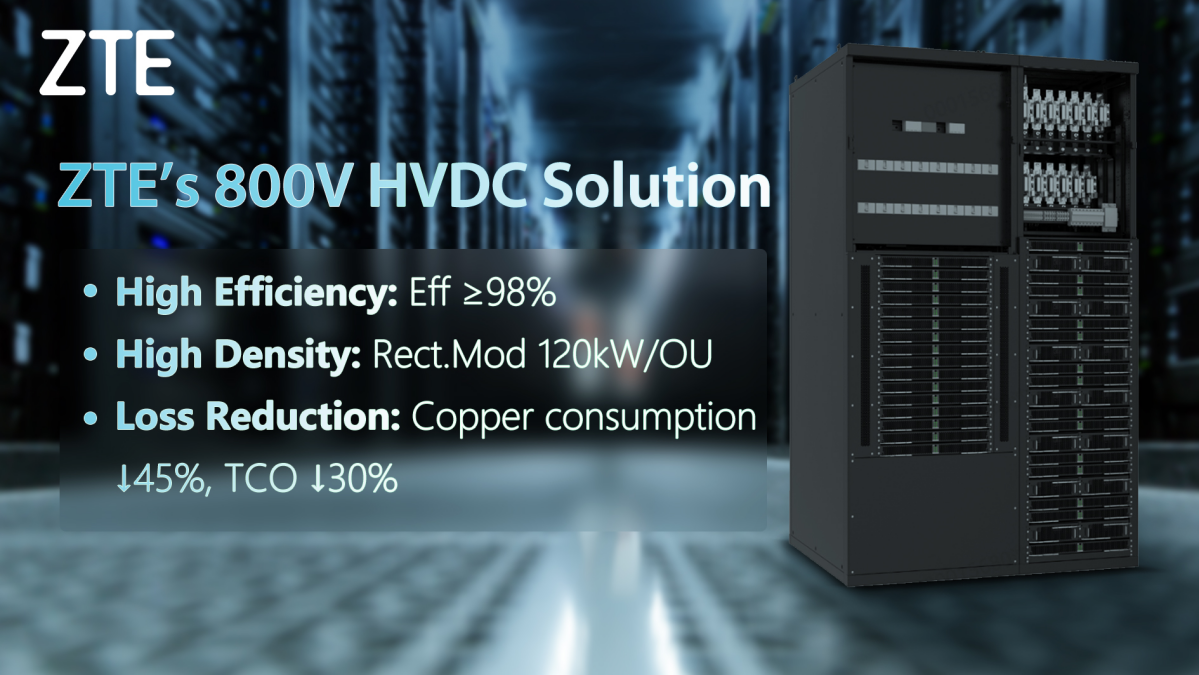
Answering this compelling industry need, ZTE’s 800V HVDC solution is set to enter commercial deployment by 2026. Featuring a high-efficiency topology, intelligent DC/DC battery management, diverse application modes, and outstanding scalability, the system empowers AI data centers with a high-density, high-efficiency, green, and reliable direct current power supply, effectively addressing the core power supply challenges of high-density computing infrastructure.
Compared to traditional power supply models, the core value of the 800V HVDC system centers on four dimensions: high density and high efficiency, multi-scenario adaptability, intelligent management, and safety and reliability. The system can slash transmission current by 2-5 times, substantially reducing losses along the power distribution chain and boosting end-to-end power supply efficiency by 2%–3% to surpass 98%.
At the same time, the reduced current cuts cable copper consumption by 50%–60%, shrinks the volume of power distribution equipment, and significantly saves equipment room space and infrastructure investment, delivering both energy efficiency upgrades and cost optimization. Moreover, the high-voltage DC architecture features fewer voltage conversion stages, a simpler power supply chain, and fewer fault points, perfectly aligning with the demanding requirements of 24/7 high-load, uninterrupted AI computing operations.
In terms of deployment, the 800V HVDC solution offers exceptional adaptability to scenarios and is a must-have for two core types of computing projects. The first is newly built ultra-high-density intelligent computing centers. For high-power computing clusters exceeding 250 kW per rack, traditional power supply schemes are completely inadequate. The 800V HVDC solution becomes the core infrastructure that ensures stable and efficient computing, supporting the large-scale deployment and elastic expansion of massive computing clusters. With a single-system capacity of up to 2 MW and support for intelligent computing cabinets exceeding 200 kW, the architecture is designed to address the growing power density requirements of AI training and high-performance computing environments.
Intelligent Computing Micro Modules: Convergence by Design
While the 800V HVDC system solves the power delivery problem, ZTE's intelligent computing micro module addresses the broader challenge of how AI workloads are physically housed and managed. Developed specifically for AIDC deployments, the micro module is engineered as a converged system, integrating local monitoring, proximal fan wall, enclosed aisle, cabinets, liquid-cooling CDU, and 800V HVDC with intelligent busbar into one unified system.
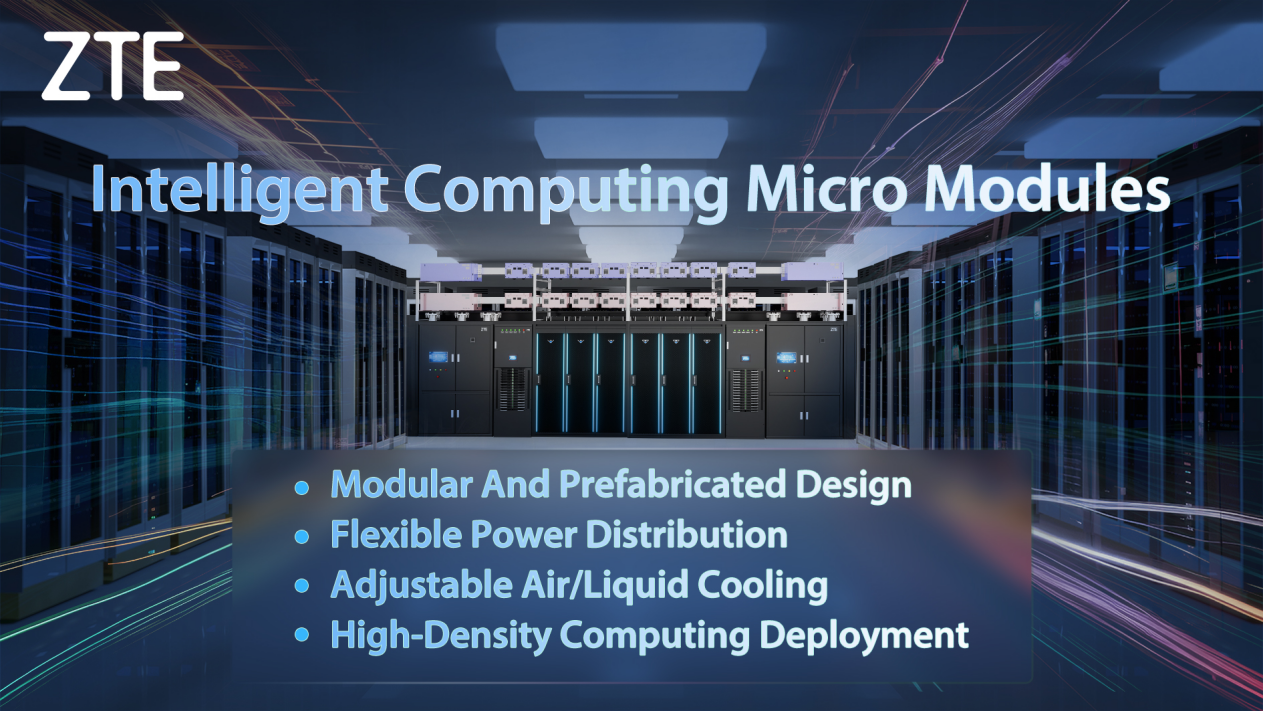
The design reflects the operational realities of high-density AI computing. Supporting deployments of 250 kW per rack and above, the module features flexible power distribution and adjustable liquid coolant flow to handle the thermal demands of dense GPU clusters. Critically, it achieves a power usage effectiveness (PUE) as low as 1.15.
AI-powered DCIM (Data Center Infrastructure Management) sits at the operational core of the system. By applying machine learning to power supply and cooling management, ZTE's DCIM platform enables predictive optimization rather than reactive maintenance, continuously tuning the relationship between power delivery and thermal management as workloads shift. The result is an infrastructure layer that gets smarter the longer it runs.
Liquid Cooling: No Longer Optional
For AI data centers, liquid cooling has moved from a premium option to an operational necessity. Air cooling, regardless of how it is optimized, cannot remove heat efficiently enough at the power densities that GPU clusters now demand. ZTE's cold-plate liquid cooling solution is engineered to meet this reality directly.
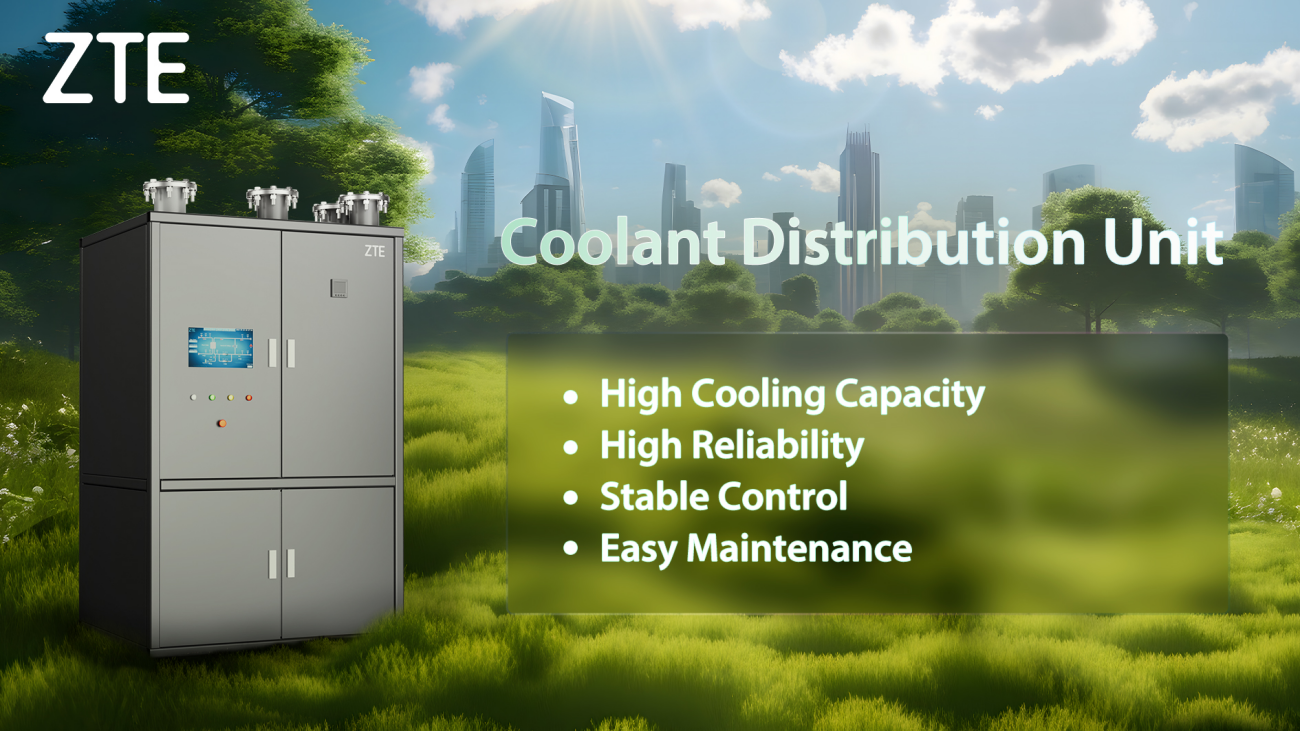
The system delivers up to 1,500 kilowatts of cooling capacity per unit, with the ability to expand to 2.4 MW for the most demanding deployments. It is designed to adapt to a wide range of geographic and climatic conditions, maximizing the use of natural cold sources wherever possible. This reduces the energy overhead of the cooling system itself, further improving overall PUE.
Reliability is built into the architecture through N+1 redundancy configurations, precise temperature and pressure controls, support for online maintenance, and the ability to perform fluid replacement without taking systems offline.
Container Data Centers: Speed and Flexibility at Scale
Increasingly, operators need compute capacity deployed quickly, in locations that may not have purpose-built data center facilities. ZTE's container data center solution addresses this need directly.
The solution integrates AC and DC power systems, HVAC infrastructure, modular enclosed hot- and cold-aisle structures, automatic fire suppression, and intelligent monitoring into a self-contained, prefabricated unit. Single-container or multi-container configurations allow capacity to be matched precisely to project requirements, with phased deployment enabling operators to stage investment over time rather than committing to full buildout upfront.
The model delivers measurable advantages across three dimensions:
1. Simplified Operations: The combination of high-availability design and remote management capability reduces the on-site staffing burden and enables intelligent O&M from a centralized control point.
2. Capital Efficiency: By eliminating the need for traditional building construction and allowing capacity to be added incrementally, the solution compresses both initial investment and time to revenue.
3. Deployment Speed: Because the modules are standardized and prefabricated, civil works and equipment installation can proceed concurrently, dramatically shortening the construction timeline compared to conventional data center builds.
Building the Foundation for What Comes Next
As AI workloads continue to scale, the organizations that get infrastructure right will sustain the compute-intensive operations that the intelligence economy demands. ZTE is building the foundation to make that possible. Intelligent computing micro modules, 800V power supply systems, and liquid cooling technologies are reshaping the core competitiveness of data centers, driving the gradual transition toward high efficiency and high density.
ZTE's AIDC infrastructure portfolio addresses and emphasizes that the transition to AI-era computing requires rethinking the data center not component by component, but as an integrated system in which power delivery, thermal management, physical infrastructure, and intelligent operations are designed to work together from the start.
Learn more about ZTE's Container Data Center Solution, featuring modular design, intelligent integration, and reliable performance for diverse industries:
https://www.zte.com.cn/global/solutions_latest/smart_energy/container_data_center_solution.html
This article was originally published by Telecom Review.


.png)

.png)

.png)

.png)