ZTE Powers High Efficiency AIDC with Robust Energy Infrastructure
- Share:
-


-


-


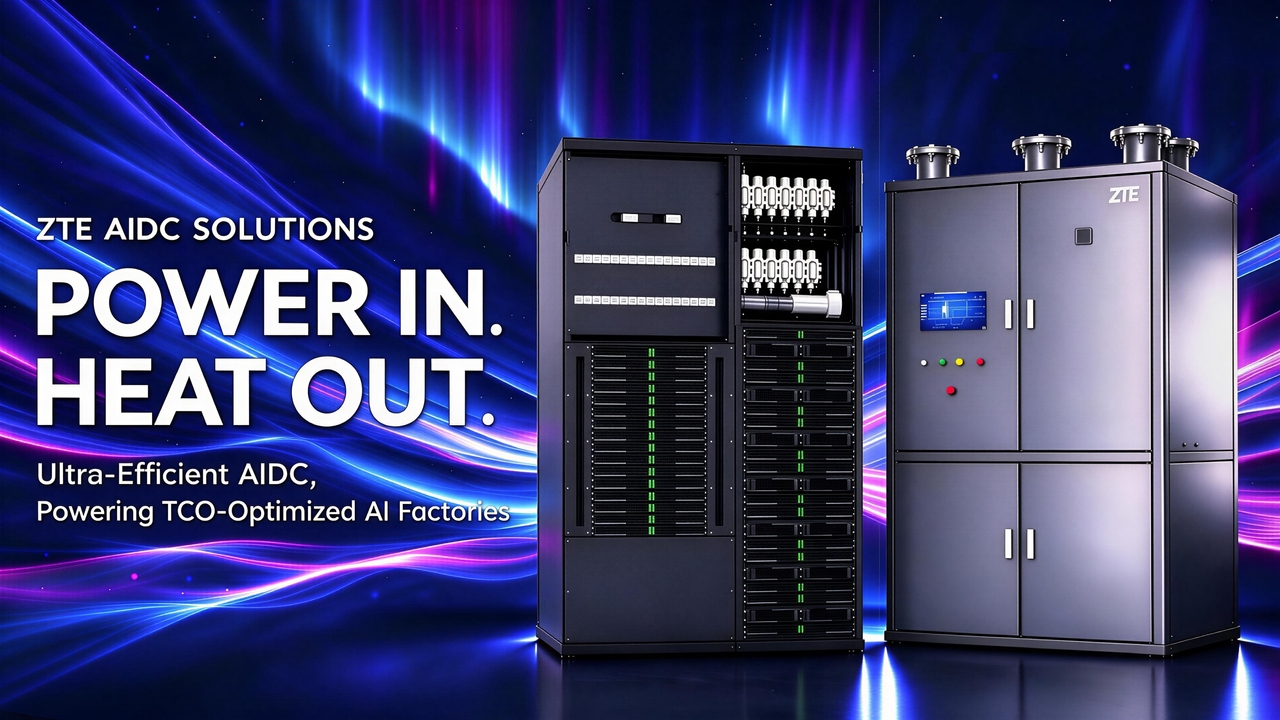
As the AI wave surges forward, computing power is reshaping industries at an unprecedented pace. Yet behind every model training run and every inference call, what truly sustains continuous computing output is a stable, efficient, and green energy foundation. As per-rack power consumption climbs from 10–20 kW to 100 kW, 600 kW, and even 1 MW, as air cooling approaches its engineering limits and losses in traditional power supply links become increasingly prominent, the benchmark for AIDC competition is shifting from "computing scale" to "computing efficiency". In this "energy efficiency battle" crucial to the sustainable development of computing power, ZTE is reconstructing the "energy foundation" of AIDC with a systematic approach—ensuring every kilowatt-hour is converted into tokens more efficiently.
Computing Power Sprints Ahead, Electricity Becomes a "Scarce Resource"
Computing demand is growing explosively, and electricity consumption in computing centers is rising rapidly. The problem goes far beyond total electricity use: traditional data centers typically have a per-rack power consumption of 10–20 kW, while in the AIDC era, high-density deployment of GPU clusters has become the norm. Per-rack loads are quickly exceeding 100 kW, and high-end intelligent computing scenarios can reach 600 kW or even 1 MW.
The shortcomings of traditional power supply architectures are now exposed: significant losses occur across the multi-stage conversion chain from transformer to server, resulting in extra annual operating costs. Such architectures can no longer meet the needs of high-density racks, making power supply architecture innovation urgent. Cooling challenges are equally severe: the engineering limit of air cooling is approximately 20–30 kW per rack, beyond which cooling capacity drops sharply. When the heat flux density of GPU clusters far exceeds the boundaries of air cooling, liquid cooling is no longer an "option" but a "mainstream solution"—the core guarantee for high-value computing power to operate stably at full load.
The competitive benchmark for AIDC is shifting from "computing scale" to "computing efficiency". The long-term development of AI computing power increasingly depends on the upper limit of energy supply and on the end-to-end conversion efficiency from Energy to Token. This is precisely the core proposition ZTE is addressing.
800V High-Voltage DC System: Tackling Power Loss from the Source
ZTE's first answer is the 800V high-voltage DC system, a fundamental innovation in traditional power supply architecture. With an efficient topology design, DC/DC intelligent battery management, diverse application modes, and excellent scalability, it delivers high-density, high-efficiency, green, and reliable DC power supply, solving the core power supply challenges of high-density computing infrastructure.
Intelligent management has also achieved a leap forward: it supports one-stop full-link management and full-system visibility and controllability, covering functions such as fault recording, temperature measurement at key locations, and selective protection simulation. Predictive maintenance is carried out across three levels—module faults, system faults, and battery lifespan—making O&M more worry-free.
Relying on dual-standard compatibility and modular elastic design, the system can flexibly switch voltage standards (±400V/800V), supporting smooth transition between old and new scenarios. Capacity can be expanded on demand, reducing initial investment pressure. It fully covers centralized large-scale computing bases and distributed edge computing upgrade scenarios, meeting the needs of all types of customers, including operators, internet companies, and professional computing power investors.
Megawatt-Level Liquid Cooling CDU: Innovation Breaks Through the "Thermal" Ceiling
While efficiency on the power supply side leaps forward, the cooling side also requires capability reconstruction. ZTE has launched a cold plate liquid cooling CDU to achieve optimal cooling costs across the full lifecycle and all-weather cooling safety assurance for equipment rooms.
The CDU has a single-unit cooling capacity of 1.5 MW, expandable to 2.4 MW, with flexible configuration of 2–5 CDU cabinets. Auxiliary modules can be selected on demand and upgraded as business grows, greatly reducing initial investment and later retrofit waste.
Based on the integration of multiple sensors for flow, pressure, temperature, and more, the 1500 kW liquid cooling CDU achieves precise temperature control of ±0.5°C and pressure control of ±0.05 bar, ensuring stable operation of high-density equipment. It is equipped with health indicators and status visualization for intelligent O&M, and features multiple safety designs such as N+X redundant hot backup and dual power feeds, supporting 7×24-hour uninterrupted operation.
The combination of 800V high-voltage DC and the 1500 kW liquid cooling CDU outlines an efficient "inbound" and "outbound" channel for AIDC: the power supply side delivers every kilowatt-hour to the server with minimum loss, while the cooling side expels heat with maximum efficiency, keeping PUE stably within 1.15.
Real-world application is the only benchmark for validating technological effectiveness. The Nanjing Binjiang Data Center was among the first to deliver demonstration results from its upgrade and transformation: It implemented a liquid-cooling integrated solution with a power density of up to 60 kW, adopting high-efficiency HVDC power distribution and busway, 32°C air supply, and group control optimization, achieving a PUE of only 1.15. Recently, together with partners, ZTE has successfully launched Karakoram-01, Pakistan's first and largest purpose-built, AI-ready data center campus. It adopts technologies such as cold plate liquid cooling, prefabricated power modules, and smart busway to achieve elastic cooling and elastic power supply, providing AI computing with a high-density computing infrastructure that supports flexible expansion and continuous evolution.
The Ultimate "Symphony" of Watt, Heat, and Bit
In traditional data centers, computing power, power supply, cooling, and O&M are usually planned and built separately. In the AIDC era, however, computing density has surged, and shortcomings in any link can be magnified exponentially. The "puzzle-piece" strategy is no longer sustainable, and the "energy foundation" calls for a systematic reconstruction of construction logic.
ZTE's solution is to coordinate the design and management of computing power, power, and heat from the project source—holistically planning computing scheduling, power transmission and distribution, and heat dissipation, connecting the entire, and achieving maximum comprehensive benefits across the three types of resources through multi-dimensional dynamic resource matching and coordinated control, empowering intelligent computing centers to reduce costs, increase efficiency, and achieve green, low-carbon development.
At the infrastructure coordination level, ZTE builds an AIDC intelligent computing center based on source-grid-load-storage integration, establishing a foundation for computing-power and electricity linkage. With 800V high-voltage DC power supply and full-link liquid cooling, energy consumption is significantly reduced. Relying on multi-level BESS, iDCIM, and iEMS intelligent management and control systems, it achieves full-link intelligent regulation of computing load, power supply, and energy storage scheduling, addressing industry pain points such as high energy consumption, difficult scheduling, and weak adaptability.
At the core computing power empowerment level, on the hardware side, ZTE works with industry partners to build orthogonal SuperPod AI computing servers, ensuring high-density intelligent computing power while guaranteeing reliability and maintainability, realizing that "one SuperPod cluster is one AI factory". On the software side, ZTE utilizes full-process AI training and inference optimization technologies to improve computing power utilization efficiency, reduce energy loss, and achieve precise matching between computing power and electricity.
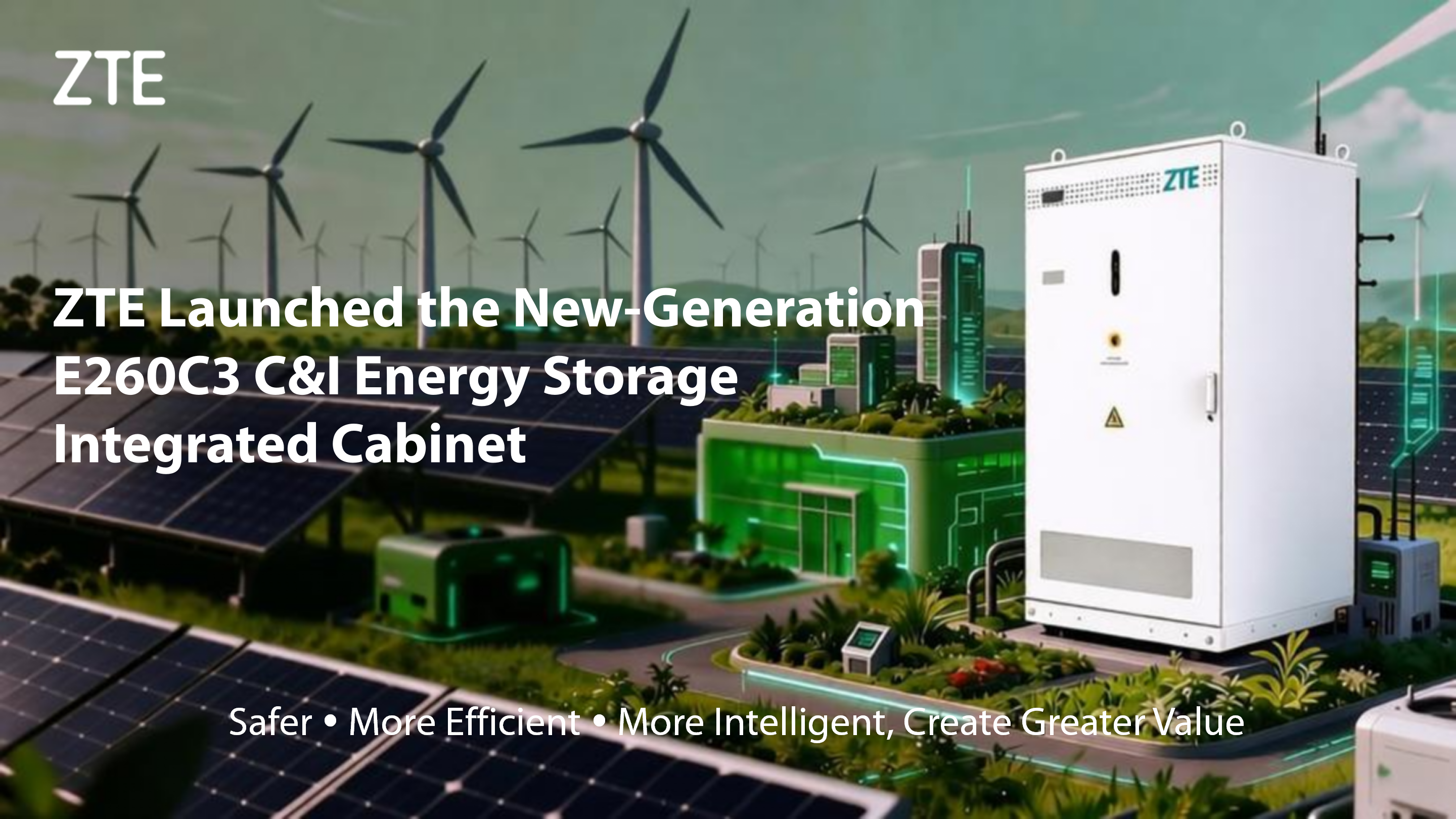
At the green energy upgrade level, ZTE implements full-scenario smart PV-storage integrated solutions, covering four major scenarios: smart PV power stations, grid-side energy storage, AIDC computing center energy storage, and PV-storage microgrids. It has launched standardized products such as the 125 kW / 261 kWh commercial and industrial integrated energy storage cabinet and 5 MWh containerized energy storage, paired with the iEMS smart energy management system. This enables integrated control of green power generation, storage, scheduling, and utilization, maximizes the proportion of local green power consumption, and provides stable, green, and low-cost power support for the computing industry.
Over the course of its journey, ZTE has delivered more than 500 projects in over 20 countries worldwide, with more than 400,000 cabinets, total installed capacity exceeding 3,200 MW, and total floor area reaching 3.5 million square meters, making it a leading end-to-end data center solution provider. Overseas deliveries have reached countries and regions including Indonesia, Uzbekistan, Mexico, Italy, Pakistan, Algeria, and Chile. Rich cross-regional practices have validated the scenario adaptability of its products and solutions, and also demonstrated the key role of open decoupling and ecosystem collaboration in the large-scale evolution of AIDC.
Looking ahead, ZTE will leverage its capabilities in technology R&D and delivery to transform flagship products—such as the 800V high-voltage DC system and the 1,500 kW liquid cooling CDU—into replicable and scalable industry-standard solutions, thereby truly converting our energy advantages into a competitive edge in computing power for the AI era.