ZTE CDO Cui Li at MWC Shanghai 2026: Unlocking Value and Embracing Uncertainty in the AI Era
- Share:
-


-


-


- In the AI era, uncertainty is the only certainty
- ZTE advances an "All in AI, AI for All" strategy to embed intelligence across products and solutions, while driving the evolution toward a data-driven organization that features human-machine collaboration
- To navigate uncertainty, ZTE is building a resilient AI system capable of agile actions and fast evolution
- Looking ahead, ZTE believes that AI is ushering in a new stage of human-AI symbiosis
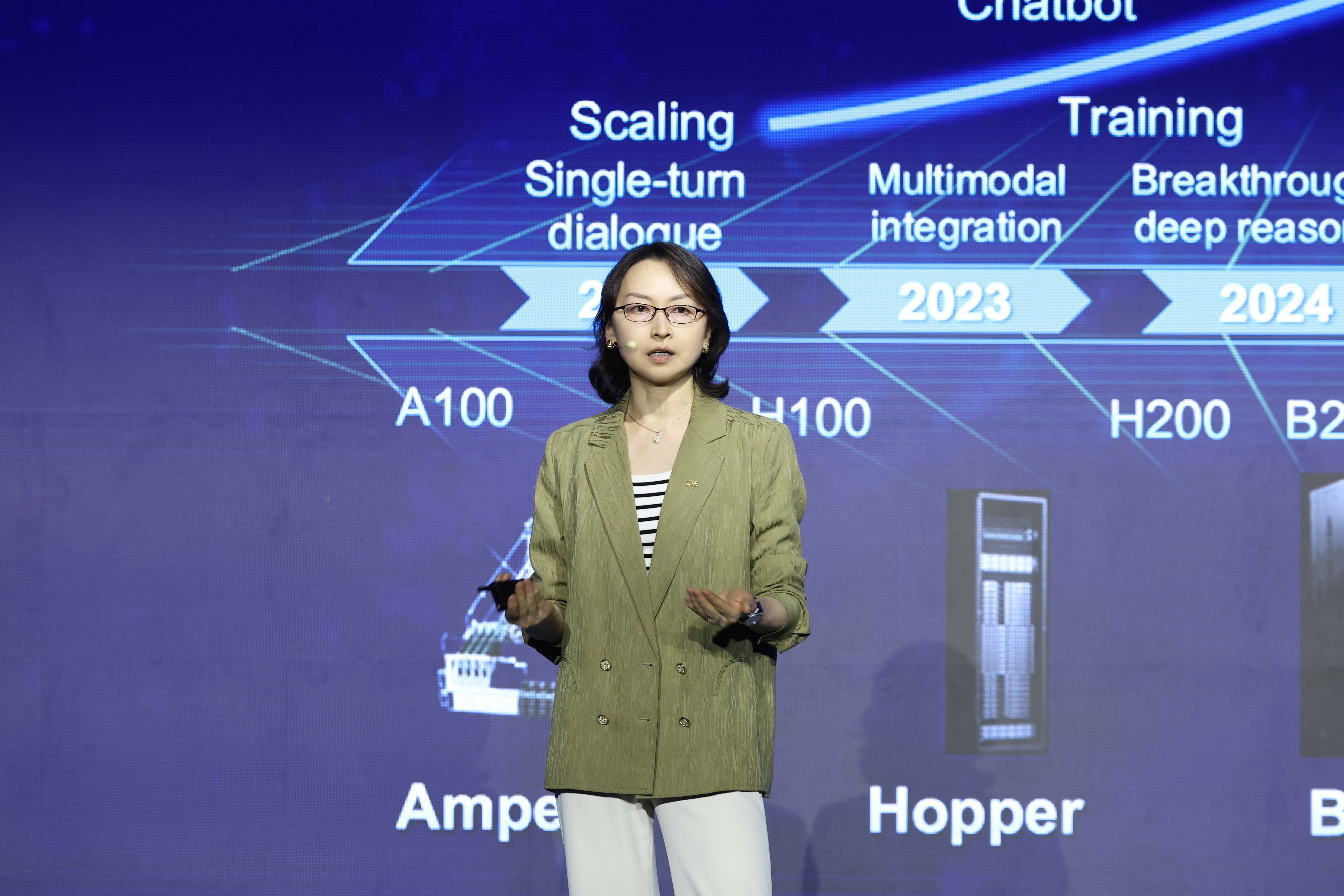
Shanghai, China, June 24, 2026 - ZTE Corporation (0763.HK / 000063.SZ), a global leading provider of integrated information and communication technology solutions, announced that Cui Li, the company's Chief Development Officer, delivered a keynote speech titled "Unlocking Value and Embracing Uncertainty in the AI Era" at MWC Shanghai 2026.
Cui Li noted that the world is undergoing a profound paradigm shift. AI is iterating at a breakneck pace and generating more customized demands, where the "one-size-fits-all" model is no longer applicable. We are now in an era where uncertainty is the only certainty. In this time of change, ZTE put forward the "All in AI, AI for All" strategy. Specifically, the company aims to unlock AI value to the fullest—deeply embedding AI-native capabilities into products and solutions to achieve a great leap in value delivery, and advancing the agile evolution toward a data-driven organization that features human-machine collaboration. Meanwhile, to address uncertainty, ZTE is committed to building a resilient AI system capable of agile actions and fast evolution from four key dimensions: openness and decoupling, flexible scaling, extreme synergy, and scenarios first. Looking into a future of human-AI symbiosis, ZTE will remain steadfast in its role as a value contributor in the ecosystem, and make continuous innovations and breakthroughs, to create a brighter future with global partners.
Below is the full transcript of Cui Li's keynote speech:
It's a great honor to meet you again here at MWC Shanghai. Last year at this venue, we explored how tech surge was reshaping the boundaries of industries under the title "Digital and Intelligent Evolution: Usher in a New Era of AI Civilization". While a year later, agentic AI is emerging as a dominant force driving industrial upgrading, redefining the business logic, and transforming how we collaborate.
So today, I'll elaborate on how we can fully unlock value and embrace uncertainty in the AI era.
Undoubtedly, we're now in an era where uncertainty is the only certainty.
From a global perspective, the macro environment is undergoing profound transformation, and AI revolution and energy transition are redefining the underlying logic of industry competition. Against this backdrop, the global industries are moving from "efficiency first" to "efficiency + resilience"—where short-term volatility and long-term structural adjustments converge, reshaping the global economic and technological landscape.
From a tech perspective, AI keeps iterating at a breakneck pace. As for software, large AI models evolve monthly or even weekly, with major capability leaps every six months. And we're seeing the profound transition from conversational AI toward agentic AI and embodied AI. Hardware upgrade is also accelerating. Companies like NVIDIA roll out new architectures every two years and update flagship chips annually, continuously expanding compute supply. Meanwhile, huge gains in inference efficiency are transforming cost structures, and the competition between open-source and closed-source models is advancing the democratization of AI. As we can see, compressed tech iteration cycles give rise to new application scenarios, while posing higher requirements on companies in choosing the right tech roadmap, setting an appropriate pace for asset updates, and aligning talent capabilities.
In addition, markets are segmenting at an unprecedented pace. AI is generating more customized demands, and the "one-size-fits-all" model is no longer applicable. On the consumer side, the long-tail demand is exploding, driven by personalized recommendation algorithms, and niche brands are breaking through against all odds via content marketing in e-commerce platforms. In production, the "small order, fast supply" model becomes the norm powered by flexible manufacturing and AI quality inspection. Meanwhile, emotional economy and experience economy are rising fast, as evidenced by the exponential growth of segmented markets like AI pet, emotional healing, and silver hair technology. Under such trends, the traditional economies of scale are being disrupted, and a new business paradigm is taking shape, where niche is the new mainstream. Amidst such market uncertainty, innovation is the only way forward.
In this time of change, we advocate for deeply embedding AI-native capabilities into our products and solutions to achieve a great leap in value delivery, while advancing the agile evolution toward a data-driven organization featuring human-machine collaboration. Also, we should fully take into account the exponential factors of AI iteration—namely, keep our architecture flexible and open, leave room for dynamic resource reallocation, and thus build a resilient system that is capable of addressing uncertainty.
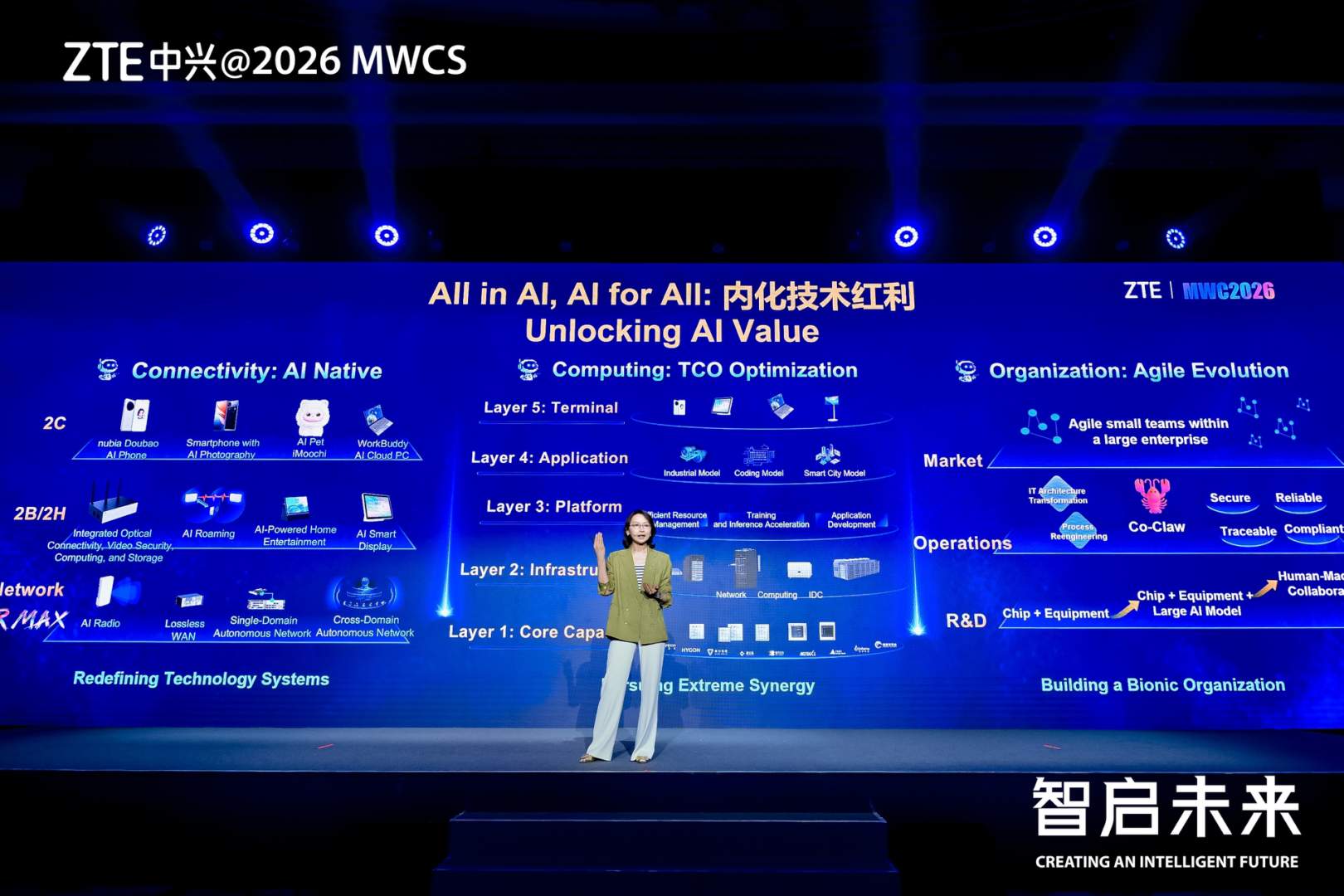
After over three years of AI sprints, model capabilities have continuously improved. Large AI models already perform at or beyond PhD level, especially good at info-heavy, super-uncertain tasks. Agents move from passive information processing and reasoning to active interaction and execution, steadily advancing toward continuous learning and self-evolution. This raises a fundamental question: how intelligent does a model really need to be? For most consumers, today's models are already overkill; yet for developers and enterprises, there is still a considerable gap in using AI well. ZTE's proposition is clear: unlock AI value to the fullest. We are upgrading products, solutions, and platforms, building full-stack, all-scenario intelligent computing solutions driven by end-to-end TCO optimization, and fully accelerating the company-wide intelligent transformation.
In 2025, ZTE proposed the "All in AI, AI for All" strategy. At the core of it lies our commitment to fully unlocking AI value.
To start with, with an AI-native mindset, we are redefining telecom networks and our offerings for enterprises, homes, and consumers.
In connectivity, we bring intelligence to our products and solutions, such as AIR MAX and lossless WAN, while harnessing agentic AI and digital twins to accelerate the evolution toward L4 autonomous networks.
For enterprises, our all-in-one gateway, integrating optical connectivity, video security, computing, and storage, delivers plug-and-play simplicity, making AI adoption effortless for small and micro-sized enterprises.
For homes, we have partnered with operators to develop AI smart displays—an AI hub covering education, entertainment, eldercare, and home security. The cumulative shipments already exceed 3 million units.
For consumers, our AI-native phones and AI Cloud PC WorkBuddy bring brand-new intelligent experiences.
In computing, we focus on end-to-end TCO optimization and stay committed to building a homegrown, open AI ecosystem.
At the core capability layer, we deliver full-range, system-level AI chip capabilities that enable optimal selection. This is empowered by our in-house switch chips for high-speed intra-HBD/cross-HBD interconnects, domain-specific CPUs, DPUs, and NICs, alongside the adaptation and optimization for various mainstream GPUs.
As for infrastructure, we provide a full-stack intelligent computing solution that brings together computing, high-speed network, and green IDC—all designed to deliver the optimal TCO.
Regarding platforms, we are building an AIOS and an agent hub, supporting elastic scheduling of intelligent computing resources, training and inference acceleration, and rapid agent development.
At the application layer, based on the "1+N+X" model (one foundation model, N domain-specific models, and X scenario-based applications), we have delivered more than 1,000 AI projects across over 18 industries such as telecom, manufacturing, and power grid.
At the terminal layer, we have launched innovative products including AI-native phones, AI cloud PCs, and AI smart displays, creating an intelligent home hub that integrates networks, computing, displays, and agents. This is how we promote scenario-based application and truly realize AI for all.
Regarding organizational evolution, building on the digital transformation initiated in 2016, ZTE has achieved comprehensive intelligent upgrade across key areas, including R&D, marketing, operations, and supply chain.
In R&D, we have successfully advanced from "Chip + Equipment" to "Chip + Equipment + Large AI Model", and are now accelerating toward "human-machine collaboration".
In marketing, we have created "agile small teams within a large enterprise" to break down organizational and process barriers, and strengthen process reengineering and cross-enterprise IT system interconnection, thereby ensuring fast response and efficient execution.
In operations, our in-house Co-Claw has been deployed across the company. As an enterprise-grade agent platform compared to OpenClaw, Co-Claw has been significantly enhanced in compliance, security, reliability, and integration with internal systems. Deeply embedded into our core systems, it can effectively execute high-frequency tasks, including document management, contract analysis, fault ticketing, event creation, and R&D collaboration.
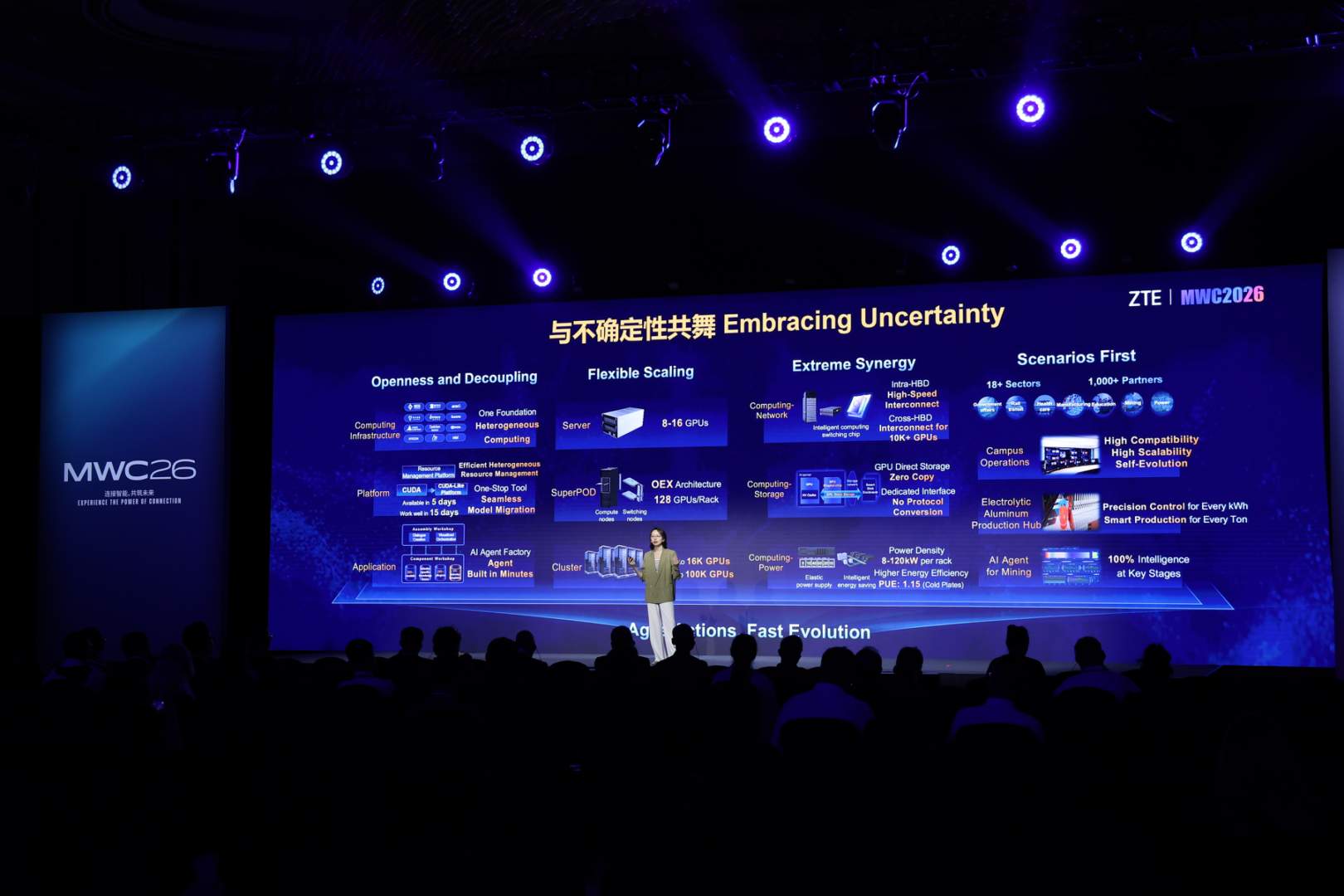
Over the past three years, innovations in AI algorithms and architectures have exploded, with landmark advancements such as MoE, MLA, quantization, distillation, attention mechanism optimizations, and ultra-long context windows. Different algorithms require tailored hardware to achieve optimal cost-performance, while system and hardware architectures typically follow a 2 to 3-year refresh cycle. This calls for keen foresight and built-in flexibility across solution development, architectural design, investment deployment, and operations management to secure medium- and long-term competitiveness. Drawing on our experience, ZTE advocates "embracing uncertainty". We are building a resilient system capable of agile actions and fast evolution from four key dimensions: openness and decoupling, flexible scaling, extreme synergy, and scenarios first.
First, openness and decoupling. Given AI's rapid evolution, only openness and decoupling allow us to fully internalize the latest industry innovations and practices. That's why, in the intelligent computing field, ZTE remains committed to decoupling hardware from software, models from platforms, and training from inference.
For hardware, our solutions support different GPU and CPU combos for optimal performance and compatibility, while delivering software-hardware co-optimization to maximize tokens per watt.
Additionally, ZTE's platform is fully compatible with over 200 models, enabling efficient heterogeneous resource management and deep software-hardware synergy. It also accelerates the full lifecycle from model development to application with one-click deployment and seamless migration.
For applications, our product packages support high-quality data synthesis, one-click rapid fine-tuning, intelligent generation of knowledge graphs, tacit knowledge mining, minute-level agent building, and autonomous tool evolution. Notably, ZTE's Co-Sight AI agent factory has been open-sourced.
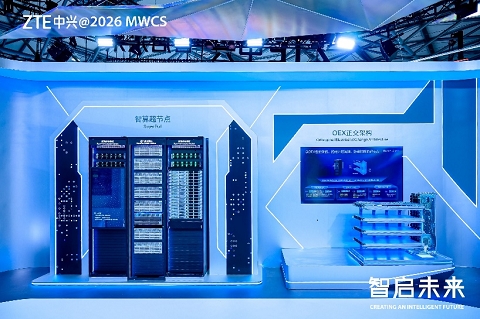
Second, flexible scaling. Take ZTE's AI server portfolio as an example. It spans standard 8-GPU/16-GPU nodes, SuperPOD, and modular solutions. The SuperPOD, built on an innovative OEX architecture, packs 64 or even 128 GPUs into a single rack. In cluster-level scaling, our modular design allows seamless expansion all the way to tens of thousands or even hundreds of thousands of GPUs. For our customers, this means they can scale incrementally rather than all at once. This approach significantly slows down hardware depreciation and maximizes the long-term ROI.
Third, extreme synergy. For computing-network convergence, through scale-up, we boost computing density to up to 16,000 GPUs; through scale-out, we expand clusters beyond 100,000 GPUs via optical interconnects and electrical switching. This truly strengthens computing power through advanced networks.
For computing and storage, our in-house switch chips guarantee high running efficiency, while our Dinghai DPU chips enable Pod-level shared memory, delivering microsecond latency and PB-scale expansion for KV cache.
In computing-power coordination, operation strategies can be dynamically adjusted based on grid loads—enabling elastic power supply and intelligent energy saving. The rack power density scales flexibly from 8 to 120 kW. And our cold-plate liquid cooling solution reduces the PUE to 1.15, making green and sustainable development a tangible reality.
Finally, scenarios first. We emphasize tailoring solutions to the unique requirements of each scenario and application—because the best fit delivers optimal cost effectiveness. To date, ZTE's intelligent computing solutions, including AI all-in-one machines, have empowered more than 18 vertical industries. Together with over 1,000 ecosystem partners, we have delivered over 100 best use cases, charting a path from pilot projects to industry-wide adoption.
Here are some examples:
- At ZTE Nanjing Binjiang Base, our integrated intelligent operations system has shortened order scheduling cycles by 80% and improved per capita output by 81%.
- In the Yunnan Sunho Aluminum factory, ZTE's Co-Claw, as an intelligent hub, enables millisecond load regulation, with capacity utilization exceeding 99% and aluminum distribution efficiency up by 30%.
- At the Shaanxi Yanchang Petroleum Balasu Coal Mine, four digital employees have been deployed, accumulating more than 60 AI skills. This has accelerated major hazard identification to the minute level, reduced technical report generation to just 5 minutes, and lowered the proportion of repetitive operational and management tasks to below 15%, significantly improving production safety and operational efficiency.
The future has already arrived. We are entering a new stage of civilization that is defined by "human-AI symbiosis". Through the profound synergy of computing, networks, energy, and algorithms, AI is seamlessly embedded into every facet of social operations—much like a vast, intelligent organism. In this living system, 6G serves as the "neural fibers", enabling millisecond information transmission; computing power is the "heart", pumping energy to sustain the entire system; energy functions as the "blood", which is intelligently scheduled and circulates in an endless cycle; and algorithms represent the "genes", which define the shape of the entire system and where it evolves. Looking ahead, research into continuous learning and self-evolution will further propel the system toward higher-level intelligence.
For ZTE, we firmly believe that though the road is long, every step forward brings us closer to our destination. Our commitment is to fully unlock AI value and embrace uncertainty with agile iteration. We also believe that harmony lies in diversity and prosperity lies in symbiosis—and that only through open collaboration can we build an ecosystem that is stronger and truly thrives. ZTE will remain steadfast in its role as a value contributor in the ecosystem, and make continuous innovations and breakthroughs, to create a brighter future with global partners.

.png)

.png)

.png)

.png)