Language
Home Broadband Complaint Agent Solution
Release Date:2026-06-05
By Lu Yun, Chen Aiming, Zhang Rong
With the continuous development of the home broadband business (HBB), users have increasingly higher requirements for network quality and service experience. At present, home broadband complaint handling faces pain points such as slow response, difficult fault location, and long repair cycles, resulting in a persistently high number of complaint work orders. According to Q4 2025 data, home broadband complaints accounted for 41.7% of all network fault tickets, of which about 68% were soft faults caused by improper configuration or operation of user-side equipment. The average handling time reached 3.2 hours, straining O&M resources.
To overcome these bottlenecks, ZTE has developed a home broadband complaint handling intelligent agent. It leverages large AI models, end-to-end quality analysis engine, and automatic control capabilities to transform the service mode from passive response to active perception, intelligent diagnosis, and automated repair. Its core objectives are to achieve a 20% year-on-year reduction in home broadband complaints, shorten the average complaint handling time to less than 120 minutes, and increase the self-service resolution rate to over 40%, supporting simplified O&M and customer experience upgrade.
Disadvantages of Traditional Complaint Handling Methods
Currently, the complaint handling process has four major structural defects that seriously restrict service efficiency and user experience:
Fault Location Relies on Manual Experience and Lacks End-to-End Analysis
In the traditional mode, fault delimitation depends on segment by segment troubleshooting by O&M personnel, covering the user terminal, home gateway, indoor cabling, splitter, OLT, and MAN. Due to the lack of a unified QoS view, it is difficult to accurately map "user-perceived lag" to abnormal network-layer indicators. For example, "video stuttering" may be caused by Wi-Fi channel congestion, ONU optical power thresholds, or mismatched MAN QoS policy. However, the current system only provides device-level alarms, such as "ONU offline", and cannot identify soft faults, resulting in low fault delimitation efficiency and more work orders.
Soft Faults Require On-Site Support
About 68% of home broadband complaints are related to soft faults, such as Wi-Fi channel interference, DNS configuration errors, user PC faults, and router faults. These problems usually do not require hardware replacement. However, the existing system lacks remote intervention capabilities, leading to unnecessary on-site visits. For example, slow network speeds due to Wi-Fi 2.4 GHz channel congestion can be solved remotely by adjusting the channel or guiding users to switch to the 5 GHz frequency band, but in practice, it still follows the "on-site repair" procedure.
High Skill Requirements
Troubleshooting highly relies on the experience and knowledge of O&M personnel, resulting in long training periods for new employees, and high cross-domain coordination costs. In scenarios integrating multiple technologies such as PON, IP, Wi-Fi, and IPTV, it is difficult for a person to master all issues, resulting in repeated diagnosis and a high misjudgment rate. In addition, the lack of standard diagnosis processes may cause different personnel to reach different conclusions when handling the same problem, affecting service consistency.
Low User Participation and Lack of Self-Service
After a fault occurs, users can only submit complaints through the customer service hotline or app, and cannot obtain network status information or perform a preliminary self-check. Even simple user-side issues, such as router restart, ONT restart, or loose network cables still require manual intervention. This generates a large number of low-value work orders. Users also lack transparency regarding handling progress, increasing dissatisfaction.
Key Advantages of Home Broadband Complaint Agent
By integrating large AI models, multi-source data, automated control, and user interaction capabilities, the home broadband complaint agent builds a closed loop of "perception, analysis, decision-making, execution, and feedback", comprehensively solving the pain points of traditional complaint handling and enabling service model innovation.
End-to-End Service Quality Analysis and Precise Fault Delimitation
The home broadband complaint agent connects full-link data from the FTTH access network (FAN domain), core network, home terminals, and application layer to implement end-to-end service quality monitoring and analysis. Based on large AI models, service indicators such as HTTP response delay, video stuttering rate, and game packet loss rate are modeled and mapped back to network layer KQIs/KPIs, enabling accurate fault delimitation from user-perceived deterioration to root cause. Algorithm models are used for automatic association analysis to quickly locate the faulty link and determine whether the issue lies in the operator's PON network, the home side, the transmission network or the application side. Fault delimitation accuracy can reach more than 92%, greatly shortening the troubleshooting time.
Remote Handling and Automatic Optimization of Soft Faults
The agent integrates remote control capabilities and supports automatic operations on devices such as the home gateway and ONT. For identifiable soft faults, the system can automatically trigger repair policies, such as remotely switching to the optimal channel or instructing users to switch to the 5 GHz band for Wi-Fi issues, automatically adjusting DBA parameters or issuing optical module gain optimization commands for critical optical power issues, remotely resetting DNS configurations or switching to the standby server for DNS abnormalities, and adjusting service QoS configurations to guarantee differentiated services for video and gaming stuttering. Pilot data shows that 62% of soft faults can be remotely fixed without dispatching installation and maintenance (I&M) work orders.
Reducing Skill Requirements and Simplifying O&M
The agent uses an expert knowledge base and diagnosis decision tree to standardize and automate complex troubleshooting processes. O&M personnel only need to follow the root cause analysis and troubleshooting suggestions provided by the agent without fully understanding the underlying protocols or topologies. For example, the system can output: "Fault cause: Wi-Fi channel 3 seriously overlaps with the adjacent AP. Recommended operation: Switch to channel 9 remotely or instruct users to switch to the 5 GHz band.” This approach reduces the skill threshold for front-line maintenance personnel by 40%, shortens the onboarding period of new employees from three months to two weeks, and supports the transformation to minimalist O&M.
App-Based Self-Diagnosis and Self-Repair
For users, the agent provides capability invocation interfaces integrated into the HBB mobile app, offering network health detection, one-click speed tests, Wi-Fi optimization, and fault self-healing functions. Users can view the home network quality score, Wi-Fi coverage heat map, and optical power status at any time. When a network fault is detected, the app pushes a diagnosis report and provides a one-click repair button, enabling operations such as restarting the ONT, switching the Wi-Fi channel, clearing the DNS cache, and enabling prioritized assurance for video and gaming services. These self-operations allow users to solve problems independently, significantly reducing low-value complaint tickets. In addition, the app displays processing progress and repair results in real time, improving service transparency and user satisfaction.
Home Broadband Complaint Agent Solution
ZTE’s home broadband complaint agent is currently deployed on the UME system. It provides northbound interfaces and interconnects with the telecom operator's customer response center (CRC), network operations center (NOC), and I&M assistant (Fig. 1). It supports complaint preprocessing, fault diagnosis, and service quality analysis, enables remote complaint processing and precise fault ticket dispatching, and helps front-line I&M personnel improve on-site efficiency.
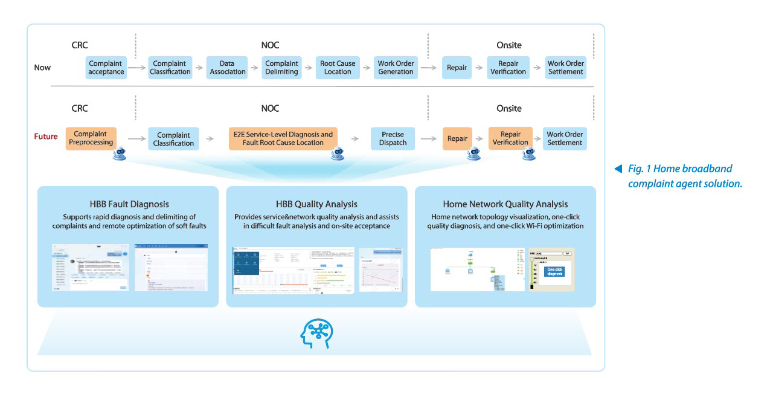
The home broadband complaint agent can assist in three phases of complaint handling.
- Acceptance phase: The agent provides end-to-end complaint pre-diagnosis capabilities, identifies faults such as poor quality or fiber disconnection, accurately delimits the faults, and supports precise complaint ticket assignment. In addition, it can remotely repair soft faults with one click, reducing fault tickets.
- Analysis phase: The agent accurately locates faults in the PON network segment, assisting with fault dispatching and rapid repair. For complex faults, it assists NOC personnel in performing quality traceback at both service and network levels, enabling efficient analysis.
- Maintenance phase: The agent supports the I&M assistant in home network fault analysis, as well as Wi-Fi analysis and self-optimization. It helps I&M personnel perform fast repair and verification.
By deploying the home broadband complaint agent, operators can enable end-to-end service quality analysis, automatic soft fault repair, simplified O&M, and user self-service, establishing a new-generation closed-loop system for home broadband fault handling. This solution significantly improves O&M efficiency and customer experience, supports operators’ evolution towards L4 autonomous networks, and serves as the core engine for HBB digital transformation.
Related Articles

.png)

.png)

.png)

.png)