Language
ZTE and Zong Collaborate to Explore and Deploy UBR Solution in Pakistan
Release Date:2026-09-24
By Li Deliang, Su Guojun, Liu Wutao
- Over the years, ZTE and Zong (CMPak Ltd.) have been committed to driving technological innovation, exploring new solutions to enhance network capabilities and elevate user experience, and accelerating the commercial deployment of innovative wireless technologies in Pakistan.
ZTE UBR solution is one of the successful cases that has been deployed on a large scale commercially. It meets evolving requirements as the network develops while delivering a better user experience and higher revenue.
UBR Solution Meets Zong’s Network Requirements
The successful deployment of the UBR solution not only meets the requirements of Zong’s network development and evolution, but also addresses the specific needs of Pakistan's wireless market. Key characteristics of Pakistan's wireless market include:
- New site deployment results in a higher TCO due to substantial CAPEX and OPEX associated with site acquisition, civil works, batteries, and diesel generators (DGs).
- Mobile subscriptions and smartphone adoption continue to increase. According to data from the Pakistan Telecommunication Authority (PTA), Pakistan’s teledensity reached 83.35% as of July 2026. Smartphones account for 71.8% of active devices on Pakistan’s mobile networks, while 2G-only devices account for around 28%.
These two factors lead to a lower ROI for new site investment. As a result, the sector-level expansion on existing sites become the preferred option. ZTE, together with Zong, introduced the sector split solution (ZTE X-Site solution) into the existing network, using 2T2R or 4T4R sector splitting. The sector split solution not only improves existing 4G performance but also brings additional benefits. First, it enables sector-level capacity expansion based on actual traffic load. Second, as it can be deployed on existing sites, it offers greater deployment flexibility and speed than new site deployment.
The sector split solution was first commercially deployed at scale on Zong’s network by the end of 2018. In January 2019, ZTE together with Zong announced the commercial launch of X-Site+4T4R sector split solution in Pakistan.
With the large-scale deployment of the 4T4R sector split solution, new deployment challenges emerged. The growing number of single-band RRUs, including both reused and newly added units, increased site complexity, required additional tower space, and raised power consumption, resulting in additional OPEX.
Starting in 2019, ZTE and Zong pioneered the UBR solution (ZTE UniSite solution). The solution supports 4T4R on both the 1.8 GHz and 2.1 GHz bands, integrates filters to mitigate interference from the 1900 MHz band, and simplifies site deployment with fewer RRUs and lower power consumption.
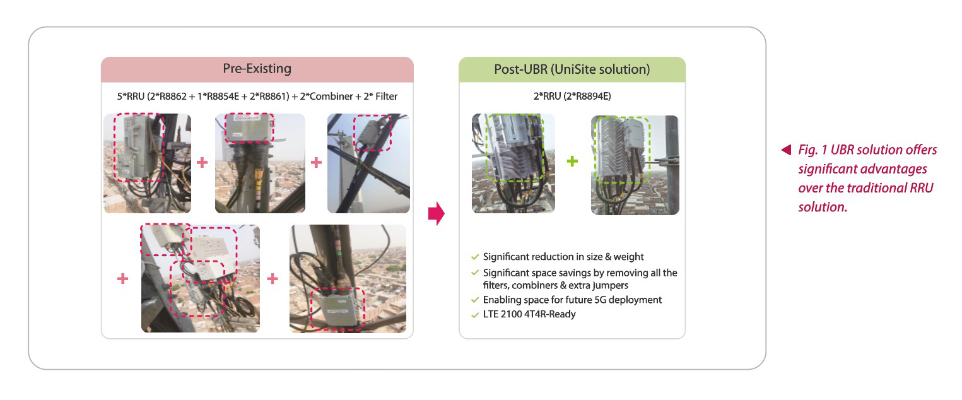
Commercial deployment results show that, the UBR solution offers significant advantages in 4T4R sector-split scenarios (Fig. 1). For example, a traditional single-band solution requires five RRUs, two combiners, and two additional filters, whereas the UBR solution requires only two 4T4R UBRs. Additionally, the UBR solution enhances 4G capacity by upgrading LTE 2100 MHz from 1T2R to 4T4R. As a result, the UBR solution while reducing OPEX.
UBR Solution Expanded to More Scenarios with a Diversified Portfolio
With continuous network development and evolving requirements, the UBR solution has been extended to a broader range of application scenarios, with new products and solutions introduced to meet diverse network requirements.
- New site scenarios: Three dual-band 4T4R UBRs can replace six traditional single-band RRUs, reducing the number of RRUs per site by up to 50% and helping reduce tower rental costs.
- Hotspot and coverage blind spot scenarios: In 2024, ZTE and Zong commercially launched the ZTE PAD site solution, integrating antennas, BBU, and UBR into a single unit, significantly reducing the site footprint and enabling more flexible and rapid deployment.
- High-power UBR requirements: Driven by LTE refarming and spectrum evolution, UBR power requirements have increased from the initial 4 × 80 W to 4 × 120 W to meet enhanced coverage requirements and deliver a better user experience.
- Capacity expansion scenarios: FDD Massive MIMO is a key 5G technology that can be introduced into 4G networks to enhance network capacity. As network requirements continued to evolve, ZTE and Zong further extended dual-band integration to 1.8 GHz + 2.1 GHz FDD Massive MIMO (FMM). In September 2021, Zong, together with ZTE, successfully completed the first commercial trial deployment of a dual-band FDD Massive MIMO site supporting both 1.8 GHz and 2.1 GHz in Peshawar. Since then, FDD Massive MIMO has become a new capacity expansion solution and has been deployed at scale.
UBR Innovation Driving Enhanced Network Quality and User Experience
Since 2024, ZTE and Zong have accelerated UBR innovation, translating new technologies into improved network quality and user experience.
In 2024, ZTE and Zong introduced the innovative Omni 12T12R UBR Site, featuring ZTE’s industry-unique Omni 12T12R UBR. Supporting both the 1.8 GHz and 2.1 GHz dual bands, the solution can be flexibly configured as either a 4T3S site (3 sectors with 4T4R per sector) or a 2T6S site (6 sectors with 2T2R per sector), accommodating 2G, 3G, and 4G while also being ready for the 5G evolution. Compared with the traditional 4T4R UBR, the Omni 12T12R UBR site reduces the number of RRUs by 67%, resulting in a corresponding 67% decrease in RRU-related tower rental costs and a 26% reduction in RRU weight.
In 2025, ZTE and Zong further strengthened their collaboration with the commercial launch of the industry's first high-power 8T8R UBR solution coupled with ZTE digital intelligent antenna (DIA) solution, marking another significant milestone for both companies. ZTE's high-power 8T8R UBR solution delivers the industry's highest power of 8 × 120 W for 1.8 GHz and 2.1 GHz dual bands. Coupled with ZTE's DIA antenna solution, the system supports software-defined beamforming function, which enables two 4T4R cells for current network or one 8T8R cell for the coming 5G NR deployment.
Accelerating AI-RAN and 5G Solutions for Future Network Leadership
Today, AI and 5G have emerged as key drivers of network evolution in Pakistan. Drawing on their successful collaboration and experience with UBR solutions, ZTE and Zong have continued to jointly explore evolving UBR requirements and AI-RAN solutions to support 5G network development. In February 2026, Zong and ZTE achieved the first commercial deployment of AI-based FDD Massive MIMO in Pakistan. By introducing the AIREngine board, the FDD Massive MIMO can automatically switch to multiple beams (up to six beams) based on traffic load, enabling efficient resource allocation, further boosting cell capacity, and optimizing user experiences.
Going forward, ZTE and Zong will continue to collaborate on innovative UBR solutions for new 5G spectrum bands, addressing new challenges as 5G deployment accelerates and supporting Zong in building a leading 5G network in Pakistan.
Related Articles

.png)

.png)

.png)

.png)