

Language
ZTE PSIRT
ZTE Product Security Incident Response Team (PSIRT) receives, handles, and discloses security vulnerabilities related to ZTE's products and solutions, and is the channel to disclose vulnerability information. The PSIRT is also responsible for formulating ZTE's security incident management policy and security incident solution, analyzing vulnerabilities and patches released by system software providers and security organizations, and responding and handling security incidents released by customers, security organizations, or individuals.
ZTE encourages cybersecurity researchers and industry organizations to report security vulnerabilities related to ZTE products. ZTE PSIRT will follow industry standards such as ISO/IEC 30111 and ISO/IEC 29147 to handle received security vulnerabilities.
ZTE PSIRT Email: psirt@zte.com.cn。
Security Vulnerability Submission
Vulnerability Response Process
Security Bulletins
ZTE Bug Bounty Program
Announcement
Security Vulnerability Submission
ZTE encourages global security practitioners and industry organizations to proactively submit security vulnerabilities of ZTE products, helping us continuously improve security of our products and services. If you have discovered any security vulnerabilities, please submit them to us in a timely manner.Submitting channel: psirt@zte.com.cn.
Submitting scope: Products within the scope of ZTE service (excluding End of Service & Support products). If the relevant product is within the scope of the ZTE bug-bounty program, the corresponding reward will be provided.
Vulnerabilities will be addressed as soon as we receive them. Generally, you will get
an email of confirmation within 1 working day from submission;
an email of verification within 7 working days;
Subsequently, we will keep you updated with the latest progress during the vulnerability handling process.
To ensure handling efficiency, please follow the following guidelines to provide a vulnerability report:
1.Fill in the template completely and accurately.
2.As security vulnerabilities are sensitive information, we strongly suggest you use our PGP public key (key ID: FF095577) to encrypt the information you submit.
3.Use the Email subject format as: [Product Name-Vulnerability Overview]
4.Ensure that your submission does not involve intellectual property issues, and does not contain the contents prohibited by law or profanities.
Report Requirements
In order to reproduce the vulnerability, your report must contain a detailed vulnerability description and a complete POC or Exploit.
1 Report description requirements
1) Vulnerability description, which needs to include the vulnerability types, the causes, the methods of exploitation, and the potential risks;
2) Affected product or service name, module name, detailed version information, and specific vulnerability location;
3) Describe the detailed steps required for reproducing the vulnerability by using texts, screenshots, graphics, etc. Describe the reproducing process step by step (recommend to submit a vulnerability reproduction video);
4) Strict manual verification: Vulnerability reports generated by AI-assisted or automated mining must undergo manual verification before submission. Please ensure that you have completed the assessment and reproduction of the report's authenticity and severity, and provide detailed manual verification results in the report, including but not limited to:
· Vulnerability hazard description
· Detailed steps for reproduction
· Complete POC
· Key steps and result screenshots
2 POC or Exploit requirements
1) Provide a complete and compilable POC or Exploit. The POC or Exploit can be used to successfully verify the reported vulnerability;
2) Compilation and running environment description, including: compiler name, compiler version, compilation options, operating system version, and other necessary information;
3) The running result of POC or Exploit should be consistent with that described in your report;
A vulnerability report should include the detailed vulnerability description, proof of harm, and POC. Reports that are too simple or have no proof of harm will be degraded or ignored.
In addition, we assume that you agree to keep the information confidential before ZTE discloses the information. At the same time, ZTE is committed to keeping the sensitive information confidential for customers before remediation and disclosing the security bulletin.
For non-security vulnerabilities, please consult Global Technical Support。
Vulnerability Response Process
"Security in DNA, trust through transparency" is ZTE’s vision on cybersecurity, ZTE is committed to delivering secure and trustworthy products and services to customers. ZTE performs security governance that covers the supply chain, R&D, delivery, incident response, and various support fields, forming a cybersecurity assurance system throughout the product lifecycle. Abiding by laws and regulations, following industry standards and customer needs, ZTE PSIRT formulate the ZTE vulnerability response process.
ZTE attaches great importance to vulnerability management throughout the product lifecycle, and formulates a complete vulnerability response process in accordance with ISO/IEC 30111 and ISO/IEC 29147 standards to ensure that security vulnerabilities are effectively and rapidly handled to reduce security risks.
The security vulnerability response process includes five steps:
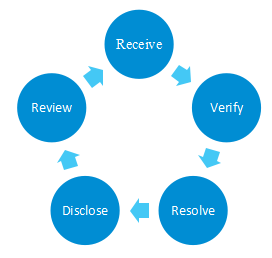
1.Receive: Receive vulnerabilities discovered from the various relevant parties.
ZTE encourages global security practitioners and industry organizations to submit security vulnerabilities of ZTE products. Meanwhile, ZTE PSIRT proactively search for threat intelligence released by the industry and identifies effective vulnerability information.
2.Verify: Verify vulnerabilities, analyze impacts, and assess risks.
ZTE PSIRT analyzes and verifies security vulnerabilities, and grades and scores vulnerabilities in accordance with the CVSS standard. Relevant security experts further review and confirm the verification result. The security vulnerabilities within the scope of the ZTE’s bug-bounty program will be rewarded.
3.Resolve: Provide mitigation measures and solutions, after confirming that a product is affected by the vulnerability.
For confirmed security vulnerabilities, PSIRT collaborates with the product team to formulate, develop, and provide vulnerability remediation solution (including mitigation measures and solutions), effectively addressing security risks, and ensuring the security and stability of customer data and systems.
4.Disclose: Maintain communication, fix vulnerabilities and disclose vulnerabilities.
During the process of vulnerability response, ZTE keeps communication with the customer and related parties, synchronizes the handling progress, assists the customer in remediating vulnerabilities as soon as possible, and completes coordinated disclosure of vulnerabilities.
5.Review: Accumulate experience from perspectives of management, technology, etc. to improve the efficiency and capability of vulnerability management.
ZTE will conduct managerial and technical root cause analysis, summarize lessons learned, continuously optimize vulnerability response processes, and improve product security to deliver secure and trustworthy products and services to customers.
Vulnerability Disclosure Policy
ZTE discloses vulnerability information and remediation solution in the following ways:
Security Bulletin: A security bulletin includes the vulnerability severity level, scope of affected products and versions, business impact, and remediation solution. It is usually used to disclose the information and remediation solution of serious and high-risk security vulnerabilities of ZTE products, so that customers can obtain the vulnerability information and evaluate risks. ZTE reserves the right to release and continuously update vulnerability bulletins.
Security Statement: A security statement includes a description of vulnerabilities that have a wide impact on the industry or society, a brief description of relevant security topics, and ZTE’s latest handling progress. It is used to disclose important security topics (including security vulnerabilities and non-security vulnerability topics), so that relevant parties can stay informed of the progress of ZTE's handling progress.
Release Notes: A release note includes information about remediated vulnerability of ZTE products. It is used to disclose security vulnerabilities that have been remediated during the R&D process, so that the customers can understand the product’s security status.
Additional Information
1.ZTE PSIRT will strictly control the scope of vulnerability information, ensuring it is only shared among those directly involved in the vulnerability remediation process.
2. ZTE PSIRT has the right of interpretation for the above policy.

Security Bulletins
Insisting on the principle of being open and transparent, ZTE ensures that it exposes potential product vulnerabilities, including final solutions, to customers in a timely manner.
As a member of the FIRST and a CVE Numbering Authority (CNA), ZTE is dedicated to publishing vulnerability exposures jointly with customers and stakeholders in a more open manner. Relevant exposures can be found on CVE and ZTE website.
Click Bulletin -Security Bulletins for more information.

ZTE Bug Bounty Program
ZTE is committed to continuously improving security of its products and services to provide users with secure and reliable service experience, so we have set up two bug bounty programs according to product categories.
We welcome security researchers/organizations to report security vulnerabilities in our products and services to us. We promise to follow up and respond to your reported security vulnerabilities as soon as possible.
ZTE has been cooperating with GSMA Coordinated Vulnerability Disclosure (CVD) programme to eliminate and mitigate vulnerabilities which are standards-related, for such vulnerabilities you may consider also submitting to GSMA CVD.
Announcement on Submission Specifications for AI-Assisted Vulnerability Reports
Release Date: October 19, 2026
Dear Security Researchers:
ZTE Corporation has always attached great importance to vulnerability feedback submitted by white-hat security researchers worldwide. For a long time, researchers have upheld a professional spirit in discovering and reporting risks, providing important external support for us to optimize product protection and build robust security defenses. We hereby extend our sincere gratitude to all security researchers who support ZTE's security development.
In recent years, AI and automated scanning technologies have become increasingly widely used in security research, effectively improving the efficiency and coverage of vulnerability discovery. However, we have been receiving a large number of AI-generated reports that have not undergone manual verification. Some of these reports have issues such as inaccurate vulnerability claims, inability to reproduce, templated content, and incoherent wording. Such low-quality invalid reports not only consume review resources but also disrupt the response efficiency and remediation pace for real vulnerabilities.
We encourage security researchers to make reasonable use of AI tools to improve research efficiency, but the authenticity and reproducibility of vulnerability reports and the accuracy of risk assessment ultimately depend on researchers' professional judgment and rigorous empirical verification. To further clarify vulnerability submission standards, improve vulnerability handling efficiency, and ensure the value of every valid submission, the relevant requirements and handling rules are hereby announced as follows:
Vulnerability reports shall include a detailed description of the vulnerability and a complete POC or exploit.
1. Report Description Requirements
1) Vulnerability description, which must include the vulnerability type, root cause, exploitation method, possible security risks caused by the vulnerability, etc.;
2) Names of the affected product(s) or service(s), module name(s), detailed version information, and specific vulnerability location;
3) Detailed steps required for reproduction, described step by step in text, screenshots, graphics, etc.;
4) Strict manual verification: For vulnerability reports generated with AI assistance or automated mining, manual verification and reproduction in a real environment must be completed before submission to ensure the authenticity of the report and the accuracy of the impact assessment. Please provide detailed manual verification results in the report, including but not limited to:
- Description of vulnerability impact
- Detailed reproduction steps
- Complete POC verification code
- Screenshots or videos of the runtime state in which the vulnerability is actually triggered on real affected devices; materials that only contain the local POC tool's running interface and do not reflect the real device operating environment will not be considered valid verification.
2. POC or exploit Requirements
1) Provide a complete and compilable POC or exploit that can successfully verify the submitted vulnerability;
2) Description of the compilation and runtime environment, including necessary information such as compiler name, compiler version, compilation options, and operating system version;
3) The execution results of the POC or exploit shall be consistent with the report description.
Vulnerability reports must include a detailed vulnerability description, proof of vulnerability impact, and a POC for vulnerability reproduction to enable rapid response. Reports that are too simple or contain no proof of impact whatsoever will be directly rejected. Please ensure that the report content does not infringe upon others' intellectual property rights, does not contain legally prohibited content.
Handling of Invalid Reports:** To ensure that review resources are directed toward genuine and valid vulnerabilities, for reports that are directly generated by AI, have not been manually reproduced, or lack valid verification materials (key screenshots or reproduction videos may be submitted), as well as reports with confusing expression, poor logic, and an inability to clearly convey vulnerability information, we will directly reject them and will not provide reasons for rejection.
Handling of Non-compliant Submissions:** If a submitter has cumulatively submitted 3 or more AI-generated vulnerability reports whose validity has not been manually verified, we will issue a reminder; if a submitter has cumulatively submitted 5 or more AI-generated vulnerability reports whose validity has not been manually verified, we will no longer accept vulnerability emails from that submitter and will cancel their eligibility to participate in ZTE Bug Bounty Program.
The healthy development of the security ecosystem is inseparable from every researcher's professional commitment and sense of responsibility. The ZTE Corporation PSIRT Team will continue to optimize the vulnerability response and handling mechanism, take every high-quality vulnerability submission seriously, and work with the industry to jointly safeguard cybersecurity.
Once again, thank you for your understanding and support.
ZTE PSIRT Team


