ZTE Reports First-Quarter Revenue of RMB 35.0 Billion, Up 6% YoY, with Computing Revenue Mix Rising to 27%
- Share:
-


-


-


- Revenue growth was driven by double-digit increases in Computing, Home and Personal Devices, and international markets, offsetting weaker domestic carrier demand
- ZTE continues to advance its "Connectivity + Computing" strategy, strengthening its position in AI infrastructure with competitive TCO and in AI-enabled terminals
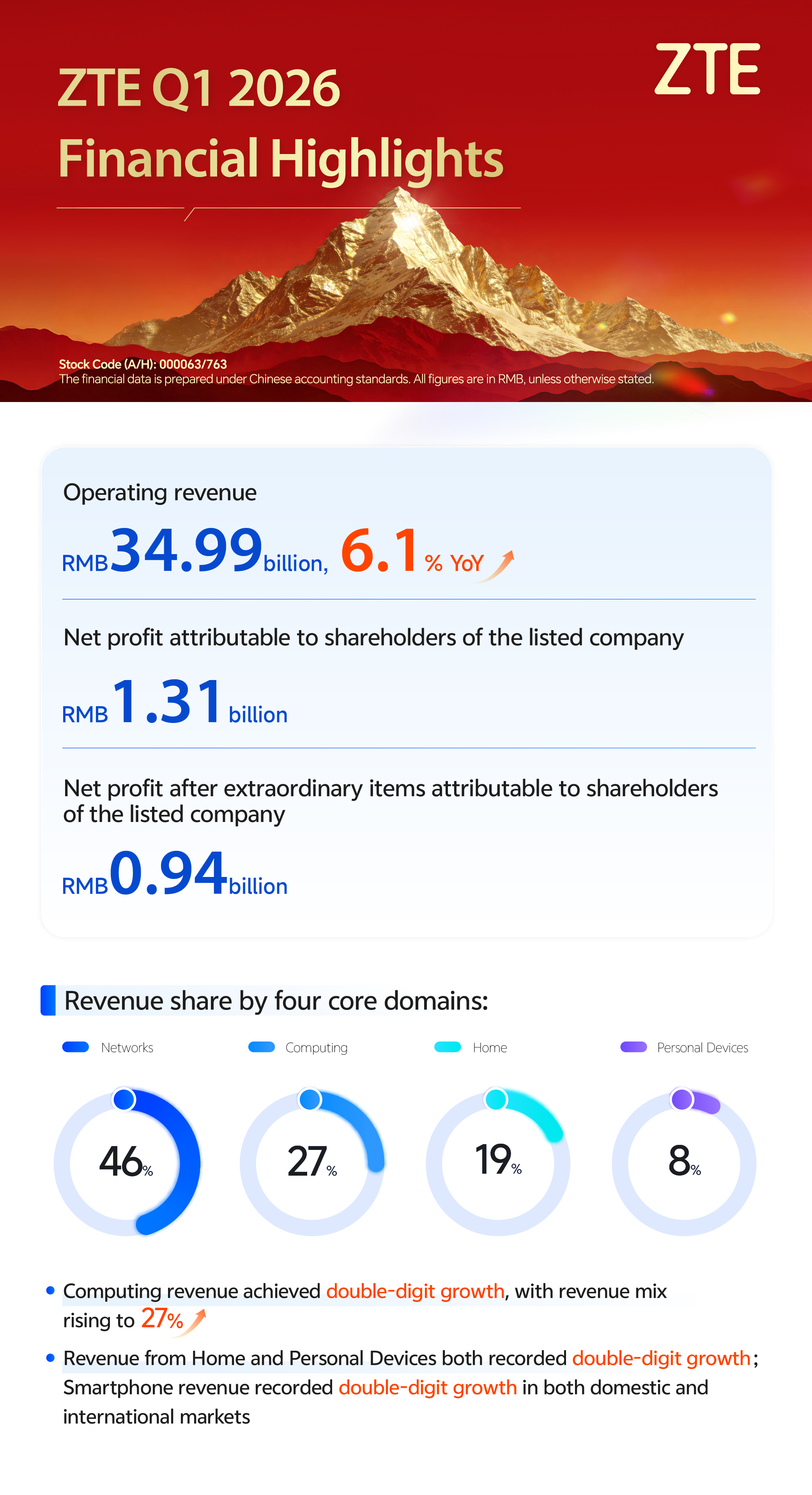
Shenzhen, China, April 24, 2026 - ZTE Corporation (0763.HK / 000063.SZ), a global leading provider of integrated information and communication technology solutions, today announced revenue of RMB 34.99 billion for the first quarter of 2026, an increase of 6.1% year-on-year.
According to ZTE's results announcement today, during the period, the net profit attributable to shareholders of the listed company reached RMB 1.31 billion, and net profit after extraordinary items attributable to shareholders of the listed company amounted to RMB 0.94 billion.
ZTE continues to advance its "Connectivity + Computing" strategy, building an end-to-end AI capability framework and establishing a diversified business structure across Networks, Computing, Home and Personal Devices. Guided by its "All in AI, AI for All" principle, the company prioritizes AI infrastructure with competitive TCO while continuing to drive innovation in AI-enabled terminals, accelerating AI commercialization from infrastructure to end-user applications.
During the reporting period, ZTE recorded steady revenue growth year-on-year, primarily driven by double-digit increases in Computing, Home and Personal Devices, and international markets, which offset the impact of reduced capital expenditure in communication infrastructure by domestic carriers.
Specifically, Computing accounted for 27% of total revenue, with revenue mix continuing to increase, while revenue from Home and Personal Devices both recorded rapid growth. International markets delivered double-digit growth, driven by ongoing 5G rollouts and fiber deployments, as well as rising demand for computing infrastructure, alongside deepened collaboration with Chinese enterprises with global operations.
On the profitability front, net profit attributable to shareholders declined year-on-year in the first quarter of 2026, primarily due to reduced investment in communication infrastructure by domestic carriers, which weighed on domestic network businesses.

In the Networks domain, ZTE is advancing AI-driven upgrades across its product portfolio, accelerating the convergence of AI and communications. In the first quarter, the company introduced its 576×800G ports chassis switch, which supports large-scale AI computing clusters through a two-tier network architecture. It also launched its Scale-Across solution, supporting computing dispatch over distances of up to 300 kilometers, enabling computing resources across multiple locations to be pooled and managed as a unified system.
The company continues to advance next-generation technologies, including 6G, TBit optical networking, 200G PON, and Wi-Fi 8, to sustain its long-term technology competitiveness.
In the Computing domain, ZTE is building comprehensive end-to-end AI solutions supported by a five-layer framework spanning core capabilities, infrastructure, platforms, applications and terminals. The company adopts an open approach to its core capabilities, enabling architecture-level co-optimization to enhance system compatibility and performance. Anchored in a "Chip + Ecosystem" strategy, it serves leading customers across carrier, internet, public sector, and financial sectors.
At the core of its architecture, ZTE's proprietary Orthogonal Electric eXchange (OEX) enables high-density, high-bandwidth, and highly reliable node interconnects, supporting super-node configurations and large-scale AI factory deployments. This architecture underpins full-stack intelligent computing infrastructure with competitive TCO.
On the ecosystem front, ZTE has partnered with over 1,000 companies to achieve full-stack compatibility across more than 200 mainstream large language models. Built on AIOS, its enterprise-level AI agent platform integrates core business systems spanning R&D, production, and supply chain, and is embedded across cloud PCs, smart home devices, and AI smartphones, building a "device-edge-cloud" AI productivity ecosystem.
In the Home and Personal Devices domain, ZTE is strengthening its AIOS technology foundation and advancing scenario-based innovation to develop high-demand products and capture expanding market opportunities.
The company continues to develop its smartphone business with a dual focus on AI smartphones and gaming smartphones. For AI smartphones, ZTE is advancing its device-side AI strategy, co-developing a new generation of AI smartphones with leading internet partners, while enhancing system-level AI capabilities by integrating proprietary intelligent scheduling technologies, including Co-Claw, to improve cross-application coordination and support more advanced automated use cases. For gaming smartphones, the Nubia Neo 5 series has been launched in Southeast Asia, targeting the evolving lifestyle needs of younger consumers.
Beyond smartphones, ZTE is expanding its smart device ecosystem. Its AI emotional companion product, iMoochi, received the iF Design Award 2026 and has entered crowdfunding pre-sale in Japan.
Leveraging deep collaboration with global carriers, gaming companies, internet players and local partners, ZTE's smartphone business is building long-term resilience. During the reporting period, smartphone revenue recorded double-digit growth in both domestic and international markets.
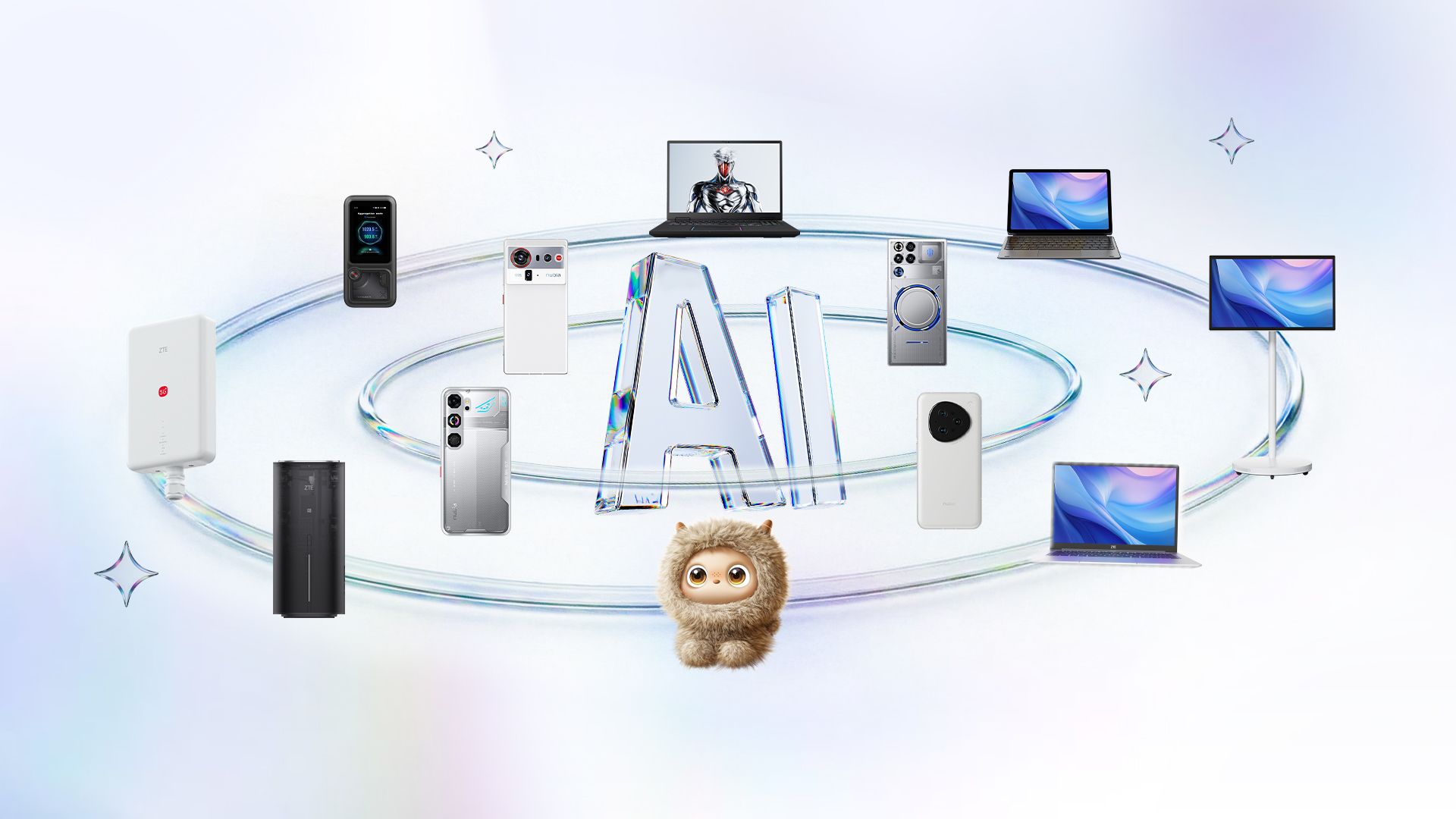

As it embraces the broader AI industry transition, ZTE is accelerating its transformation into an AI-driven company, embedding AI across R&D, sales, operations, and supply chain to enhance efficiency and strengthen overall competitiveness.
Looking ahead, ZTE will remain focused on AI as its core strategic direction, continuing to deepen its AI capabilities, strengthen AI safety and governance, and expand ecosystem collaboration. The company aims to deliver end-to-end AI solutions with competitive TCO, working with industry partners to make AI more accessible and economically viable across a broader range of users and applications.



.png)

.png)

.png)

.png)