Language
Indoor Networks: From Connectivity to Experience
Release Date:2026-09-24
By Wang Jing, Wu Jun, Wei Yuan
A 4K livestream stalling at 10% upload progress during a sold-out concert. A payment QR code failing to load in an underground farmer's market. A critical video call freezing in an elevator. These moments define how users score their network. In the 5G-Advanced era, indoor areas have evolved from "signal coverage zones" to the primary battleground for user experience. Users' expectations have upgraded from "being connected" to demanding ultra-smooth and zero-wait experiences.
Three Transformations Are Reshaping Indoor Network Evolution
Firstly, high-density hotspots are evolving from traffic delivery to experience assurance. VR spectating, HD livestreaming, and AR interactions are proliferating rapidly, challenging the traditional downlink-centric model and creating more balanced uplink-downlink, ultra-low-latency, high-concurrency traffic. The value of hotspot venues is no longer measured by data volume alone, but by the ability to guarantee that every livestream remains buffer-free and every AR interaction responds instantly. Premium indoor network capabilities are becoming a key differentiator for operators seeking to capture value in business districts, stadiums, and other strategic venues.
Secondly, traditional coverage blind spots are creating value beyond traffic alone. In underground garages, connected vehicles consume gigabytes per OTA update and continuously upload surveillance video. In underground markets, vendors use livestreaming to expand their reach while mobile payments make reliable connectivity essential to daily business. Emergency communications in fire escape routes and elevators, as well as smart building IoT sensing all depend on that "last meter" of indoor coverage. Blind-spot remediation has upgraded from simple signal filling to supporting traffic monetization, industry enablement, and public safety.
Finally, the proliferation of mobile AI terminals is catalyzing a new connectivity paradigm. With AI glasses, commercial service robots, and other intelligent become more common, the traditional human-centric connectivity model is being disrupted. A new pattern prioritizing both humans and machines is emerging, increasing connection density and service types. With manual configuration and static management becoming costly and inefficient, intelligence has become a critical requirement for reducing network costs and improving efficiency.
These three transformations lead to a common imperative: indoor networks must achieve breakthroughs in experience, coverage, and intelligence—leveraging ultra-wideband aggregation to deliver premium experience, full-scenario tiered coverage to eliminate blind zones, and AI-powered operations to simplify network management.
Ultra-Wideband Spectrum Aggregation: Enabling Premium Experience
Bandwidth is the most direct factor in ensuring user experience. High-frequency bands offer abundant resources but limited coverage; mid- and low-frequency bands provide good coverage but scarce bandwidth. The challenge lies in efficiently coordinating fragmented spectrum.
Leveraging an ultra-wideband digital architecture, ZTE's QCell (Fig. 1) integrates four frequency bands and 12 transceiver channels into a single remote radio head. Combined with multi-carrier aggregation, it consolidates fragmented spectrum resources into a continuous, high-capacity pipeline to deliver peak single-user throughput of over 5 Gbps, supporting bandwidth-hungry applications such as HD live streaming or AR/VR.
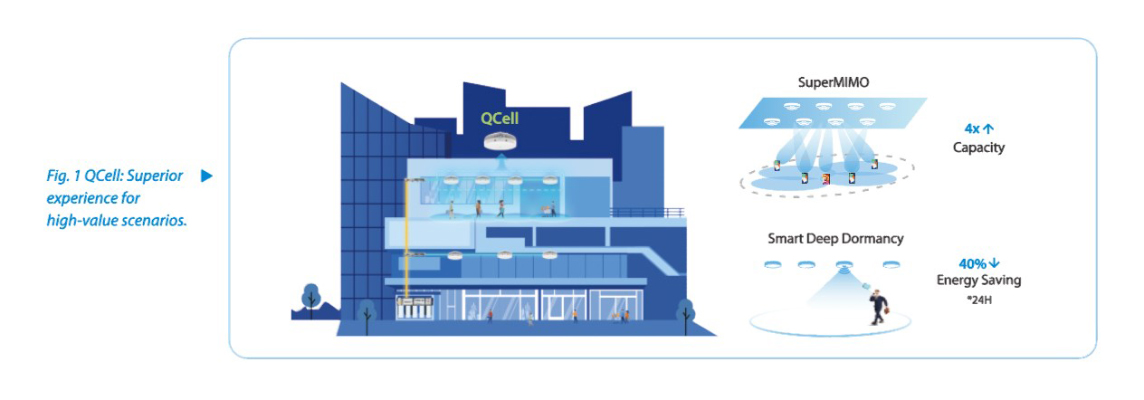
Furthermore, Distributed SuperMIMO technology significantly boosts spectrum efficiency. Through intelligent joint scheduling, distributed radio heads are coordinated to operate as a massive MIMO cell, leveraging beamforming and multi-user MIMO to serve more terminals on the same time-frequency resources. It increases network capacity by three to four times over conventional 4T4R solutions, helping operators meet traffic growth while reducing spectrum and capacity expansion costs.
Notably, this architecture is future-proof. It meets the long-term evolution needs of 5G-A without any hardware modifications. Through simple software configuration or upgrades, operators can split cells, add new carrier configurations, or introduce new services such as sub-meter-level high-precision indoor positioning, thereby safeguarding the long-term sustainability of infrastructure investments.
Full-Scenario Tiered Coverage: Balancing Deployment Cost and Service Value
Indoor scenarios are complex, with varying demands. The traditional one-size-fits-all approach often leads to insufficient capacity in hotspots and wasted resources in low-demand areas. The essence of full-scenario coverage is matching each space with the optimal solution, striking the right balance between network performance and deployment cost.
Based on the 3GPP R18 specifications, ZTE’s network-controlled repeater, qNCR (Fig. 2), provides a lightweight, cost-effective solution to achieve deep coverage. Adopting a wireless backhaul architecture, the device requires no fiber deployment or additional baseband units, and can be rapidly deployed with access to mains power. A single unit can cover an underground garage ranging from 5,000 to 8,000 square meters or elevator shafts in 35-story high-rise buildings. Compared to traditional solutions, it reduces construction costs by 40% and power consumption by 50%, making it a precise fit for wide-coverage, low-traffic blind areas.
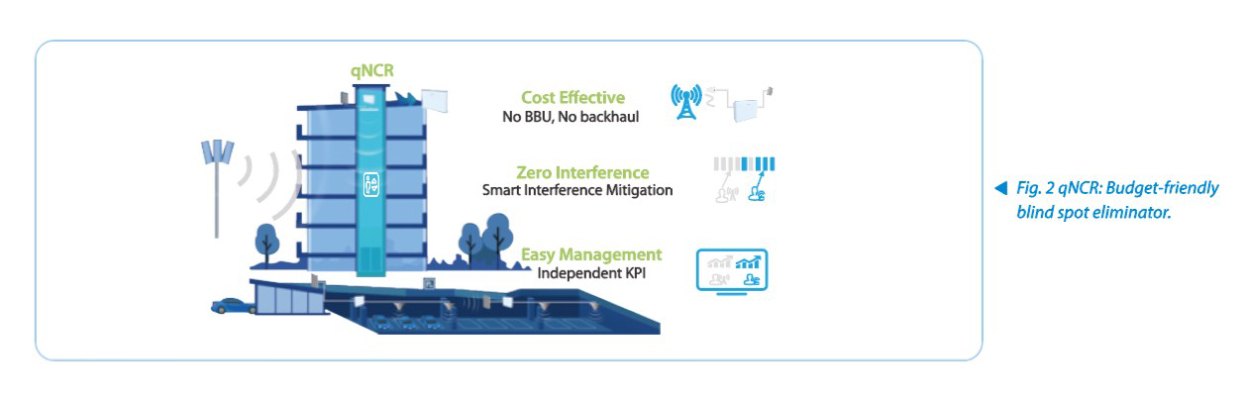
Crucially, qNCR solves the long-standing pain points of traditional repeaters, including poor manageability, interference issues, and lack of KPI monitoring. The device establishes a stable control link with the host base station and uses intelligent interference suppression algorithms to adapt to macro-network scheduling in real-time, avoiding interference at the source. Relying on unique RF identification technology, the network management system can accurately distinguish between macro-cell users and qNCR users, enabling independent monitoring of core KPIs such as coverage, capacity, and interference. Fault troubleshooting efficiency is dramatically improved, bringing coverage blind spots into the standardized O&M system.
Together, QCell and qNCR form a complementary architecture that precisely matches diverse scenario requirements, optimizes deployment and operational costs, and ensures every investment translates into improved user experience and business returns.
AI-Powered Intelligent Operations: Sustaining Long-Term Network Value
The ultra-wideband and full-scenario coverage solution provides a solid foundation, while intelligent operations unlock long-term network value. Leveraging AI technologies, operators can dynamically balance between user experience, energy consumption, and maintenance efficiency.
For energy saving, AI-based intelligent deep sleep predicts user distribution and service load to enable precise on/off control for individual QCell radio heads. Equipment automatically enters deep sleep during idle periods and wakes up within milliseconds when a user accesses the network, reducing overall site energy consumption by 30%–40% and supporting operators’ green and low-carbon goals.
Regarding operations, QCell’s all-digital architecture shifts operations from experience-based practices to data-driven intelligence. Full-link visualization enables one-click fault tracing,
replacing the traditional point-by-point investigation. Meanwhile, qNCR’s intelligent algorithms perceive environmental changes in real time and dynamically optimize parameters, ensuring network stability in complex scenarios and significantly shortening fault resolution times.
In terms of user experience, AI endows the network with proactive adaptation capabilities. The system perceives user density, service type, and traffic requirements in real time, enables intelligent system-level coordination, and optimizes beam scheduling strategies to dynamically allocate resources. In high-capacity scenarios, this ensures transmission quality for both users and intelligent terminals, transforming the network from a passive pipe into an intelligent service platform capable of active adaptation.
Conclusion
Empowered by 5G-A and AI, indoor networks are transitioning from basic connectivity infrastructure to user experience platforms. Ultra-wideband technology unleashes the value of spectrum assets, full-scenario hierarchical coverage balances between cost and performance, and AI-driven intelligent operations continuously improve quality and efficiency. Together, they provide a mature, actionable path for global operators to evolve their indoor networks.
The technical synergy between ZTE’s QCell and qNCR represents not just a product upgrade, but a revolution in network deployment philosophy. Through scenario-specific deployment and intelligent operations, operators can simultaneously meet the demand for premium experience in key scenarios and basic coverage in blind spots. This helps unlock the value of indoor scenarios, build differentiated service advantages, and realize the commercial and social value of 5G-A indoor networks.
Related Articles


