Language
Green PA Evolution: Energy Efficiency Innovations for a Low-Carbon Future
Release Date:2026-09-24
By Fan Yingying, Li Sijun
Radio access networks (RANs) consist of three core subsystems: passive supporting infrastructure (e.g., power distribution and cooling systems), digital baseband units (BBUs), and radio units (RUs, namely RRUs/AAUs). Among them, RUs account for approximately 40% of total mobile network energy consumption and up to 78% of power consumption at individual base stations.
Within each RU, power amplifiers (PAs) serve as the dominant power-consuming devices. As a key part of the digital front-end, they amplify signals prior to over-the-air transmission. Under heavy cell load, their power share increases significantly. For a conventional 4T4R dual-band 5G radio operating at full load, PAs may account for as much as 90% of the total power consumption.
Current mainstream energy-saving solutions mainly reduce PA power consumption through semiconductor process optimization and intelligent power management, including low-power idle modes and radio sleep/shutdown mechanisms during low-traffic periods. However, these incremental improvements are insufficient to satisfy the growing energy-efficiency requirements of next-generation RUs, calling for disruptive architectural innovations.
Integrated Hardware Optimization for High-Efficiency Green PAs
An integrated hardware paradigm moves beyond incremental improvements in traditional PA designs by integrating architectural performance, material reliability, and packaging compactness.
- Super-N Architecture
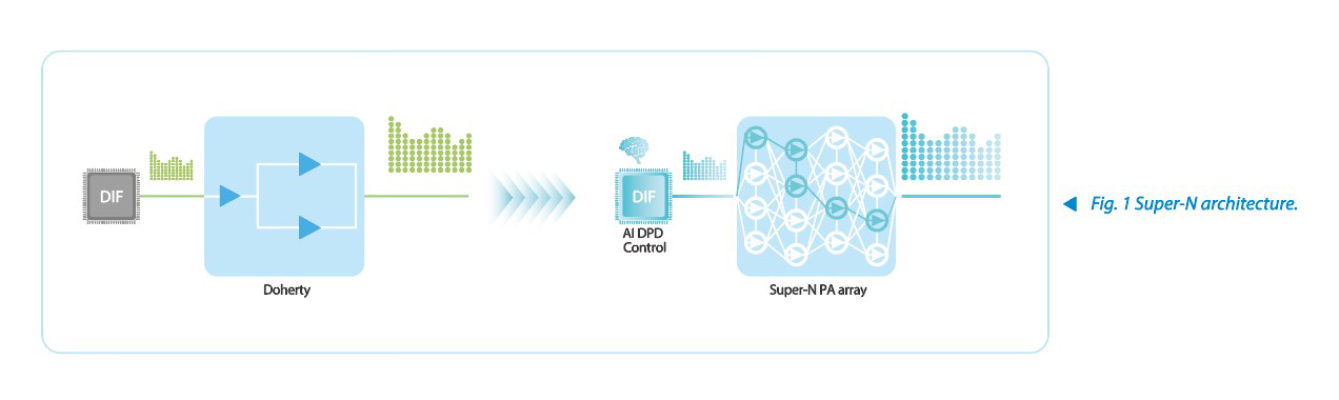
At the core of the scheme is the Super-N architecture (Fig. 1) , which replaces two bulky Doherty PAs with dozens of smaller PAs optimized in real time. Through multi-channel parallel arrays and adaptive load-sensing modules, the architecture dynamically adjusts operating transistor stages, bias current, and output power in response to real-time network traffic fluctuations. This adaptive operation effectively eliminates excessive static power loss under light- and medium-load conditions, a major source of energy waste in traditional PAs. In typical 4T4R dual-band 5G scenarios, Super-N reduces average PA power consumption by 25%–35% across the service cycle.
- Diamond-Based Materials
To sustain the high-efficiency operation of the Super-N architecture and mitigate efficiency degradation at high temperatures, diamond-based materials can be adopted as the primary heat dissipation medium for high-power PAs in 5G and 6G scenarios. Conventional silicon and alumina ceramic substrates feature limited thermal conductivity. Even with high-power GaN transistors, high-density integration readily creates localized hotspots, resulting in degraded device performance and reduced reliability. In contrast, diamond-based materials offer an ultra-high thermal conductivity of 1,500–2,200 W/(m·K), approximately 5 to 10 times that of traditional substrate materials, together with a low thermal expansion coefficient, superior insulation, and high mechanical stability.
- 3D Heterogeneous Integration Packaging
3D heterogeneous integration packaging is a key enabler of miniaturized, low-loss, and highly stable PAs. Conventional 2D planar packaging suffers from lengthy interconnection traces, large parasitic parameters, and low integration density. In contrast, 3D vertical stacking technology enables high-density integration of PA core chips, passive components, and diamond thermal management modules. This structure drastically shortens signal interconnection routes, reduces parasitic resistance, capacitance, and inductance, cuts power losses during signal transmission, and raises device integration density by more than 60%. Meanwhile, the vertical stacking architecture creates a three-dimensional heat conduction path to further boost the overall device heat dissipation performance.
The combination of Super-N architecture, diamond-based thermal materials, and 3D heterogeneous packaging forms an integrated hardware system for green PA optimization. The architecture improves power, reducing heat generation at its source; diamond-based thermal materials enable long-term reliable operation through highly efficient heat dissipation; and advanced 3D packaging enables low-loss transmission, compact integration, and improved thermal management. This solution addresses key limitations of traditional PAs, including low light-load efficiency, severe thermal accumulation, and bulky form factors, providing a solid hardware foundation for the large-scale, low-carbon deployment of next-generation RU systems.
AI-Driven Energy Optimization
New-generation power amplifiers must also improve linearity to achieve higher energy efficiency. Linearity refers to a PA’s ability to amplify signals without distorting their waveforms, ensuring high consistency between the input and output signals.
Digital pre-distortion (DPD) is a technique used to improve PA linearity, enabling higher signal quality and improved power efficiency. Incorporating AI into DPD algorithms can further improve performance and adaptability.
Replacing or enhancing conventional DPD algorithms with machine learning models enables dynamic adaptation to diverse input signals and environmental variations. Deep neural networks (DNNs) can be trained to learn the nonlinear properties of PAs and modify the input signal in real time, while reinforcement learning or online learning enables DPD to self-adjust under real-world operating conditions.
AI-driven DPD requires substantial data for training and enhancement, collected from diverse real-world scenarios covering different frequency bands, output power levels, and environmental conditions. Simulations are conducted in controlled settings, and models are optimized using actual device data to ensure robustness. PA input and output signals are labeled to train models to identify and mitigate nonlinear distortion. Meanwhile, AI-based DPD systems accelerate radio design by optimizing the match between the PA and specific radio products for optimal performance, reducing development time from months to weeks.
Innovations in both PA hardware and software will be essential for reducing total power consumption and improving power efficiency, making a significant contribution to MNOs’ energy reduction goals and accelerating the transition toward net-zero RANs.


