Language
GigaMIMO: Advancing Ultra-Massive Arrays as a Cornerstone of 6G Evolution
Release Date:2026-09-24
By Bai Wei, Hao Yupeng
In the mobile AI era, innovative services such as holographic communication, XR, AIGC real-time generation, and digital twins are rapidly emerging. Their diverse requirements—high bandwidth, low latency, and ultra-reliability—are pushing 5G-A networks to evolve continuously from “connecting everything” to “intelligent connectivity.”
At the pivotal stage of the evolution from 5G to 6G, the industry faces a dual mission: maximizing the potential of 5G-A for emerging services and accelerating the research and development of 6G core technologies to build a solid foundation for the future intelligent world. Whether it is enhancing 5G-A capabilities or preparing 6G for the future, the generational leap of wireless networks always follows one core logic—breakthroughs in capacity are the starting point of evolution. Only by approaching the Shannon limit can we create the fundamental impetus for new services, scenarios, and ecosystems.
Capacity Breakthroughs Underpin the Evolution of Mobile Technology
The evolution of mobile technology has always been a process of continuously pushing performance boundaries. Shannon’s theorem defines the theoretical ceiling of communication system capacity, and each generation’s evolution essentially achieves capacity breakthroughs by pushing the limits of the key variables in this theorem. For example, from 2G to 4G, the focus was on expanding bandwidth, improving spectral efficiency, and effectively mitigating interference.
In the Pre5G era, to further increase system capacity under limited spectrum resources, ZTE, with forward-looking technological insight, pioneered Massive MIMO technology, opening up the spatial dimension—much like adding multiple lanes to a communication highway—and dramatically boosting data transmission capacity, making it a cornerstone of 5G networks.
Continuing this technological trajectory, ZTE has introduced the GigaMIMO solution as the industry evolves from 5G-A to 6G. Based on ultra-massive antenna arrays, GigaMIMO further unleashes the potential of the spatial dimension, helping break through network capacity bottlenecks, and providing higher-speed, more stable, and more reliable network support for cutting-edge applications such as immersive communications, connected vehicles, and embodied AI.
GigaMIMO Redefining Cellular Boundaries Toward 6G Evolution
GigaMIMO represents the next evolution of Massive MIMO. It expands the capabilities of ultra-massive antenna arrays, fully exploits spatial degrees of freedom, and evolves the data transmission architecture from two-dimensional to three-dimensional, marking another leap in transmission capacity and serving as a cornerstone for 6G.
The GigaMIMO solution comprises two core technologies: centralized MIMO and collaborative MIMO, which work together to deliver consistently high performance from the cell center to the edge (Fig. 1) .
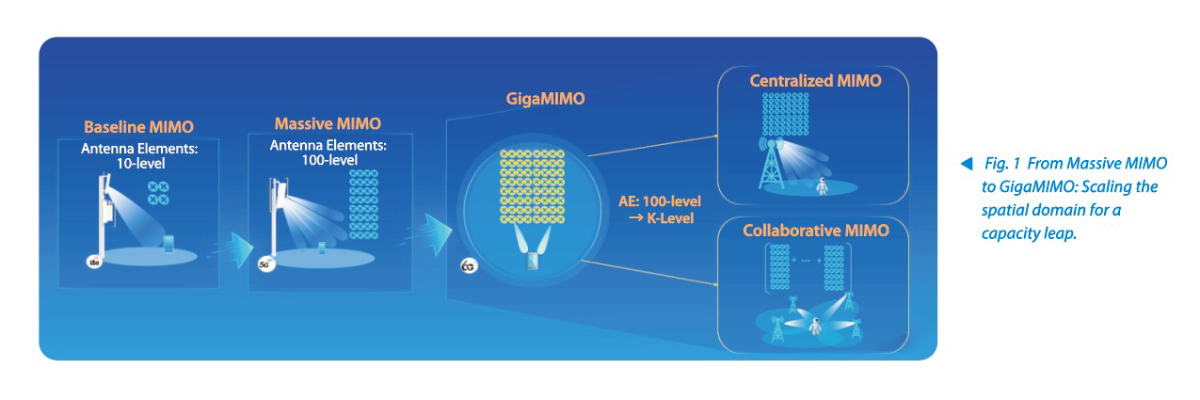
- Centralized MIMO focuses on the cell center, using ultra-massive antenna arrays to achieve a tenfold increase in capacity, providing ample resources for massive connections and data floods in future higher-frequency, wider-bandwidth scenarios.
- Collaborative MIMO focuses on the cell edge, forming a virtual ultra-massive antenna array through intelligent collaboration among multiple sites, bridging the traditional experience gap at the cell edge and delivering seamless, stable, high-bandwidth experiences for users in high-mobility and cell-edge scenarios.
GigaMIMO drives the continuous evolution of massive antenna array technology, both enhancing 5G-A network capabilities and laying a solid technical foundation for the smooth evolution to 6G, achieving a balance between current network value enhancement with future technology readiness.
GigaMIMO Conquering Challenges in Efficiency, Computation, and Collaboration
To fully unlock the potential of the spatial dimension, GigaMIMO must overcome three major challenges.
- Efficiency: As antenna scale grows, insertion loss and power consumption rise exponentially, not linearly—controlling energy consumption while multiplying performance is a prerequisite for large-scale deployment.
- Computation: The drastic increase in the number of channels leads to a rapid increase in MIMO matrix dimensions, causing computational complexity to grow quadratically and making traditional brute-force computing unsustainable.
- Collaboration: Cross-site collaboration requires picosecond-level synchronization accuracy and massive real-time information exchange; achieving such precise coordination among nodes is far from trivial.
To address these challenges, GigaMIMO achieves key technological breakthroughs in architecture, computational structure, and collaborative algorithms.
Architectural Innovation
GigaMIMO adopts a new hybrid analog-digital fully connected architecture. On top of traditional digital beamforming, it adds analog beamforming in the vertical dimension, enabling adaptive wide and narrow beams and adjustable directions, making spatial resource scheduling more flexible and precise. The distributed PA architecture places PAs close to the antenna elements, greatly reducing insertion loss and routing loss, significantly improving antenna gain, and laying a foundation for the efficient deployment of large-scale arrays. Additionally, the AI DPD chip with an embedded neural network deeply integrates RF device characteristics to automatically calibrate signal distortion in real time, greatly enhancing nonlinearity compensation and translating it into PA efficiency gains, achieving a dynamic balance between efficiency and linearity.
These three innovations work together, enabling GigaMIMO to achieve a tenfold increase in capacity while sharing coverage with existing commercial 5G networks and improving energy efficiency by over 30% in the U6G band.
Computing Capability
GigaMIMO faces the same fundamental challenge as large-scale computing systems—the scaling law: when the number of antennas or channels doubles, the matrix dimension also doubles, and computational complexity increases quadratically. GigaMIMO overcomes this challenge with a novel “1 master node + N collaborative nodes” architecture. It decomposes large matrix operations into multiple parallel subtasks, with each collaborative node processing a portion independently, reducing computational complexity from quadratic to approximately linear scaling. This means GigaMIMO can be implemented on existing commercial networks without requiring additional computing resources.
Collaborative Scheduling
Traditional schemes rely on GPS to maintain synchronization accuracy, achieving only nanosecond-level precision, which is insufficient for ultra-massive collaboration. GigaMIMO achieves two breakthroughs. First, it enables AI-predicted synchronization by combining inter-base-station caliberation and UE-assisted calibration with AI prediction. Nodes can anticipate channel variation trends and complete synchronization in advance, boosting synchronization precision from the nanosecond level to the picosecond level—a thousandfold improvement. Second, it enables projection matrix compression: it applies an innovative channel matrix projection compression algorithm to reduce dimensionality, allowing the receiving side to fully recover channel information without affecting joint beamforming performance, while drastically cutting inter-site data exchange—from about 64 Gbps to just 4 Gbps for a single 64TR cell, a reduction of over 93%.
GigaMIMO Delivers Remarkable Trial Results
The technical potential of GigaMIMO has been fully verified in live networks. Collaborative MIMO was field-tested at a university in Wuhan. Through an innovative high-precision cross-site clock synchronization and calibration mechanism, synchronization accuracy between sites was improved from the nanosecond level to the picosecond level, with phase error controlled within ±10°, laying a solid foundation for joint beamforming. Multiple distributed sites form a virtual ultra-massive array, enabling more precise joint beamforming and effectively improving network performance in overlapping coverage areas. Field test results show that this technology boosts user-experienced rates in overlapping areas by 2–6 times and increases the average capacity by 26.5%, fully demonstrating potential for practical deployment. Meanwhile, field verification of centralized MIMO in the U6G band shows that single-user rates can exceed 9.6 Gbps, and single-cell throughput can surpass 192 Gbps.
Through its innovative exploration of 6G technologies and products, GigaMIMO not only enhances existing 5G-A network capabilities and substantially elevates user experience, but also provides a critical technical foundation for the smooth evolution from 5G-A to 6G. From Massive MIMO to GigaMIMO, ZTE continues to push the boundaries by “deeply exploiting the spatial dimension,” laying a cornerstone for next-generation communication networks.
Related Articles


