Language
AI-Powered M-MIMO: Teaching Antennas to Think How Artificial Intelligence Is Reshaping the Performance Boundaries of Massive MIMO Systems
Release Date:2026-09-24
By Li Ting
The Capacity Crunch
The laws of physics are stubborn things. As mobile operators race to accommodate an ever-growing appetite for data—streaming video, video calls, connected cars, and industrial robots—they keep bumping up against a hard ceiling: the radio spectrum is finite, and there is only so much information you can squeeze through any given slice of airwaves.
The industry’s answer, so far, has been Massive Multiple-Input Multiple-Output, or M-MIMO. Think of it as replacing a single loudspeaker with a wall of speakers, each steering its signal precisely toward individual listeners rather than broadcasting blindly across a crowd. A base station equipped with dozens, even hundreds, of antenna elements can serve multiple users simultaneously in the same frequency band, multiplying capacity without requiring new spectrum.
The catch? These antenna arrays are only as good as the software that controls them. Traditional M-MIMO systems rely on fixed rules and manual tuning—beam management by spreadsheet, in effect. In the real world, where traffic patterns shift by the minute, users move constantly, and buildings, vehicles, and even trees alter signal paths, rigid strategies waste enormous amounts of potential capacity.
Enter artificial intelligence. By training algorithms on the patterns that emerge from millions of radio transmissions, equipment makers are now building M-MIMO systems that learn, adapt, and optimize in real time. The results, measured in live networks from Karachi to Jakarta, suggest the performance gains are not marginal—they are transformative.
Smart Sector Splitting for FDD M-MIMO
In frequency division duplex (FDD) networks—the workhorse of modern mobile telephony—a particularly stubborn problem has long limited M-MIMO’s effectiveness. Because the frequencies used for uplink and downlink are different, the base station cannot simply infer what the downlink channel looks like from what it receives on the uplink. Without accurate channel state information (CSI), beamforming becomes a guessing game.
ZTE’s answer is something it calls smart spatial cell group (SSCG) technology (Fig. 1). The principle is disarmingly simple: instead of treating each sector as a single, monolithic cell, the system uses artificial intelligence to divide it dynamically into smaller sub-cells, each with its own precisely tailored beam. The number of sub-cells adapts continuously to the traffic load.
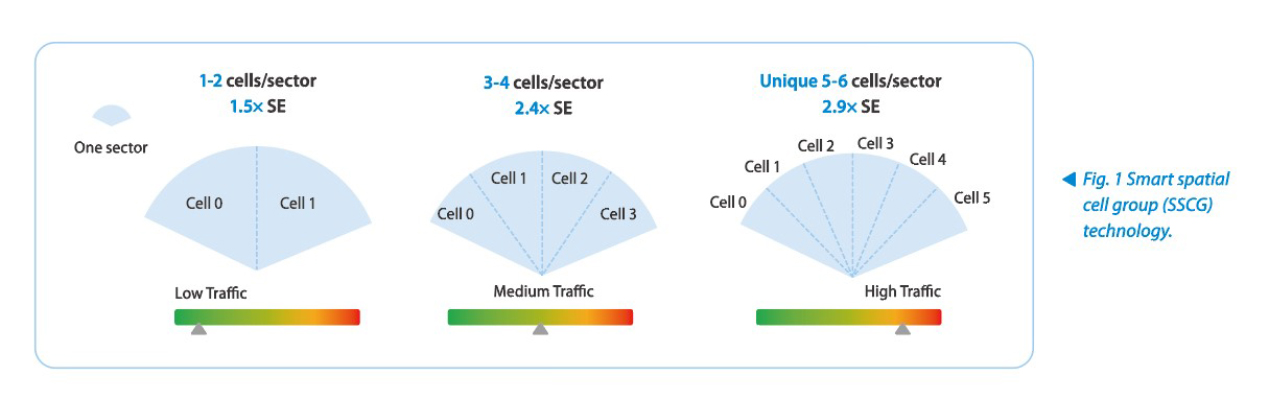
The effect is striking. Under light traffic, a sector might split into just two cells, yielding a 1.5x improvement in spectral efficiency compared with a 4T4R cell. As demand builds, the system scales to three or four cells, pushing the gain to 2.4x. In dense urban hotspots, where hundreds of users cluster within a few hundred meters, the system can sustain five or six cells per sector—an industry-leading configuration that drives spectral efficiency up by a factor of 2.9.
The intelligence lies in the algorithm’s ability to learn. By analyzing historical traffic data, user distribution, and service patterns, the system identifies the optimal cell-splitting strategy within minutes and adjusts beam weights from among tens of thousands of possible combinations. What once required teams of radio engineers with clipboards and spectrum analyzers now happens autonomously across every cell in the network.
Intelligent User Pairing of TDD M-MIMO
Time division duplex (TDD) systems, widely used in Asia and increasingly elsewhere, have a natural advantage: because uplink and downlink share the same frequency, channel reciprocity makes it far easier to acquire accurate CSI. But having good data is only half the battle. The real challenge is deciding which users to serve simultaneously—and that is where AI makes its second major contribution.
In conventional multi-user MIMO (MU-MIMO), users are grouped for simultaneous service based on crude orthogonal criteria: users with sufficiently different channel characteristics are paired together. It works, after a fashion. But in complex environments where signals bounce off buildings, interfere with one another, and fluctuate constantly, or in a heavy-traffic cell with very large numbers of users, these simple rules leave substantial capacity on the table.
ZTE’s AI-enhanced MU-MIMO (Fig. 2) takes a more sophisticated approach. Machine-learning models evaluate multiple factors simultaneously—channel correlation, interference levels, service priority, even the type of application each user is running—to identify pairings that maximize total throughput. The result is an additional 20% or more in cell capacity, extracted from the same spectrum and hardware.
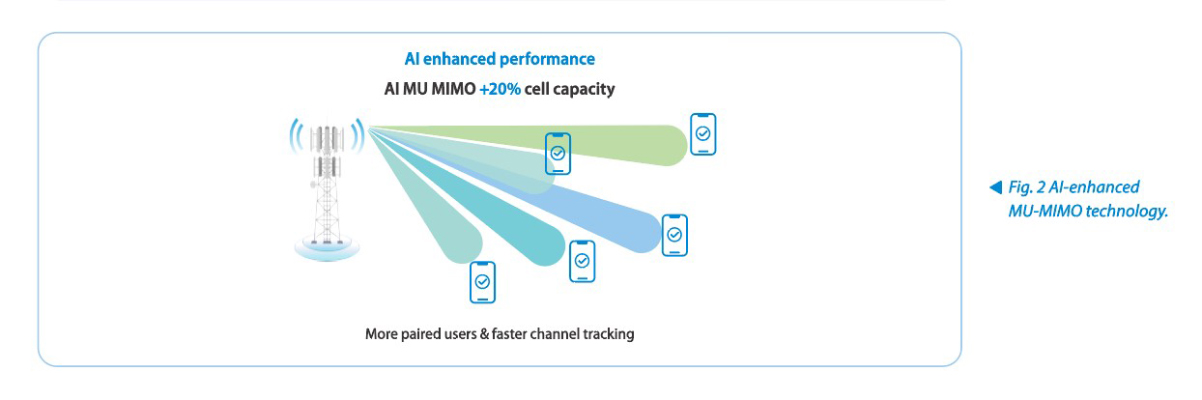 Beyond smarter pairing, AI also addresses the problem of channel aging—the degradation of channel estimates that occurs when users are moving quickly, as they do on high-speed trains or in busy urban corridors. Advanced AI channel prediction algorithms analyze historical channel samples to anticipate how conditions will evolve, allowing the base station to pre-adjust beam directions before the signal quality drops. The result is more stable connections and fewer dropped sessions in motion.
From Lab to Live Network
Promising technology is one thing. Technology that works in the messy reality of commercial networks is another. The evidence so far suggests that AI-powered M-MIMO passes this test with flying colors.
Consider Pakistan. In February 2026, ZTE and local operator Zong activated the world’s first commercial deployment of AI-enhanced FDD Massive MIMO. The results after just weeks of operation: downlink throughput during busy hours rose by 39.4%, with a daily average improvement of 34.3%. Traffic loads increased 17.1% at peak times and 21.5% across the full day—evidence that better network performance encourages users to consume more. The system automatically switches between up to six splitting cells and the traditional four cells based on real-time demand, with no human intervention required.
The Chinese market offers a different kind of validation. In trials with a major domestic operator, ZTE’s AI MU-MIMO solution demonstrated a 10% capacity uplift over traditional MU-MIMO on a live network—a meaningful improvement in a market where every megahertz of spectrum is already being squeezed for maximum output.
The Road Ahead
The marriage of AI and M-MIMO is still in its early days, but the trajectory is clear. What began as an optimization layer—with algorithms fine-tuning beam weights and user pairings—is evolving into something more fundamental. The next generation of systems, already in development for 6G, will feature larger antenna arrays, more sophisticated cooperative scheduling across multiple sites, and deeper integration of communications with sensing and positioning.
For operators, the economics are compelling. AI M-MIMO extracts substantially more capacity from existing spectrum and hardware, deferring the need for expensive new infrastructure. For consumers, it means faster, more reliable connections in the places where they matter most—crowded city centers, moving vehicles, and more.
The antenna, it turns out, was only half the invention. The other half is the brain that controls it.
Related Articles


