Language
How 5G Ultra-Long-Range Coverage Is Reshaping Maritime Connectivity
Release Date:2026-09-24
By Hao Yupeng, Wang Jing
Global marine economic activity is entering an unprecedented period of growth. The precision operations of deep-sea fishing, the large-scale O&M of offshore wind farms, the digital upgrade of marine tourism, and the intelligent transformation of maritime law enforcement—all these trends share a common underlying enabler: a reliable maritime communication network. Yet it is precisely in the vast and harsh maritime environment that traditional terrestrial communications fall short. For vessels far offshore or platforms operating in remote marine areas, a communication breakdown is not merely an efficiency loss—it can mean a safety risk. Achieving wide-area, high-reliability maritime connectivity at a reasonable cost has become a key challenge for coastal nations and regions worldwide.
Layered Collaboration: A 3D Network Architecture for Maritime Coverage
The difficulty of maritime communications lies in the gradient effect of distance—the closer to shore, the higher the traffic density and the more stringent the throughput requirements; the farther offshore, the greater the coverage challenge, yet business demands do not necessarily diminish accordingly. A "three-network-in-one" architecture enables three-dimensional coverage on demand through layered collaboration (Fig. 1) :
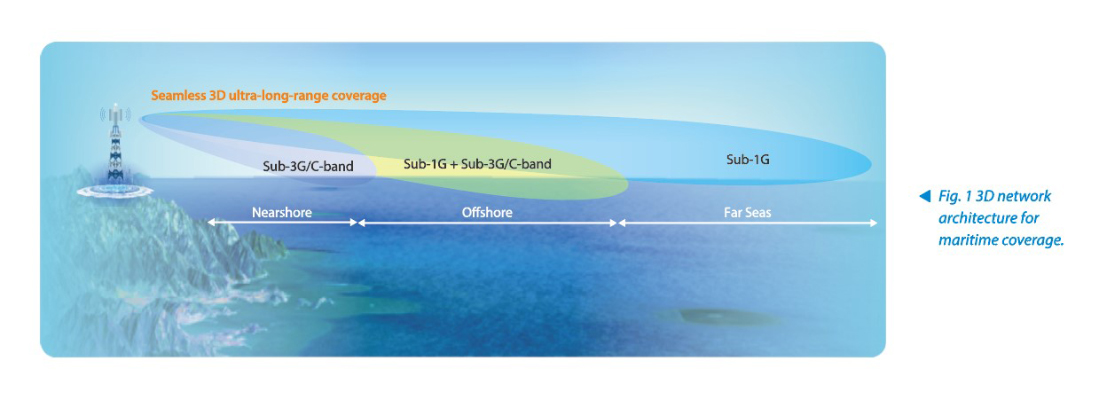 Nearshore Network (0-10 km) leverages existing coastal base stations as anchors to provide high-capacity access. This zone supports high-density scenarios such as aquaculture rafts, port logistics, and coastal tourism, with demanding requirements for downlink throughput and network capacity. The solution deploys industry-specific private networks using sub-3 GHz and C-band frequencies, delivering 100 Mbps downlink and 5 Mbps uplink access capabilities to meet the real-time connectivity requirements of smart ports and aquaculture monitoring.
Offshore Network (10-50 km) is the primary coverage zone for maritime operations. Ultra-long-range base stations are deployed at key locations such as coastal towers, hilltops, and platforms, combining low- and mid-band networking with high-gain directional antennas to provide stable signal coverage up to 50 km offshore. This layer supports core services including fishing vessel communications, video backhaul for maritime law enforcement, and marine ranch monitoring—making it the critical infrastructure for the digital transformation of the marine economy.
Far-Sea Network (50-120 km) targets far-offshore operational scenarios. Sub-1 GHz low-band frequencies provide wide-area coverage, with shipborne CPE terminals serving as mobile relays and supporting seamless handover between 5G and satellite links. This ensures communication continuity at the network edge while dramatically reducing the costs of satellite-only communications.
The three-layer architecture is not solely distance-driven; each layer addresses specific coverage ranges and service requirements, forming an integrated and collaborative solution from nearshore to far offshore.
Technical Depth: From Signal Enhancement to Network Self-Intelligence
In the ultra-long-range coverage domain, challenges center on two key directions: how to make signals travel farther and how to keep the network stable and efficient in complex maritime environments. Achieving ultra-long-range coverage depends on systematic breakthroughs across multiple key technologies.
At the RF layer, the combined application of three technologies significantly improves signal propagation efficiency. Dual-PA power superposition technology delivers approximately 2.5 dB of combining gain in transmit power; tower-top RRU deployment reduces feeder loss by 2–3 dB; and 65° narrow-beamwidth high-gain antennas precisely focus signal energy toward target sea areas.
A further breakthrough comes from intelligent O&M. Maritime networks face far more complex interference sources than terrestrial networks—atmospheric ducts, sea-surface reflections, and meteorological changes all cause signal quality fluctuations. Traditional manual optimization methods cannot respond in real time. By deploying intelligent computing boards at base stations, the network leverages AI computing capabilities to identify service types (such as video backhaul, voice calls, and IoT reporting) in milliseconds, dynamically allocate network resources, and proactively avoid interference sources. Field test data shows that in the 15–20 km maritime zone, uplink throughput improves by over 30%, latency drops by 7%, and service stuttering is reduced by 50%. This "self-optimizing" capability is particularly vital for maritime scenarios where O&M teams cannot be permanently stationed.
Terminal-side innovation is equally critical. The marine environment imposes stringent reliability requirements on equipment—salt spray corrosion, extreme temperature differentials, and continuous vibration are the norm. Terminals designed for shipborne scenarios must operate stably across a wide temperature range of –35°C to 75°C, with transmit power reaching four times the industry conventional level to overcome long-distance transmission loss, while supporting dual-mode switching between 5G and satellite networks to ensure uninterrupted communications in far off-shore regions.
Commercial Validation: From Benchmark Projects to Global Deployment
The value of technology is ultimately tested in the market. In recent years, ZTE's ultra-long-range coverage solution has been deployed across multiple coastal regions globally, gradually forming differentiated commercial pathways.
The Rizhao project in Shandong is a typical case of large-scale deployment. In 2026, 24 ultra-long-range base stations were deployed along the Yellow Sea coast, covering 50 km of coastline. The project integrates the 700 MHz low-band coverage with the 2.6 GHz capacity layer through coordinated networking, achieving downlink throughput exceeding 100 Mbps in nearshore waters and maintaining uplink throughput above 10 Mbps in mid-to-far offshore areas. The service supports more than 1,200 fishing vessels and over 50 offshore platforms, enabling diverse applications ranging from fisher livestreaming to fisheries law enforcement.
The Qingdao "Hanhaitong" project explores a commercialization pathway for far-offshore operations. Targeting fishing operations 80–120 km offshore, operators launched a "CPE terminal + satellite backup" service model. Equipped with Hanhaitong terminals, vessels use low-cost 5G connectivity in nearshore waters and automatically switch to satellite links within milliseconds when entering open seas, ensuring seamless communication continuity. Compared with traditional maritime satellite services, this model significantly reduces per-vessel communication costs. The terminal supports extreme temperatures from –35°C to 75°C and has been validated under harsh winter conditions in the Yellow Sea.
In overseas markets, a 5G ultra-long-range maritime coverage test was completed in Indonesia's Sulawesi Sea using the 2.3 GHz band, achieving a coverage distance of 60 km and providing a digital foundation for local fisheries and marine tourism. In South Africa's Mossel Bay, Africa's first 5G ultra-long-range maritime network was deployed, delivering throughput exceeding 210 Mbps at 22 km offshore.
Outlook: From Ultra-Long-Range Coverage to the Smart Deep Blue
The coverage bottleneck of maritime communications is, in essence, an adaptability challenge for terrestrial mobile networks in an entirely new spatial dimension. ZTE has proposed a network architecture centered on layered collaboration, validating a solution path that balances technical feasibility and economic viability through systematic RF hardware enhancement, dynamic optimization through intelligent algorithms, and scenario-specific terminal adaptation. For the marine industry, this means that communication connectivity is evolving from a "nearshore privilege" to "universal access across all waters"—livestreaming without stuttering, law enforcement without blind spots, rescue operations without disconnection, and data without silos. As technological boundaries continue to expand, the wave of digital transformation is advancing from land to the deep blue.
Related Articles


